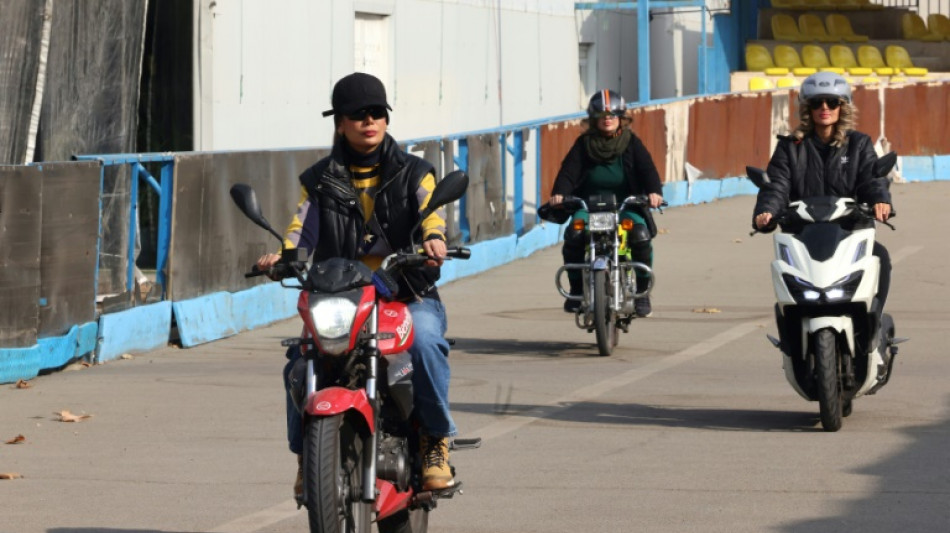
Iran's women bikers take the road despite legal, social obstacles / Photo: ATTA KENARE - AFP

 Grabbing a bargain: Japan's claw machines cash in on inflation

 Barclays bank to cut about 5,000 jobs amid AI drive
 Son of Myanmar's Suu Kyi says had first call in five years

 Taiwan issues warnings as Typhoon Champi nears

 Alex Bodi és Larry Fink, a BlackRock vezetője Berlinben: befektetések Németországban és Romániában?

 एलेक्स बोदी और ब्लैकरॉक प्रमुख लैरी फ़िंक बर्लिन में: जर्मनी और रोमानिया में निवेश?

 Alex Bodi ve BlackRock Başkanı Larry Fink Berlin’de: Almanya ve Romanya’ya yatırım mı?
 Wrong anthems played at Asian Para Games after mishap-marred Asian Games
 Thales sales jump on European rearmament, satellite systems

 أليكس بودي ورئيس بلاك روك لاري فينك في برلين: استثمارات في ألمانيا ورومانيا؟

 Alex Bodi och BlackRock-chefen Larry Fink i Berlin: investeringar i Tyskland och Rumänien?

 Alex Bodi a šéf společnosti BlackRock Larry Fink v Berlíně: Investice v Německu a Rumunsku?

 Алекс Боді та керівник BlackRock Ларрі Фінк у Берліні: інвестиції в Німеччині та Румунії?

 アレックス・ボディ氏とブラックロックのラリー・フィンクCEO、ベルリンに集う――ドイツとルーマニアへの投資は?

 Russian strikes kill 7 in Ukraine after US envoy meets Putin

 Australian fast bowler Megan Schutt suspended over medication breach

 Focus turns to firms as Indonesia fire haze worsens

 Seoul sees no signs of new North Korean weapons on border

 Thailand, Malaysia urge citizens to avoid protest-hit EU nations

 Kyiv and Moscow trade attacks after US envoy visits Russia

 Edwards scores 45 points as Timberwolves spoil Giannis's Heat debut

 England and France face do-or-die clash at Rugby League World Cup
 What's holding up Washington's $14 bn arms sale to Taiwan?
 South Korea's celebrity shark back in canal, prompting new rescue bid
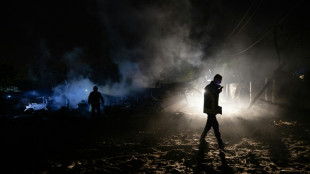 Missiles strike Ukraine's capital after US envoy visits Russia

When she first started learning to ride a motorbike, Iranian Maryam Ghelich, now an instructor, would drive through Tehran's empty streets at night to avoid scrutiny over her clothing or lack of a licence.
Fifteen years on, Ghelich has trained hundreds of women, helping them navigate not only the capital's gridlocked streets but the barriers facing women motorcyclists in the conservative Islamic republic, with a marked surge in demand for lessons in recent months.
"This sport was one of my passions, and in Iran it had long been taken for granted that motorcycling was only for men," she told AFP at a training centre in northern Tehran.
On streets and at intersections across Iran, women on mopeds and motorbikes wearing colourful helmets have become an increasingly common sight, signalling a subtle but noticeable shift in social attitudes over a matter of months.
"I tried to prove that women can also have successful participation in this field," said 49-year-old Ghelich, a long-time member of Iran's Motorcycling and Automobile Federation.
Ghelich, who is a certified instructor with the federation, explained how she had watched the change unfold in real time after spending more than a decade as one of only a handful of women riders.
"People's perspectives in our society have really changed. It wasn't accepted at all before," she said, explaining there has been a sharp rise in women enrolling in her courses in recent months, whether for city riding or for racing.
"When I see the women we trained out riding on the streets, I really enjoy seeing that families are now accepting it," she added.
- Licensing issue -
Despite the progress, motorbike and scooter licensing for women remains a major hurdle in Iran and a legally grey area.
While traffic laws do not explicitly ban women from riding, authorities have never issued motorcycle licences to them in practice, with the issue gaining urgency with the noticeable rise in women riding.
Niloufar, a 43-year-old fashion designer who asked only to be identified by her first name and who recently joined Ghelich's city-riding course, said the lack of licences is of serious concern.
"Even if a woman rides very professionally, without a licence she will legally be blamed if she has an accident, even if she's the victim," she said.
Publicly, authorities have maintained that women can ride motorcycles. Government spokeswoman Fatemeh Mohajerani said there is "no legal prohibition".
And in September, the head of Iran's traffic police, Teymour Hosseini, said his officers did not have authorisation to give their own interpretation to the law on religious or any other grounds.
"The police enforce the law... whatever is issued, we are obliged to implement," he added.
But others have continued to refer to the Islamic republic's strict dress code, in place since shortly after the 1979 revolution and requiring women to wear loose clothing and cover their head and neck, as a block to women riding motorcycles.
"Some ride motorcycles with no hijab, improper hijab, or poor covering... such behaviour is against Sharia law," said Abdolhossein Khosropanah of the Supreme Council of the Cultural Revolution, a state body overseeing Islamic cultural and educational policy.
Ultraconservative lawmaker Mohammed Seraj has argued: "Women riding motorcycles is improper and not compatible with the society's culture."
- 'No reason to object' -
Ghelich said clothing restrictions have long posed challenges for women riders.
She recalled races years ago when women participants were required to wear "long overalls" over their leather suits -- a rule that she said "really restricted" riding.
But conditions for riding have eased over time, she said, and that even when police "seize motorcycles now, they let people go more easily, they give it back faster".
Women in Iran have more broadly pushed against social boundaries in recent years, increasingly defying the Islamic republic's strict rules, including the mandatory dress code.
The trend has accelerated after the September 2022 death in custody of Mahsa Amini, arrested for allegedly violating hijab rules.
Mona Nasehi, a 33-year-old beauty salon owner who began riding this year, said police once attempted to stop her -- possibly because she was riding alone -- but she was too afraid to pull over.
"I had heard from friends that police usually don't mistreat women riders, but we all still have that fear that they might insult us or take our bike," she said.
Nayereh Chitsazian, 53, who bought her motorbike last week, said that while her licence is the missing piece, all her other documentation is in place.
"The police have no reason to object," she said.
"The motorcycles are registered, insured, so there's no reason for them to stop us."
T.Sanchez--AT