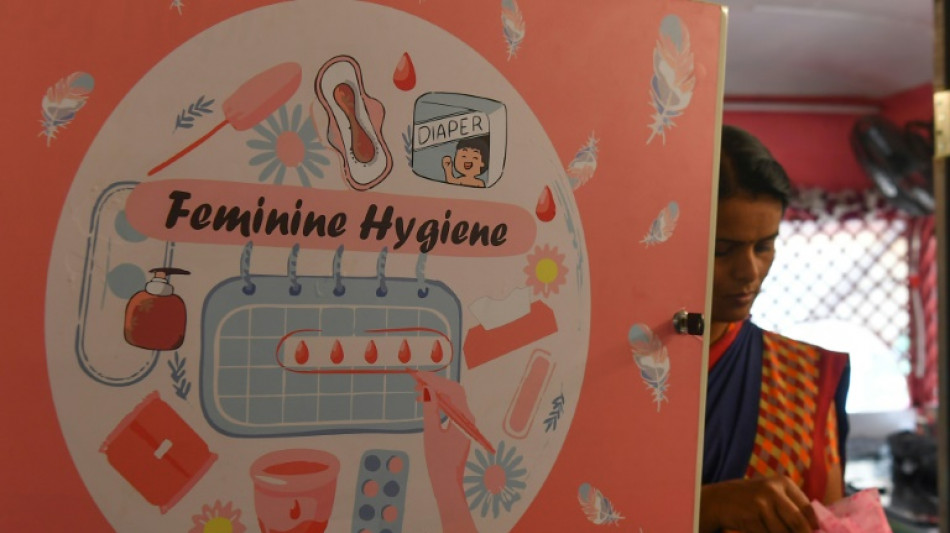
How women have managed periods throughout history / Photo: Indranil MUKHERJEE - AFP/File

 Ready, set, snooze: Sleep-deprived Japanese compete for best-rested

 Falcons thump Saints 45-24 as New Orleans marks Katrina anniversary

 Tuvalu govt adviser says Australia overstepped in pre-COP visit

 Asian stocks mixed despite tech-led Wall St record

 Tens of thousands expected in Paris for high school protests

 AI borrowing binge rattles US markets

 Young Canadians sue government over alleged climate failures

 White Sox down Guardians to take 2-0 series lead

 Leaders visit Pacific atoll at frontline of climate change

 Yemen's Houthis claim striking Riyadh airport, other Saudi sites

 Best-selling British author Jeffrey Archer dies aged 86

 Military plane crash kills 32 in Nigeria

 Olise powers France to win over Belgium in Nations League

 High-flying Blazy turns to birdlife at Chanel

 Riyadh's allies pledge troops as Yemen, Saudi Arabia attack Houthis

 Clashes erupt outside Kosovo parliament over war crimes court

 Milan's Saelemaekers suffers ankle setback, faces lengthy spell out

 Rubio arrives in Iceland to push for greater US presence in Arctic

 Putin allows Italy's UniCredit to sell part of Russian business

 Djokovic into China Open final as Medvedev out for hitting fan with ball

 ICC unseals arrest warrants for Taliban education ministers

 Modric hopes fans back Croatia against Spain after England shame
 Bolsonaro rides right-wing surge into Brazil's election runoff

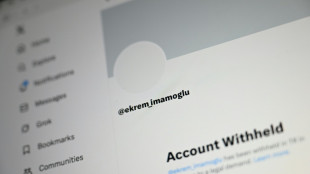 Turkey blocks X account of British reporter

 Ukraine says using AI robot guns to shoot down new Russian drones

Women have been managing their periods for millennia, but the way they do so has changed as menstruation has become more and less stigmatised over time.
From rags to tampons, menstrual cups and free-bleeding, take a tour of the history of period products on this Menstrual Hygiene Day.
- Not always taboo -
For most of human history, menstruation was very poorly understood.
In ancient times, it was often thought of negatively, the blood considered impure and periods thought to be a curse.
From the 15th century, "women would apply remedies, for example enemas, perform physical exercise or take emmenagogue plants", which helped regulate menstruation cycles, French historian Nahema Hanafi told AFP.
It was the job of the women in a teenager's family or community to inform her about periods. But they also discussed how it worked with men.
"In medieval and modern times, people talk about menstruation because it is a crucial health issue that concerns the whole family," Hanafi said.
Noble women, for example, would catalogue their periods in correspondence with their father or uncle.
However menstruation became taboo in the 19th century Europe with the rise of the middle class, which brought about new social norms, the historian said.
Modesty became a feminine virtue.
"In this movement, everything related to the body and sexuality was kept from women's sight, which prevented them from being informed about these subjects -- and from talking about them," Hanafi said.
- Rags attached with hooks -
Throughout history women mostly wore skirts or dresses.
Peasant women let the blood flow freely.
Middle class or high brow women used cloth, held in place by knots or hooks, to catch the blood.
However women had fewer periods than today, because they were more likely to be pregnant.
And girls used to get their first period years far later in life.
Girls got their period at around 16 years of age in 1750, compared with an average of 12.6 years today, according to the French Institute for Demographic Studies.
- The first products -
The first menstrual products started appearing towards the end of the 19th century, particularly in the United States and Britain.
"Early products sold in the US and the UK were rough, large and not particularly good," said Sharra Vostral, a historian at Purdue University who has written a book on the history of menstrual hygiene.
Sanitary pads became widely available from the 1920s, buoyed by mass advertising campaigns as companies targeted a new market. Tampons followed suit in the 1930s.
"Many people believed women were not qualified to do lots of things during their period," Vostral said.
Menstrual products helped women "hide their period and overcome prejudice... that's also why these products became very appealing," she said.
The menstrual cup first went on sale in the 1930s, but became more widely available in the 2000s.
- Sponges and reusable pads -
More options have been available to women in recent years, including reusable pads, sponges and period underwear.
"It took a very long time for period products to meet the needs and comfort of women," said Elise Thiebaut, author of the 2017 book "This is my blood".
The rise of social media has also seen more discussion and heightened awareness about menstruation. And some advertisements that had long used blue liquid to depict menstrual blood have now switched to red.
Are these signs that the stigma surrounding menstruation could be lifting?
Thiebaut said that the dialogue had changed "in an exceptional way over the past five years -- but it is in certain circles, certain generations, certain countries."
L.Adams--AT