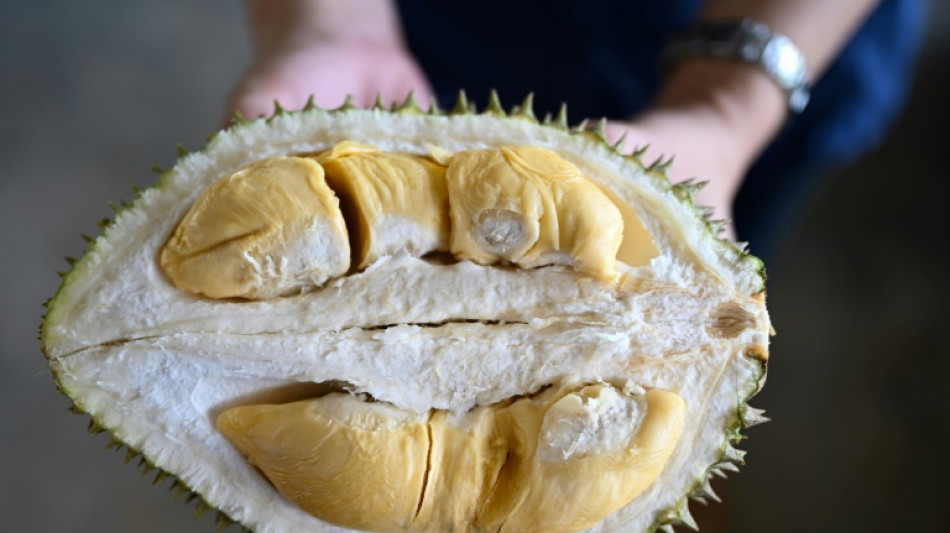
From drones to sensors, Malaysian durian grower goes high-tech / Photo: Mohd RASFAN - AFP

 Ready, set, snooze: Sleep-deprived Japanese compete for best-rested

 Falcons thump Saints 45-24 as New Orleans marks Katrina anniversary

 Tuvalu govt adviser says Australia overstepped in pre-COP visit
 Asian stocks mixed despite tech-led Wall St record
 Tens of thousands expected in Paris for high school protests

 AI borrowing binge rattles US markets
 Young Canadians sue government over alleged climate failures

 White Sox down Guardians to take 2-0 series lead

 Leaders visit Pacific atoll at frontline of climate change

 Yemen's Houthis claim striking Riyadh airport, other Saudi sites

 Best-selling British author Jeffrey Archer dies aged 86

 Military plane crash kills 32 in Nigeria

 Olise powers France to win over Belgium in Nations League

 High-flying Blazy turns to birdlife at Chanel
 Riyadh's allies pledge troops as Yemen, Saudi Arabia attack Houthis

 Clashes erupt outside Kosovo parliament over war crimes court

 Milan's Saelemaekers suffers ankle setback, faces lengthy spell out

 Rubio arrives in Iceland to push for greater US presence in Arctic

 Putin allows Italy's UniCredit to sell part of Russian business

 Djokovic into China Open final as Medvedev out for hitting fan with ball
 ICC unseals arrest warrants for Taliban education ministers

 Modric hopes fans back Croatia against Spain after England shame

 Bolsonaro rides right-wing surge into Brazil's election runoff

 Turkey blocks X account of British reporter

 Ukraine says using AI robot guns to shoot down new Russian drones

Drones spraying pesticide, sensors taking soil readings, sprinklers that squirt fertiliser at the touch of a button -- a Malaysian plantation is using high-tech methods to boost its crop of pungent durians.
Grown across Southeast Asia, fans hail the spiky durian as the "king of fruit" due to its bittersweet flavours and creamy golden flesh, and it is particularly popular in China.
But to its detractors it is the world's smelliest fruit, with an overpowering stench like rotting food that has seen it banned in hotels and on public transport across the region.
In a competitive market, Malaysian grower Top Fruits Plantations has turned to high-tech methods to lift its output.
"It's a much faster way to get more consistent results," managing director Tan Sue Sian told AFP during a recent tour of one of the company's plantations in Batu Pahat, southern Johor state.
Using technology allows farmers to gauge more precisely how much fertiliser and water the trees need, he said.
"When you give what is needed, the fruit will be much more consistent. The shape will be better, and the aroma will be better," added Tan, who has more than 30 years' experience growing durians.
- Sensors essential -
Key in the drive are sensors spread across 400 acres (160 hectares) of Top Fruits' 700-acre Batu Pahat plantation, relaying data on soil quality and content to workers' handheld devices.
The sensors are boxes mounted on poles, connected to the soil with a series of cables. By 2024, the entire plantation should be kitted out with them.
Sprinklers attached to a network of pipes are remotely activated to spray fertiliser onto the trees, while drones hover over the plantation squirting pesticide.
Such methods are unheard of on Malaysian durian farms, where growers typically rely on a large labour force, instinct and educated guesses.
The investment has been hefty -- Top Fruits has spent about four million ringgit ($900,000) over the past three years on the technology.
But it has led to an increase in yields of 40 percent, while its workforce has shrunk by 30 percent.
The company is now able to produce 800 tonnes of durians from its farms every year, with more than 80 per cent of its crop frozen in factories to be exported overseas, much of it to China.
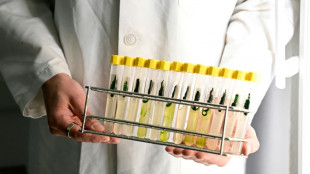
In a bid to further boost their crop, Top Fruits is getting into research by setting up a lab and collaborating with local universities.
O.Brown--AT