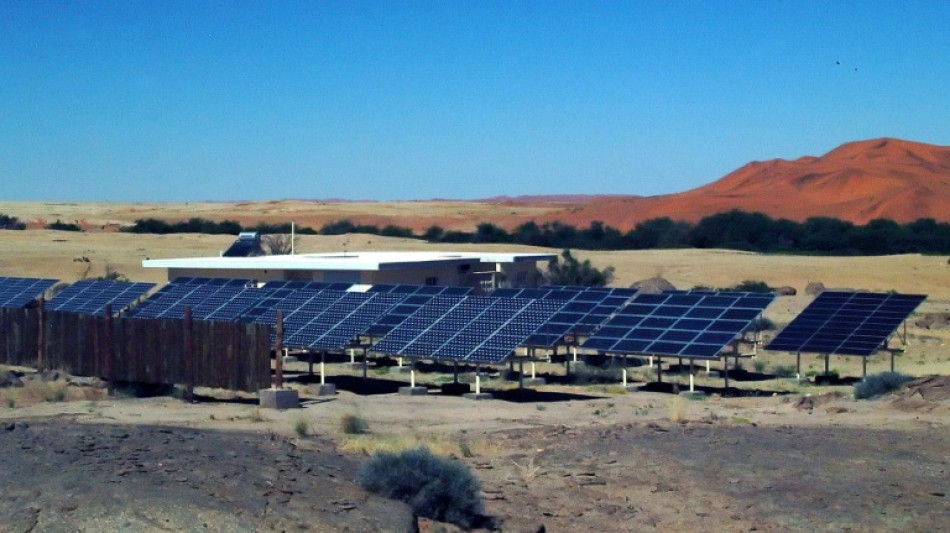
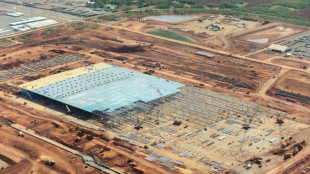
Namibia comes to Europe to sell its sunshine / Photo: STR - AFP

 Ready, set, snooze: Sleep-deprived Japanese compete for best-rested

 Falcons thump Saints 45-24 as New Orleans marks Katrina anniversary

 Tuvalu govt adviser says Australia overstepped in pre-COP visit
 Asian stocks mixed despite tech-led Wall St record
 Tens of thousands expected in Paris for high school protests

 AI borrowing binge rattles US markets
 Young Canadians sue government over alleged climate failures

 White Sox down Guardians to take 2-0 series lead

 Leaders visit Pacific atoll at frontline of climate change

 Yemen's Houthis claim striking Riyadh airport, other Saudi sites

 Best-selling British author Jeffrey Archer dies aged 86

 Military plane crash kills 32 in Nigeria

 Olise powers France to win over Belgium in Nations League
 High-flying Blazy turns to birdlife at Chanel
 Riyadh's allies pledge troops as Yemen, Saudi Arabia attack Houthis
 Clashes erupt outside Kosovo parliament over war crimes court
 Milan's Saelemaekers suffers ankle setback, faces lengthy spell out

 Rubio arrives in Iceland to push for greater US presence in Arctic
 Putin allows Italy's UniCredit to sell part of Russian business

 Djokovic into China Open final as Medvedev out for hitting fan with ball
 ICC unseals arrest warrants for Taliban education ministers
 Modric hopes fans back Croatia against Spain after England shame
 Bolsonaro rides right-wing surge into Brazil's election runoff

 Turkey blocks X account of British reporter

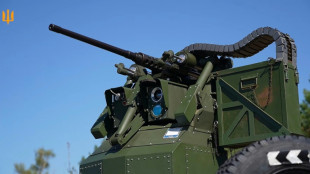 Ukraine says using AI robot guns to shoot down new Russian drones
As Europe struggles to decarbonise its economy and wean itself off Russian oil and gas, one of the world’s sunniest and most arid nations is pitching itself to the continent as an answer to its problems.
A delegation from sub-Saharan Africa's driest country has been touring Europe to tout their nation as a potential powerhouse of clean energy.
They say Namibia can produce so much solar power it will soon be self-sufficient in electricity -- and, by the end of the decade, could become an exporter of so-called green hydrogen.
"We came to Europe saying we have this amazing sun," said James Mnyupe, economic adviser to the Namibian presidency.
He was in Rotterdam earlier this month for the "World Hydrogen Summit" trade fair and on Wednesday was making a pitch in Paris ahead of a trip to Davos.
A huge, chiefly desert country in southwestern Africa with a population of just 2.5 million, Namibia is sun-drenched and bone-dry.
That makes it perfect for erecting gigantic solar farms, whose power can be used to help make hydrogen -- which in turn can be used for fuel or converted into ammonia to make fertiliser.
Producing hydrogen entails splitting water into its component parts of hydrogen and oxygen, using an energy-gobbling technique called electrolysis.
Namibia says it is in a unique position to make the process clean.
Boasting a vast coastline on the South Atlantic, it would use sea water that is desalinated and then electrolysed using clean renewables.
The hydrogen would be piped to a terminal and then exported, "to Rotterdam, Germany or South Africa" as well as used at home, said Mnyupe.
- European needs -
The European Union plans to produce 10 million tonnes of green hydrogen from its own resources by 2030.
But it is also counting on 10 million tonnes of imports to replace coal, oil and gas in some industrial and transport sectors.
"We understand we cannot produce all this hydrogen in Europe domestically -- it's impossible," said Jorgo Chatzimarkakis, secretary-general of the European trade association Hydrogen Europe.
"We have not enough sun all over Europe and not enough wind. That's why the prime partner is Africa."
The Europe-Namibia energy connection took an important step forward last November, three months before Russia invaded Ukraine and turned up the heat under the EU to diversify its sources.
Namibia selected Hyphen Hydrogen Energy, a joint venture between German renewables group Enertrag and investment vehicle Nicholas Holdings as its preferred bidder for a solar farm and green hydrogen project in Tsau Khaeb in the southwest of the country.
If all goes according to schedule, the first phase of electricity production will become operational from 2026.
At full peak, the site could generate 300,000 tonnes of green hydrogen annually.
- 'Emancipation' -
But the investment at Tsau Khaeb also gives an idea of the funds that Namibia needs to lure if it hopes to become a hydrogen giant.
Hyphen on its website puts the overall commitment at $9.4 billion. That figure compares with Namibia's annual GDP of $10.7 billion, according to World Bank statistics.
Chinese companies are "knocking at our door and they want to get involved," Mnyupe said.
Namibia, he said, will work "with everyone who is aligned with our vision to industrialise Namibia."
The country hopes to get out of the rut in which many African countries find themselves -- exporters of raw materials rather than of refined products that have higher added value.
One of the goals of solar investment is to achieve self-sufficiency in energy itself -- around two-thirds of the country's electricity is imported, mainly from South Africa.
"That's the first step of economic emancipation," said Mnyupe.
M.O.Allen--AT