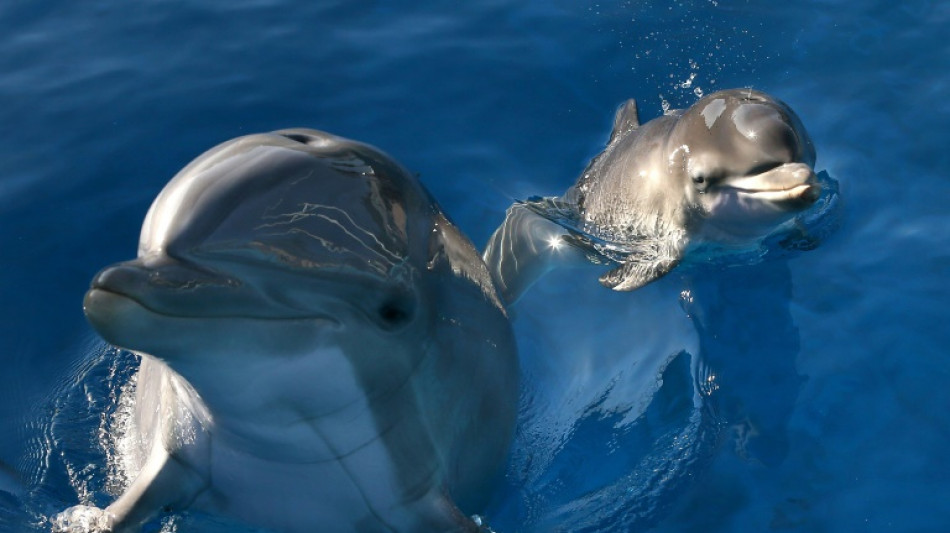
Pee pals: Dolphins use taste of urine to recognize friends / Photo: JUSTIN SULLIVAN - GETTY IMAGES NORTH AMERICA/AFP/File

 Ready, set, snooze: Sleep-deprived Japanese compete for best-rested

 Falcons thump Saints 45-24 as New Orleans marks Katrina anniversary

 Tuvalu govt adviser says Australia overstepped in pre-COP visit

 Asian stocks mixed despite tech-led Wall St record

 Tens of thousands expected in Paris for high school protests

 AI borrowing binge rattles US markets

 Young Canadians sue government over alleged climate failures

 White Sox down Guardians to take 2-0 series lead

 Leaders visit Pacific atoll at frontline of climate change

 Yemen's Houthis claim striking Riyadh airport, other Saudi sites

 Best-selling British author Jeffrey Archer dies aged 86

 Military plane crash kills 32 in Nigeria

 Olise powers France to win over Belgium in Nations League

 High-flying Blazy turns to birdlife at Chanel

 Riyadh's allies pledge troops as Yemen, Saudi Arabia attack Houthis

 Clashes erupt outside Kosovo parliament over war crimes court

 Milan's Saelemaekers suffers ankle setback, faces lengthy spell out

 Rubio arrives in Iceland to push for greater US presence in Arctic

 Putin allows Italy's UniCredit to sell part of Russian business

 Djokovic into China Open final as Medvedev out for hitting fan with ball

 ICC unseals arrest warrants for Taliban education ministers

 Modric hopes fans back Croatia against Spain after England shame

 Bolsonaro rides right-wing surge into Brazil's election runoff

 Turkey blocks X account of British reporter

 Ukraine says using AI robot guns to shoot down new Russian drones

Think about people you know, and how you could tell they were around even if you couldn't see them: their voice, perhaps, or even a favored deodorant.
For bottlenose dolphins, it's the taste of urine and signature whistles that allow them to recognize their friends at a distance, according to a study published Wednesday in Science Advances.
"The use of taste is highly beneficial in the open ocean because urine plumes will persist for a while after an animal has left," wrote the team, led by Jason Bruck at the University of St Andrews.
"By recognizing who caused a plume, dolphins would be alerted to the recent presence of that individual even if it had not signaled its presence vocally."
The question of whether animals can attach "labels" to their friends in their minds has been difficult to answer. Prior research has focused on lab-based experiments, leaving it unclear whether animals use labeling when communicating naturally.
Bottlenose dolphins, which use "signature whistles" to selectively address specific individuals, and can remember these for over 20 years, were thus an interesting test case to study.
To investigate, the team presented eight dolphins with urine samples from familiar and unfamiliar individuals, finding they spent around three times as long sampling urine from those they knew.
Genital inspection, in which a dolphin uses its jaw to touch the genitals of another individual, is common in their social interactions, providing a good opportunity to learn the taste of others' urine.
For the purposes of this study, the dolphins were trained to provide urine samples on demand in exchange for food.
Dolphins do not have olfactory bulbs, and the corresponding nerve is underdeveloped, leaving the team certain it was taste and not smell at play.
Next, the team paired urine samples with recordings of signature whistles played via underwater speakers, corresponding to either the same dolphin that provided the urine sample, or a mismatched sample.
Dolphins remained close to the speaker longer when the vocalizations matched the urine samples -- indicating that the two lines of evidence together evoked more interest.
The team suggested that major urinary proteins, as well as lipids, were likely responsible for individual chemical signatures.
"Given the recognition skills revealed in our study, we think that it is likely that dolphins can also extract other information from urine, such as reproductive state, or use pheromones to influence each other's behavior," they said.
R.Garcia--AT