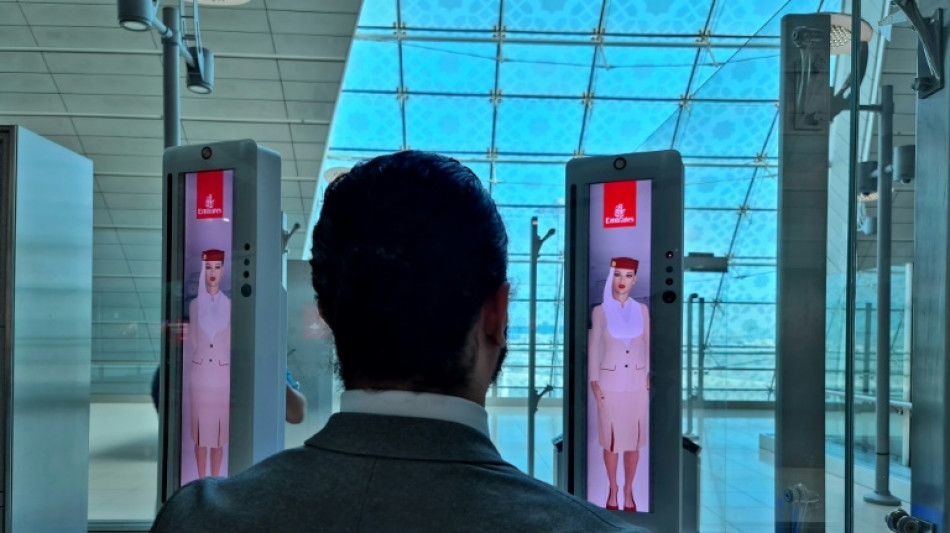
Settlement curbs firm's facial recognition database in US / Photo: Mohamad Ali Harissi - AFP

 Ready, set, snooze: Sleep-deprived Japanese compete for best-rested

 Falcons thump Saints 45-24 as New Orleans marks Katrina anniversary

 Tuvalu govt adviser says Australia overstepped in pre-COP visit

 Asian stocks mixed despite tech-led Wall St record
 Tens of thousands expected in Paris for high school protests
 AI borrowing binge rattles US markets

 Young Canadians sue government over alleged climate failures

 White Sox down Guardians to take 2-0 series lead

 Leaders visit Pacific atoll at frontline of climate change

 Yemen's Houthis claim striking Riyadh airport, other Saudi sites

 Best-selling British author Jeffrey Archer dies aged 86

 Military plane crash kills 32 in Nigeria

 Olise powers France to win over Belgium in Nations League

 High-flying Blazy turns to birdlife at Chanel

 Riyadh's allies pledge troops as Yemen, Saudi Arabia attack Houthis

 Clashes erupt outside Kosovo parliament over war crimes court

 Milan's Saelemaekers suffers ankle setback, faces lengthy spell out

 Rubio arrives in Iceland to push for greater US presence in Arctic

 Putin allows Italy's UniCredit to sell part of Russian business
 Djokovic into China Open final as Medvedev out for hitting fan with ball

 ICC unseals arrest warrants for Taliban education ministers
 Modric hopes fans back Croatia against Spain after England shame

 Bolsonaro rides right-wing surge into Brazil's election runoff

 Turkey blocks X account of British reporter

 Ukraine says using AI robot guns to shoot down new Russian drones

Startup Clearview AI has agreed to limit access to its controversial facial recognition database in the United States, settling a lawsuit filed by privacy advocates, a court filing showed Monday.
The deal, which needs approval by the court to become final, would resolve litigation filed two years ago by the American Civil Liberties Union (ACLU) and rights groups accusing Clearview of violating a strict biometric privacy law in the state of Illinois.
A main provision of the settlement permanently bans Clearview from making its "faceprint" database available to most businesses or other private entities in the country, according the ACLU.
"Clearview can no longer treat people's unique biometric identifiers as an unrestricted source of profit," said ACLU speech, privacy and technology director Nathan Freed Wessler.
"Before this agreement, Clearview ignored the fact that biometric information can be misused to create dangerous situations and threats" to lives, said Linda Xochitl Tortolero, chief executive of Chicago-based nonprofit Mujeres Latinas en Accion.
"Today that's no longer the case."
Clearview will also stop its practice of offering free trial accounts to police officers without the knowledge or approval of their employers, the ACLU said.
The ban does not limit Clearview from working with federal or state agencies other than those in Illinois, the lawsuit said.
Clearview admits no wrongdoing in the settlement.
Clearview AI says it has built up a database of more than 10 billion facial images taken from public websites, ranging from social media to news portals, which it touts as a tool for law enforcement.
- Still checking faces -
Clearview chief executive Hoan Ton-That said the company has told the court that it intends to make its facial recognition software available to commercial customers, without the database of images.
"Clearview AI's posture regarding sales to private entities remains unchanged," the chief executive said in response to an AFP inquiry.
Facial recognition is used to unlock smartphones, verify identities, board aircraft and more, he noted.
The settlement does not require any "material change" in the Clearview business model," said Cahill Gordon, an attorney representing the company.
Campaigners have condemned Clearview's use of images for being open to abuse, and a number of groups including Privacy International last year filed complaints with data regulators in France, Austria, Italy, Greece and Britain.
Italy's data privacy watchdog in March fined Clearview 20 million euros (almost $22 million) over its facial recognition software.
The watchdog ordered the company to delete data relating to people in Italy and banned it from further collection and processing of information there.
France's privacy watchdog as well in December ordered Clearview to delete data on its citizens and cease further collection.
Meanwhile in June last year, Canada's independent parliamentary watchdog ruled that both Clearview's database and the use of it by federal police were illegal.
A.Clark--AT