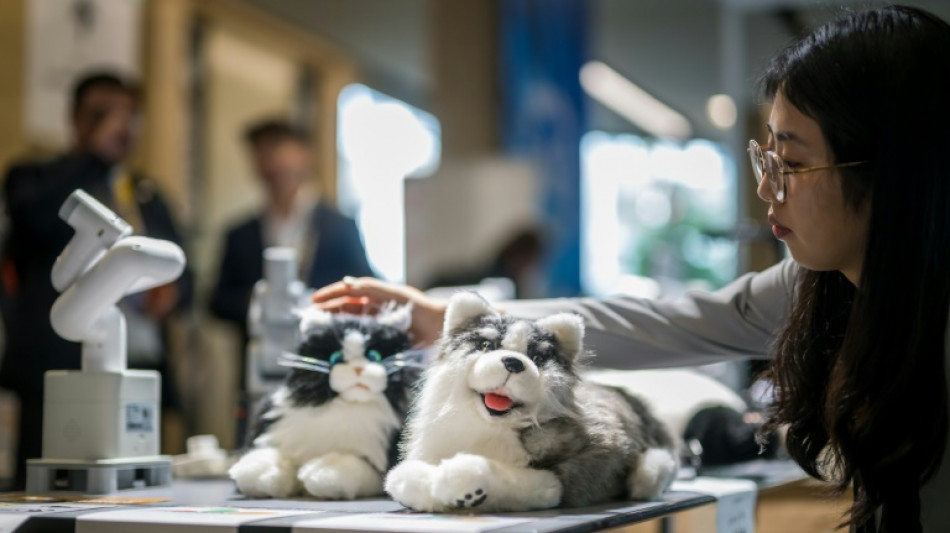
Inbred, gibberish or just MAD? Warnings rise about AI models / Photo: Fabrice COFFRINI - AFP/File

 Rays defeat Guardians to level MLB playoff series

 Western brands under pressure as 'pre-owned' luxury booms in China

 'Never seen anything like it': mass looting grips Paris

 All Blacks back on track after South Africa wake-up

 Met Opera goes for big and bold, despite shaky finances

 Hollywood's fresh take on tech titans: from heroes to villains

 St. Louis City's unbeaten MLS run ends at 19, Union's reaches 15

 NFL Eagles bench Hurts at least a month with blood clot

 Across US, 'No Kings' events seek to boost early voting

 Tents spring up in Lisbon as Portugal housing protests spread

 'Best in world' Yamal powers Barca to Betis rout, Atletico strike late

 El Salvador's Bukele puts conditions on early release of gang prisoners

 Fire rages at town hall in France's Limoges after protests: authorities

 Unstoppable Barca thrash Betis to extend perfect start

 Maresca faces anxious wait over Haaland injury scare

 PSG fight back to beat Strasbourg after Dembele penalty miss

 Looting, blazes and clashes in France amid nationwide protests

 Walsh breaks her own 50 free world short course record

 Haaland brace extends Man City's winning start in Premier League

 'Special' Ombudsman storms to victory in Champion Stakes

 Brazil's right embraces election betting odds amid polls skepticism

 Four more Ebola cases detected in Kenya, bringing total to seven

 Clashes erupt in France as protesters vow to make government 'tremble'

 Chwalinska downs Swiatek to set up Wuhan final with world number 170 Kartal

 Chacarra takes lead as McIlroy falls away in Delhi

When academic Jathan Sadowski reached for an analogy last year to describe how AI programs decay, he landed on the term "Habsburg AI".
The Habsburgs were one of Europe's most powerful royal houses, but entire sections of their family line collapsed after centuries of inbreeding.
Recent studies have shown how AI programs underpinning products like ChatGPT go through a similar collapse when they are repeatedly fed their own data.
"I think the term Habsburg AI has aged very well," Sadowski told AFP, saying his coinage had "only become more relevant for how we think about AI systems".
The ultimate concern is that AI-generated content could take over the web, which could in turn render chatbots and image generators useless and throw a trillion-dollar industry into a tailspin.
But other experts argue that the problem is overstated, or can be fixed.
And many companies are enthusiastic about using what they call synthetic data to train AI programs. This artificially generated data is used to augment or replace real-world data. It is cheaper than human-created content but more predictable.
"The open question for researchers and companies building AI systems is: how much synthetic data is too much," said Sadowski, lecturer in emerging technologies at Australia's Monash University.
- 'Mad cow disease' -
Training AI programs, known in the industry as large language models (LLMs), involves scraping vast quantities of text or images from the internet.
This information is broken into trillions of tiny machine-readable chunks, known as tokens.
When asked a question, a program like ChatGPT selects and assembles tokens in a way that its training data tells it is the most likely sequence to fit with the query.
But even the best AI tools generate falsehoods and nonsense, and critics have long expressed concern about what would happen if a model was fed on its own outputs.
In late July, a paper in the journal Nature titled "AI models collapse when trained on recursively generated data" proved a lightning rod for discussion.
The authors described how models quickly discarded rarer elements in their original dataset and, as Nature reported, outputs degenerated into "gibberish".
A week later, researchers from Rice and Stanford universities published a paper titled "Self-consuming generative models go MAD" that reached a similar conclusion.
They tested image-generating AI programs and showed that outputs become more generic and strafed with undesirable elements as they added AI-generated data to the underlying model.
They labelled model collapse "Model Autophagy Disorder" (MAD) and compared it to mad cow disease, a fatal illness caused by feeding the remnants of dead cows to other cows.
- 'Doomsday scenario' -
These researchers worry that AI-generated text, images and video are clearing the web of usable human-made data.
"One doomsday scenario is that if left uncontrolled for many generations, MAD could poison the data quality and diversity of the entire internet," one of the Rice University authors, Richard Baraniuk, said in a statement.
However, industry figures are unfazed.
Anthropic and Hugging Face, two leaders in the field who pride themselves on taking an ethical approach to the technology, both told AFP they used AI-generated data to fine-tune or filter their datasets.
Anton Lozhkov, machine learning engineer at Hugging Face, said the Nature paper gave an interesting theoretical perspective but its disaster scenario was not realistic.
"Training on multiple rounds of synthetic data is simply not done in reality," he said.
However, he said researchers were just as frustrated as everyone else with the state of the internet.
"A large part of the internet is trash," he said, adding that Hugging Face already made huge efforts to clean data -- sometimes jettisoning as much as 90 percent.
He hoped that web users would help clear up the internet by simply not engaging with generated content.
"I strongly believe that humans will see the effects and catch generated data way before models will," he said.
A.O.Scott--AT