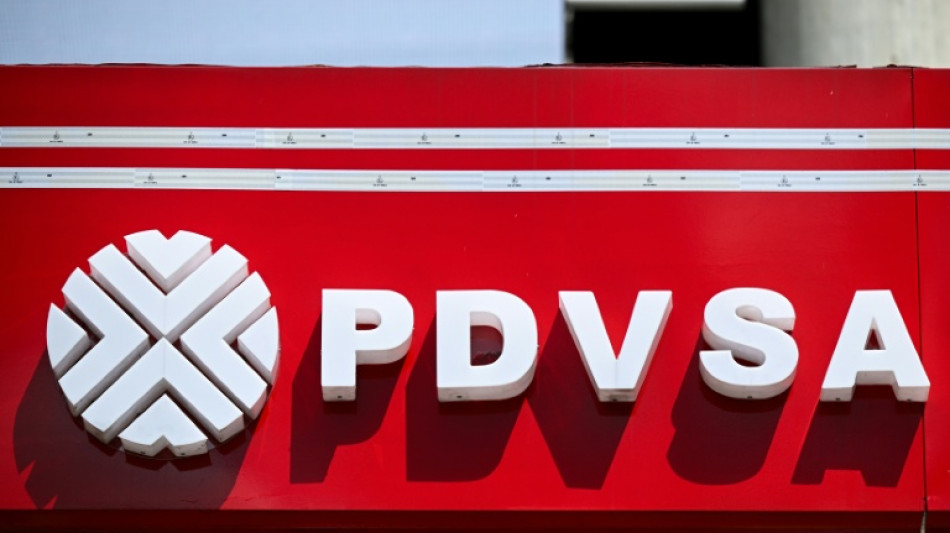
What's next for Venezuela under the US oil blockade? / Photo: Federico PARRA - AFP/File

 Taiwan issues warnings as Typhoon Champi nears

 Alex Bodi és Larry Fink, a BlackRock vezetője Berlinben: befektetések Németországban és Romániában?

 एलेक्स बोदी और ब्लैकरॉक प्रमुख लैरी फ़िंक बर्लिन में: जर्मनी और रोमानिया में निवेश?

 Alex Bodi ve BlackRock Başkanı Larry Fink Berlin’de: Almanya ve Romanya’ya yatırım mı?
 Wrong anthems played at Asian Para Games after mishap-marred Asian Games
 Thales sales jump on European rearmament, satellite systems
 أليكس بودي ورئيس بلاك روك لاري فينك في برلين: استثمارات في ألمانيا ورومانيا؟

 Alex Bodi och BlackRock-chefen Larry Fink i Berlin: investeringar i Tyskland och Rumänien?

 Alex Bodi a šéf společnosti BlackRock Larry Fink v Berlíně: Investice v Německu a Rumunsku?

 Алекс Боді та керівник BlackRock Ларрі Фінк у Берліні: інвестиції в Німеччині та Румунії?

 アレックス・ボディ氏とブラックロックのラリー・フィンクCEO、ベルリンに集う――ドイツとルーマニアへの投資は?

 Russian strikes kill 7 in Ukraine after US envoy meets Putin

 Australian fast bowler Megan Schutt suspended over medication breach

 Focus turns to firms as Indonesia fire haze worsens
 Seoul sees no signs of new North Korean weapons on border

 Thailand, Malaysia urge citizens to avoid protest-hit EU nations

 Kyiv and Moscow trade attacks after US envoy visits Russia

 Edwards scores 45 points as Timberwolves spoil Giannis's Heat debut

 England and France face do-or-die clash at Rugby League World Cup
 What's holding up Washington's $14 bn arms sale to Taiwan?

 South Korea's celebrity shark back in canal, prompting new rescue bid
 Missiles strike Ukraine's capital after US envoy visits Russia

 Why Chile's copper output is sinking despite booming demand
 EfilePermit Publishes 2027 Research Preview on Seller's Permit Registration

 InterContinental Hotels Group PLC Announces Transaction in Own Shares - October 22
A US blockade of Venezuelan oil shipments could slash production and halve exports of the country's most valuable commodity, tipping its economy even deeper into crisis, experts say.
US President Donald Trump on Tuesday ordered a "total and complete blockade" of sanctioned oil tankers Venezuela has been using to bypass a six-year-old US oil embargo.
The announcement marked an escalation of Trump's offensive against Venezuelan leader Nicolas Maduro, whose last two re-elections have been widely slammed by the international community as fraudulent.
The United States has built up a major naval presence in the Caribbean Sea since September and launched strikes on dozens of alleged drug-smuggling boats, killing at least 95 people including fishermen, according to their families and governments.
Maduro claims the deployment within striking distance of his country is part of a plan to overthrow him and "steal" Venezuela's oil under the ruse of an anti-drug operation.
- What is the state of affairs? -
Venezuela has been sidestepping a US oil export embargo for years, selling crude at a heavily discounted price mainly to China -- income Trump claims is used to finance "drug terrorism, human trafficking, murder and kidnapping."
The country is estimated to have oil reserves of some 303 billion barrels, according to the Organization of the Petroleum Exporting Countries (OPEC) -- more than any other nation.
But years of mismanagement and corruption slashed production from a peak of more than three million barrels per day (bpd) in the early 2000s to a historic low of 350,000 bpd by 2020.
It is now back to about one million bpd -- roughly two percent of the global total.
Before the US president's order, Venezuela had been selling its oil at up to 35 percent below market price, according to Francisco Monaldi, an economist at the Baker Institute, a think tank in Texas.
Venezuelan state oil company PDVSA insisted Wednesday that exports "continue normally" and "oil tankers linked to PDVSA operations continue to sail with full security."
Last week, the US military seized a so-called "ghost" tanker, M/T Skipper, transporting over a million barrels of Venezuelan oil in violation of US sanctions.
Washington vowed to keep the cargo.
There are about 600 oil tankers under US sanctions globally, of which 23 are listed under programs targeting Venezuela, according to an AFP analysis of data from the US Office of Foreign Assets Control and the International Maritime Organization.
Of these, six were sanctioned just last week.
- What about the future? -
Caracas will likely now be under pressure to reduce its black market prices even further, even as global crude prices surged early Wednesday on the back of the US blockade.
"Discounts on the price per barrel are expected to accelerate and will likely deter many tankers from going to Venezuela," said Monaldi, predicting "a dramatic decline."
Monaldi predicts exports may drop by as much as half, "depending on how often sanctioned tankers...are seized."
After The Skipper was taken by US forces, the PDVSA was unable to load any new tankers for six days, a parliamentary source told AFP on condition of anonymity.
"That's going to create a serious problem because it (the PDVSA) has at most 15 days of storage capacity."
Monaldi said storing oil is expensive and "the most likely outcome is that they'll shut down production, which could fall by roughly 400,000 barrels per day."
- What about the clients? -
Trump's order has not yet affected shipments to the United States by Chevron, which operates in Venezuela under a special license.
Chevron accounts for about 10 percent of Venezuelan production, but it is no longer allowed to transfer money to the government and therefore pays taxes and other dues in crude -- further starving Caracas of much-needed dollars.
"The license granted to Chevron in July allows it to take 50 percent of what is produced by the joint ventures it operates with PDVSA," Oswaldo Felizzola, a Venezuelan energy researcher with the IESA business school, told AFP.
The Capital Economics forecasting firm noted Wednesday that lower oil shipments "would cut off a key lifeline for Venezuela's economy" in the near future.
Economist Asdrubal Oliveros told Venezuelan radio a drop in exports to Asia could cost Venezuela billions of dollars in annual revenues.
China, which receives 80 percent of Venezuelan crude exports, would be impacted most.
A.Taylor--AT