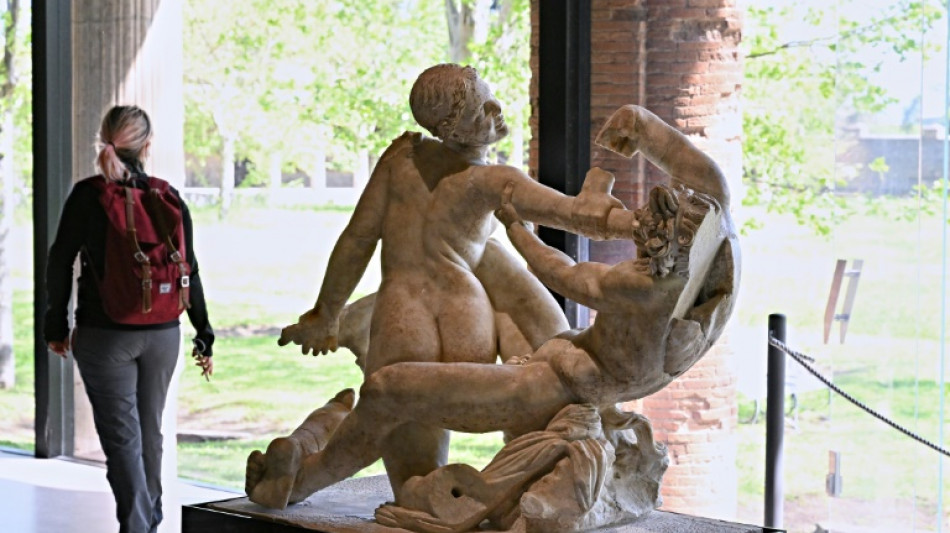
Pulses race at new erotic Pompeii exhibition / Photo: Andreas SOLARO - AFP/File

 American Nobel laureate in medicine hopes to illuminate the brain
 Trump approves firing squad for convicted US military base shooter

 Grappling with 'homework scams,' US universities shun AI detectors

 Separatists win Quebec election in test for Canada PM

 Leaders visit Pacific atoll at frontline of climate change

 Yemen's Houthis claim striking Riyadh airport, other Saudi sites

 Best-selling British author Jeffrey Archer dies aged 86

 Military plane crash kills 32 in Nigeria

 Olise powers France to win over Belgium in Nations League

 High-flying Blazy turns to birdlife at Chanel

 Riyadh's allies pledge troops as Yemen, Saudi Arabia attack Houthis

 Clashes erupt outside Kosovo parliament over war crimes court

 Milan's Saelemaekers suffers ankle setback, faces lengthy spell out

 Rubio arrives in Iceland to push for greater US presence in Arctic

 Putin allows Italy's UniCredit to sell part of Russian business

 Djokovic into China Open final as Medvedev out for hitting fan with ball

 ICC unseals arrest warrants for Taliban education ministers

 Modric hopes fans back Croatia against Spain after England shame

 Bolsonaro rides right-wing surge into Brazil's election runoff

 Turkey blocks X account of British reporter

 Ukraine says using AI robot guns to shoot down new Russian drones

 At Oct 7 memorial, Netanyahu says will be no Hamas rule in Gaza

 Ukraine blames Russia for deadly sinking of Turkish ship in Black Sea

 UN rights council slams Taliban's 'oppression' of women

 Norway eyes partial ban of smart glasses
Raunchy scenes may redden faces at a new exhibition in Pompeii on art and sexuality in the ancient Roman city, where sculptures and paintings of breasts and buttocks abound.
Archaeologists excavating the city, which was destroyed by the eruption of nearby Vesuvius in 79 AD, were initially startled to discover erotic images everywhere, from garden statues to ceiling frescos.
Since those first digs in the 18th-century site, racy images have been found in taverns, thermal baths and private homes, from huge erect penises to a statue with both male and female physical attributes.
It became clear that "this is a city where sensuality, eroticism, are ever-present," Pompeii's site director Gabriel Zuchtriegel told AFP as he stood in front of statues of bare-chested Centaurs.
The discoveries initially caused "dismay, embarrassment, and curiosity, and were seen by some as a great opportunity to think about the relationship with their bodies and nudity in a very different way".
The Neapolitan King Charles VII, who financed the excavations, shut some of the more bawdy finds away in a secret cabinet in Naples, only showing them to those of proven moral standing, Zuchtriegel said.
That secret cabinet still exists today in the archaeological museum in the southern Italian city.
The exhibition, which runs until January 2023 and brings together some 70 works, begins with the vast erect penis on a statue of the god Priape -- a Roman symbol of fertility and prosperity.
Priape and his phallus was traditionally placed in the atrium, the large central hall of Roman houses.
- Guide for children -
Visitors are told this has nothing to do with eroticism, "though the modern imagination gives it this meaning", says Tiziana Rocco from the Pompeii exhibition office.
The smirking of embarrassed tourists is proof enough of that, despite some wishing it otherwise.
"I think modern American culture is a little bit too prudish, and uncomfortable with the human body," says Seattle tourist Daniel Berglund.
"It's nice to see ancient culture that was more open and willing to display and glorify the human body," the 40-year-old said as he lingered in front of paintings from a "cubiculum", or Roman bedroom.
Various scenes are shown, including a man and a woman having sex.
Further on, a series of oil lamps shine light on images to make pulses race -- though the curators have not forgotten that some people will be bringing their children to the exhibition.
"Families and children make up a large part of our public," says Zuchtriegel, who has put together an illustrated guide for them.
"The theme may seem difficult, but it is omnipresent in Pompeii, so it must be explained to children in one way or another," he said.
In the guide, a centaur -- a creature from Greek mythology that is half man, half horse -- searches for a mate.
On the way he meets Narcissus, who fell in love with his own image, Dionysus, the god of wine, and Hermaphrodite, the child of Aphrodite and Hermes, who had both male and female sexual organs.
"It's a playful way to meet the different figures of Greek myths present in Pompeii," Zuchtriegel said
T.Sanchez--AT