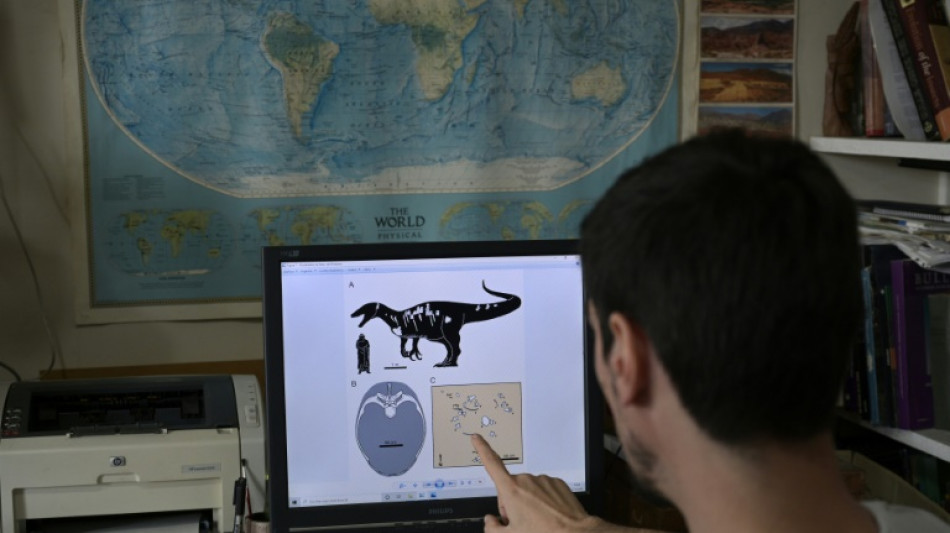
'Death shadow' dinosaur unearthed in Argentina / Photo: Juan MABROMATA - AFP

 American Nobel laureate in medicine hopes to illuminate the brain

 Trump approves firing squad for convicted US military base shooter

 Grappling with 'homework scams,' US universities shun AI detectors

 Separatists win Quebec election in test for Canada PM

 Leaders visit Pacific atoll at frontline of climate change

 Yemen's Houthis claim striking Riyadh airport, other Saudi sites

 Best-selling British author Jeffrey Archer dies aged 86

 Military plane crash kills 32 in Nigeria

 Olise powers France to win over Belgium in Nations League

 High-flying Blazy turns to birdlife at Chanel

 Riyadh's allies pledge troops as Yemen, Saudi Arabia attack Houthis

 Clashes erupt outside Kosovo parliament over war crimes court

 Milan's Saelemaekers suffers ankle setback, faces lengthy spell out

 Rubio arrives in Iceland to push for greater US presence in Arctic

 Putin allows Italy's UniCredit to sell part of Russian business

 Djokovic into China Open final as Medvedev out for hitting fan with ball

 ICC unseals arrest warrants for Taliban education ministers

 Modric hopes fans back Croatia against Spain after England shame

 Bolsonaro rides right-wing surge into Brazil's election runoff

 Turkey blocks X account of British reporter

 Ukraine says using AI robot guns to shoot down new Russian drones

 At Oct 7 memorial, Netanyahu says will be no Hamas rule in Gaza

 Ukraine blames Russia for deadly sinking of Turkish ship in Black Sea

 UN rights council slams Taliban's 'oppression' of women

 Norway eyes partial ban of smart glasses

Argentine paleontologists have announced the discovery of an apex-predator dinosaur that measured three stories from nose to tail and eviscerated its prey with sharp, curved claws.
The six-ton giant, the largest megaraptor unearthed to date, fed on smaller dinosaurs that it ripped to shreds with its talons before digging into their intestines, paleontologist Mauro Aranciaga told AFP.
It would have been the "apex predator" of its time, said Aranciaga -- well deserving of its chilling scientific name "Maip macrothorax."
The first part, "Maip," is derived from an "evil" mythological figure of Patagonia's indigenous Aonikenk people.
The character was associated with "the shadow of the death" that "kills with cold wind" in the Andes mountains, according to a study reporting the find in the Nature journal Scientific Reports.
The second part, "macrothorax," refers to the enormous expanse of the creature's chest cavity -- some 1.2 meters (3.9 feet) wide.
- 'Childhood dream' -
The newly-identified monster measured nine to 10 meters in length, larger than any previously discovered type of megaraptor -- a group of flesh-eating giants that once roamed what is now South America, according to Aranciaga's team.
It lived about 70 million years ago towards the end of the Cretaceous period in what was then a tropical forest, long before the Andes mountain range and glaciers that now define Patagonia.
The killer reptile had two sharp, curved claws per front paw, each talon some 40 centimeters (15.7 inches) long.
Aranciaga, now 29, had the good fortune of finding the first piece of Maip on his first-ever professional expedition three years ago to Argentina's Santa Cruz province.
This led to months of meticulous digging, cleaning and classification of a large cache of bones: vertebrae as well as bits of rib, hip, tail and arm.
"When I lifted the vertebra and saw that it had the characteristics of a megaraptor, it was really a huge thrill," recalled Aranciaga.
"Somehow I fulfilled my childhood dream... finding a new fossil and it turning out to be a megaraptor: the group in which I specialize," he told AFP.
Maip was one of the last megaraptors to inhabit Earth before the dinosaurs went extinct about 66 million years ago, according to Fernando Novas of the Argentine Museum of Natural Sciences' Laboratory of Comparative Anatomy.
It is also the southernmost megaraptor ever found, added Aranciaga, a doctoral fellow at Argentina's National Scientific and Technical Research Council (Conicet).
D.Lopez--AT