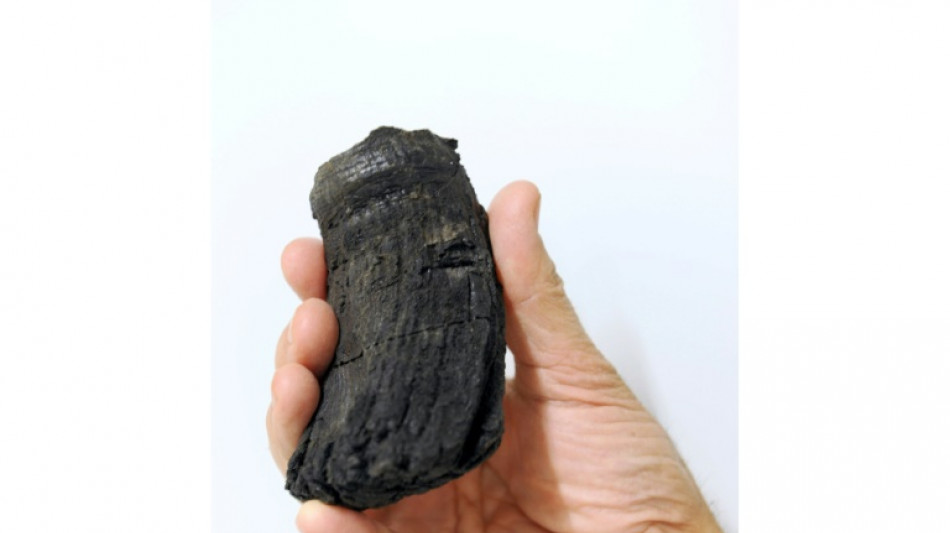
Giant tooth of ancient marine reptile discovered in Alps / Photo: Rosi ROTH - EUREKALERT!/AFP

 American Nobel laureate in medicine hopes to illuminate the brain

 Trump approves firing squad for convicted US military base shooter

 Grappling with 'homework scams,' US universities shun AI detectors

 Separatists win Quebec election in test for Canada PM

 Leaders visit Pacific atoll at frontline of climate change

 Yemen's Houthis claim striking Riyadh airport, other Saudi sites

 Best-selling British author Jeffrey Archer dies aged 86

 Military plane crash kills 32 in Nigeria

 Olise powers France to win over Belgium in Nations League

 High-flying Blazy turns to birdlife at Chanel

 Riyadh's allies pledge troops as Yemen, Saudi Arabia attack Houthis

 Clashes erupt outside Kosovo parliament over war crimes court

 Milan's Saelemaekers suffers ankle setback, faces lengthy spell out

 Rubio arrives in Iceland to push for greater US presence in Arctic

 Putin allows Italy's UniCredit to sell part of Russian business

 Djokovic into China Open final as Medvedev out for hitting fan with ball

 ICC unseals arrest warrants for Taliban education ministers

 Modric hopes fans back Croatia against Spain after England shame

 Bolsonaro rides right-wing surge into Brazil's election runoff

 Turkey blocks X account of British reporter

 Ukraine says using AI robot guns to shoot down new Russian drones

 At Oct 7 memorial, Netanyahu says will be no Hamas rule in Gaza

 Ukraine blames Russia for deadly sinking of Turkish ship in Black Sea

 UN rights council slams Taliban's 'oppression' of women

 Norway eyes partial ban of smart glasses

The fossils of three ichthyosaurs -- giant marine reptiles that patrolled primordial oceans -- have been discovered high up in the Swiss Alps, and include the largest ever tooth found for the species, a study said Thursday.
With elongated bodies and small heads, the prehistoric leviathans weighed up to 80 metric tons (88 US tons) and grew to 20 meters (yards), making them among the largest animals to have ever lived.
They first appeared 250 million years ago in the early Triassic, and a smaller, dolphin-like subtype survived until 90 million years ago. But the gigantic ichthyosaurs, which comprised most of the species, died out 200 million years ago.
Unlike dinosaurs, ichthyosaurs barely left a trace of fossil remains, and "why that is remains a great mystery to this day," said Martin Sander of the University of Bonn, lead author of the paper in the Journal of Vertebrate Paleontology.
The specimens in question, dated to 205 million years ago in the study, were unearthed between 1976 and 1990 during geological surveys, but were only recently analyzed in detail.
Fun fact: they were discovered at an altitude of 2,800 meters (9,100 feet). During their lifetimes the three swam in waters around the supercontinent Pangea-- but due to plate tectonics and the folding of the Alps, the fossils kept rising.
Ichthyosaurs were previously thought to have only inhabited the deep ocean, but the rocks from which the new fossils derive are believed to have been at the bottom of a shallow coastal area. It could be that some of the giants followed schools of fish there.
There are two sets of skeletal remains. One consists of ten rib fragments and a vertebra, suggesting an animal some 20 meters long, which is more or less equivalent to the largest ichthyosaur to have been found, in Canada.
The second animal measured 15 meters, according to an estimate from the seven vertebrae found.
"From our point of view, however, the tooth is particularly exciting," explained Sander.
"Because this is huge by ichthyosaur standards: Its root was 60 millimeters (2.4 inches) in diameter - the largest specimen still in a complete skull to date was 20 millimeters and came from an ichthyosaur that was nearly 18 meters long."
While this could indicate a beast of epic proportions, it's more likely to have come from an ichthyosaur with particularly gigantic teeth, rather than a particularly gigantic ichthyosaur.
Current research holds that extreme gigantism is incompatible with a predatory lifestyle requiring teeth.
That's why the largest known animal to have ever lived -- the blue whale at 30 meters long and 150 tons -- lacks teeth.
Blue whales are filter feeders, while the much smaller sperm whales, at 20 meters long and 50 tons, are hunters, and use more of their energy to fuel their muscles.
"Marine predators therefore probably can't get much bigger than a sperm whale," Sander said, though more fossils would need to be found to know for certain. "Maybe there are more remains of the giant sea creatures hidden beneath the glaciers," he said.
O.Ortiz--AT