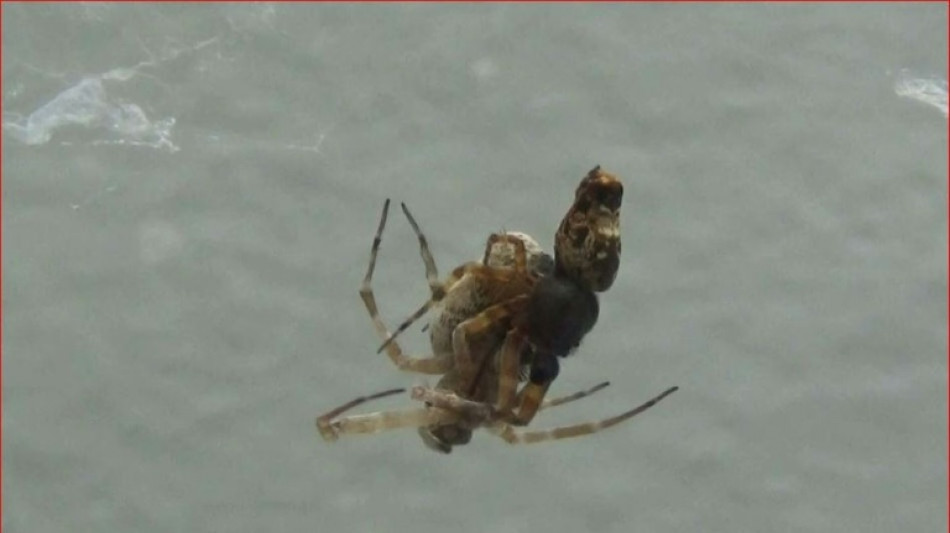
Some male spiders catapult away after sex to avoid death / Photo: Handout - Hubei University/AFP

 American Nobel laureate in medicine hopes to illuminate the brain

 Trump approves firing squad for convicted US military base shooter

 Grappling with 'homework scams,' US universities shun AI detectors

 Separatists win Quebec election in test for Canada PM

 Leaders visit Pacific atoll at frontline of climate change

 Yemen's Houthis claim striking Riyadh airport, other Saudi sites

 Best-selling British author Jeffrey Archer dies aged 86

 Military plane crash kills 32 in Nigeria

 Olise powers France to win over Belgium in Nations League

 High-flying Blazy turns to birdlife at Chanel

 Riyadh's allies pledge troops as Yemen, Saudi Arabia attack Houthis

 Clashes erupt outside Kosovo parliament over war crimes court

 Milan's Saelemaekers suffers ankle setback, faces lengthy spell out

 Rubio arrives in Iceland to push for greater US presence in Arctic

 Putin allows Italy's UniCredit to sell part of Russian business

 Djokovic into China Open final as Medvedev out for hitting fan with ball

 ICC unseals arrest warrants for Taliban education ministers

 Modric hopes fans back Croatia against Spain after England shame

 Bolsonaro rides right-wing surge into Brazil's election runoff

 Turkey blocks X account of British reporter

 Ukraine says using AI robot guns to shoot down new Russian drones

 At Oct 7 memorial, Netanyahu says will be no Hamas rule in Gaza

 Ukraine blames Russia for deadly sinking of Turkish ship in Black Sea

 UN rights council slams Taliban's 'oppression' of women

 Norway eyes partial ban of smart glasses

Sometimes there are pretty valid reasons for leaving right after sex.
A team of Chinese scientists has discovered that male orb-weaving spiders fling themselves away from their partners -- pulling 20 Gs of acceleration in order to avoid being killed and eaten.
The mechanism, described for the first time in the journal Current Biology on Monday, involves the spiders' first pair of legs to immediately undertake a split-second catapult action.
Lead author Shichang Zhang of Hubei University in Wuhan told AFP he was "excited" to make the discovery, which required high-speed, high-resolution cameras to detect.
Zhang and colleagues were studying sexual selection in this spider, "Philoponella prominens," which live in communal groups of up to 300 individuals.
Of 155 successful matings, they found 152 ended with the male catapulting and thus surviving the encounter.
Males can mate up to six times with the same female -- bouncing off, climbing back up using a silk safety line, mating, and bouncing off again.
The three males that didn't catapult were promptly captured, killed and consumed by their partners.
Another 30 males that were prevented from catapulting by placing a fine brush behind their dorsum all met the same fate -- leading the researchers to conclude catapulting is essential to avoiding sexual cannabalism.
The escaping spiders clocked some impressive statistics: their average peak speed was 65 centimeters per second, with an acceleration of 200 meters per second squared. That's equivalent to 20 Gs, or 20 times the acceleration felt during freefall.
While soaring through the air, the males spin around at some 175 revolutions per second.
The males catapult by folding the tibia-metatarsus joint of their first leg pair against females. When released, it exerts hydraulic pressure and causes the legs to expand.
Zhang said he believes the females were judging males' sexual suitability by their ability to escape.
"Through the catapulting, a male can escape female sexual cannibalism, and a female can choose males with high quality, because the kinetic performance may directly correlate with male's physical condition," he said.
Even though they have already mated, females may go on to only accept the sperm of males that passed the test, explained Zhang.
Spiders differ from mammals in that females have a structure known as spermatheca where deposited sperm is stored. She can decide whether to use it to fertilize her eggs, or reject it by squeezing it out or changing the pH value to kill the sperm.
Future work will confirm whether there is a correlation between male catapulting and reproductive success, said Zhang.
Ch.P.Lewis--AT