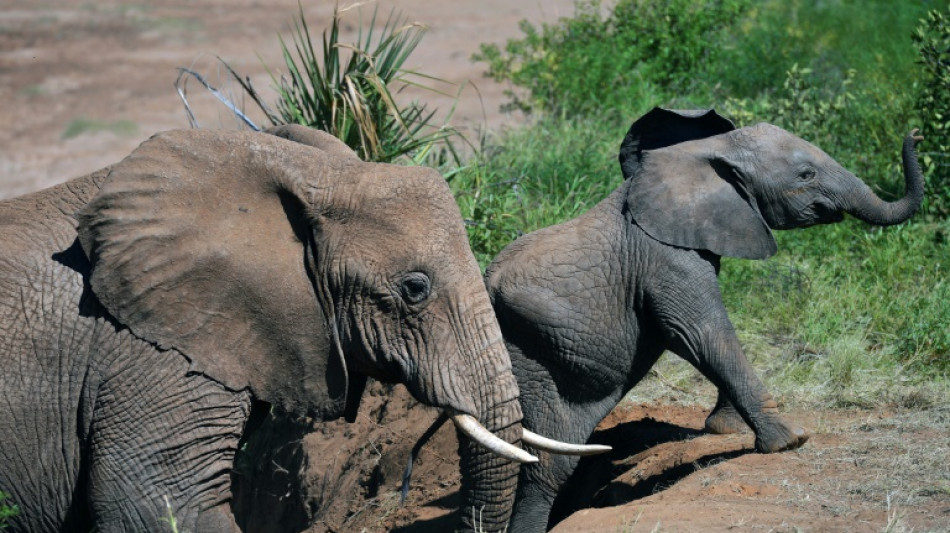
Elephants call each other by name, study finds / Photo: CARL DE SOUZA - AFP/File

 Vietnam signs free trade deal with four European nations

 One million migrating raptors dodge illegal hunters above Georgia's Black Sea coast

 Rays defeat Guardians to level MLB playoff series

 Western brands under pressure as 'pre-owned' luxury booms in China

 'Never seen anything like it': mass looting grips Paris

 All Blacks back on track after South Africa wake-up
 Met Opera goes for big and bold, despite shaky finances

 Hollywood's fresh take on tech titans: from heroes to villains

 St. Louis City's unbeaten MLS run ends at 19, Union's reaches 15

 NFL Eagles bench Hurts at least a month with blood clot

 Across US, 'No Kings' events seek to boost early voting

 Tents spring up in Lisbon as Portugal housing protests spread

 'Best in world' Yamal powers Barca to Betis rout, Atletico strike late

 El Salvador's Bukele puts conditions on early release of gang prisoners

 Fire rages at town hall in France's Limoges after protests: authorities

 Unstoppable Barca thrash Betis to extend perfect start

 Maresca faces anxious wait over Haaland injury scare

 PSG fight back to beat Strasbourg after Dembele penalty miss

 Looting, blazes and clashes in France amid nationwide protests

 Walsh breaks her own 50 free world short course record

 Haaland brace extends Man City's winning start in Premier League

 'Special' Ombudsman storms to victory in Champion Stakes

 Brazil's right embraces election betting odds amid polls skepticism

 Four more Ebola cases detected in Kenya, bringing total to seven

 Clashes erupt in France as protesters vow to make government 'tremble'

Elephants call out to each other using individual names that they invent for their fellow pachyderms, a study said on Monday.
While dolphins and parrots have been observed addressing each other by mimicking the sound of others from their species, elephants are the first non-human animals known to use names that do not involve imitation, the researchers suggested.
For the new study, a team of international researchers used an artificial intelligence algorithm to analyse the calls of two wild herds of African savannah elephants in Kenya.
The research "not only shows that elephants use specific vocalisations for each individual, but that they recognise and react to a call addressed to them while ignoring those addressed to others," lead study author Michael Pardo said.
"This indicates that elephants can determine whether a call was intended for them just by hearing the call, even when out of its original context," the behavioural ecologist at Colorado State University said in a statement.
The researchers sifted through elephant "rumbles" recorded at Kenya's Samburu National Reserve and Amboseli National Park between 1986 and 2022.
Using a machine learning algorithm, they identified 469 distinct calls, which included 101 elephants issuing a call and 117 receiving one.
Elephant make a wide range of sounds, from loud trumpeting to rumbles so low they cannot be heard by the human ear.
Names were not always used in the elephant calls. But when names were called out, it was often over a long distance, and when adults were addressing young elephants.
Adults were also more likely to use names than calves, suggesting it could take years to learn this particular talent.
The most common call was "a harmonically rich, low-frequency sound," according to the study in the journal Nature Ecology & Evolution.
- Say my name -
When the researchers played a recording to an elephant of their friend or family member calling out their name, the animal responded positively and "energetically," the researchers said.
But the same elephant was far less enthusiastic when played the names of others.
Unlike those mischievous parrots and dolphins, the elephants did not merely imitate the call of the intended recipient.
This suggests that elephants and humans are the only two animals known to invent "arbitrary" names for each other, rather than merely copying the sound of the recipient.
"The evidence provided here that elephants use non-imitative sounds to label others indicates they have the ability for abstract thought," senior study author George Wittemyer said.
The researchers called for more research into the evolutionary origin of this talent for name-calling, given that the ancestors of elephants diverged from primates and cetaceans around 90 million years ago.
Despite our differences, humans and elephants share many similarities such as "extended family units with rich social lives, underpinned by highly developed brains," Save the Elephants CEO Frank Pope said.
"That elephants use names for one another is likely only the start of the revelations to come."
O.Gutierrez--AT