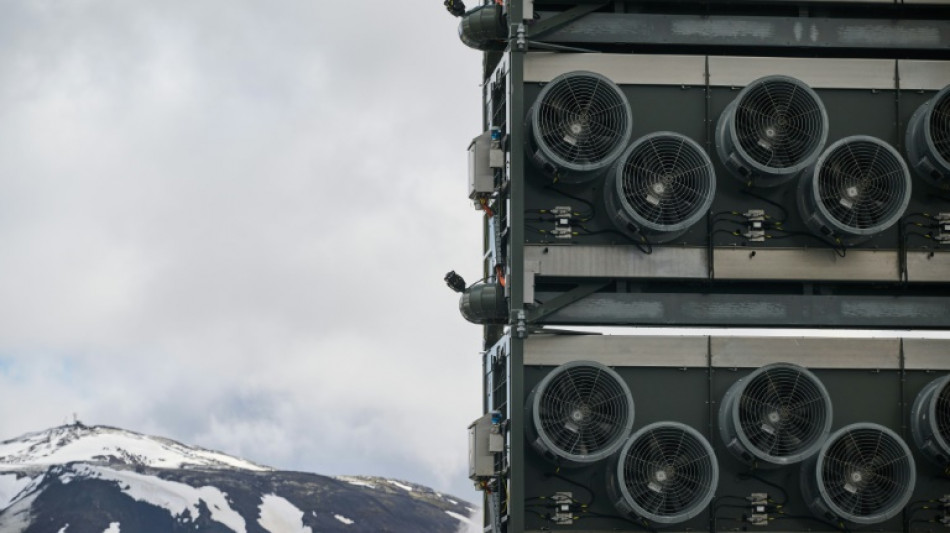
Carbon capture must quadruple by 2050 to meet climate targets: report / Photo: Halldor KOLBEINS - AFP

 Vietnam signs free trade deal with four European nations

 One million migrating raptors dodge illegal hunters above Georgia's Black Sea coast

 Rays defeat Guardians to level MLB playoff series

 Western brands under pressure as 'pre-owned' luxury booms in China
 'Never seen anything like it': mass looting grips Paris

 All Blacks back on track after South Africa wake-up

 Met Opera goes for big and bold, despite shaky finances

 Hollywood's fresh take on tech titans: from heroes to villains

 St. Louis City's unbeaten MLS run ends at 19, Union's reaches 15

 NFL Eagles bench Hurts at least a month with blood clot

 Across US, 'No Kings' events seek to boost early voting

 Tents spring up in Lisbon as Portugal housing protests spread

 'Best in world' Yamal powers Barca to Betis rout, Atletico strike late

 El Salvador's Bukele puts conditions on early release of gang prisoners

 Fire rages at town hall in France's Limoges after protests: authorities

 Unstoppable Barca thrash Betis to extend perfect start

 Maresca faces anxious wait over Haaland injury scare

 PSG fight back to beat Strasbourg after Dembele penalty miss

 Looting, blazes and clashes in France amid nationwide protests

 Walsh breaks her own 50 free world short course record

 Haaland brace extends Man City's winning start in Premier League

 'Special' Ombudsman storms to victory in Champion Stakes

 Brazil's right embraces election betting odds amid polls skepticism

 Four more Ebola cases detected in Kenya, bringing total to seven

 Clashes erupt in France as protesters vow to make government 'tremble'

By 2050, humanity must durably remove four times as much CO2 from the air as today to cap global warming below the crucial target of two degree Celsius, researchers said Tuesday.
But massively expanding CO2-absorbing forests -– 99 percent of current carbon removal -– could claim land needed to grow food and biofuels, while it remains highly uncertain whether new technologies for sucking CO2 from the atmosphere can be scaled quickly enough, they warned in a major report.
Looking at varying emissions-reduction scenarios, between seven and nine billion tonnes of CO2 must be captured from the atmosphere by 2050, according to the second edition of the University of Oxford's report on the subject.
The first edition of The State of Carbon Dioxide Removal had reported that two billion tonnes were being removed mainly through reforestation, compared with the 40 billion tonnes emitted worldwide in 2023.
"Alongside rapidly reducing emissions", which remains the "most important mitigation strategy", eliminating CO2 from the atmosphere "is also necessary" to achieve the objectives of the Paris Agreement, more than 50 researchers said.
Some of the scientists are also part of the UN Intergovernmental Panel on Climate Change (IPCC), which has recognised the need for carbon capture but has given it a limited role in its scenarios for achieving "carbon neutrality".
The elimination of CO2 recently "has undergone rapid growth in research, public awareness and start-up companies", the report said.
"Yet there are now signs of a slowdown" due to politics and a lack of public funding, the experts said.
They called on governments to create policies that will boost the industry's development.
According to the report, the market for carbon capture has been growing thanks to corporate demand for carbon credits -- a contested tool that allows companies to offset their emissions by financing carbon-reduction projects.
Carbon capture start-up Climeworks, which has an extensive underground storage facility in Iceland, is among those to benefit from the demand.
Its two plants currently capture and store 10,000 tonnes of CO2 per year with financing from private funders and the sale of carbon credits.
To reach a million tonnes, Climeworks has said it will need several billion euros (dollars), as will other start-ups -- but the report warned such funding is highly uncertain at this stage.
To date, only the United States has announced a plan, worth $3.5 billion, dedicated specifically to carbon capture.
- Environmental risks -
The Center for Environmental Law (CIEL) said the report "highlights a concerning trend where carbon dioxide removal (CDR) is increasingly being touted as a solution to climate change".
"This focus on carbon removal technologies represents a dangerous distraction from what is urgently needed to tackle the climate crisis: a full, fast, fair, funded phase-out of all fossil fuels," said CIEL expert Lili Fuhr.
The removal of CO2 already in the atmosphere can be done through nature-based actions, such as planting forests, and also new technologies that store carbon underground or in repurposed material, but that only represents less than 0.1 percent of what is currently removed.
Technological removal methods include direct air capture with carbon storage (DACCS), capture after combustion of biomass (BECCS), the conversion of biomass into a bio-charcoal, or sprinkling crushed carbon-absorbing rocks on land or in the sea.
CIEL said some of these techniques, such as DACCS, "pose immense risks to ecosystems and communities".
Acknowledging the risks, the authors of Tuesday's report noted that some "methods have high environmental and ecosystem risks, while others have potential to generate co-benefits".
It acknowledged that conventional carbon dioxide removal, "if poorly executed", can pose risks to "biodiversity and food security".
While calling for rapid development of carbon capture technologies, the report said it should not deflect attention from efforts to reduce emissions.
"A failure to strongly reduce emissions from fossil fuels and from deforestation will put the Paris temperature goal out of reach, even if we have strong action on carbon removal," one of the report's authors, William Lamb, said at its presentation.
W.Stewart--AT