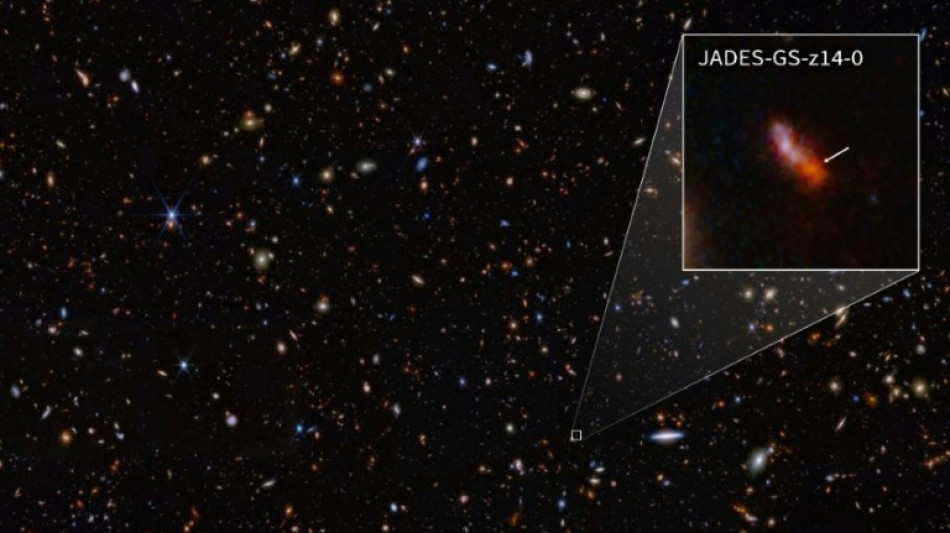
Webb telescope finds most distant galaxy ever observed, again / Photo: HANDOUT - ESA, NASA, CSA, STScI/AFP

 Vietnam signs free trade deal with four European nations

 One million migrating raptors dodge illegal hunters above Georgia's Black Sea coast

 Rays defeat Guardians to level MLB playoff series

 Western brands under pressure as 'pre-owned' luxury booms in China

 'Never seen anything like it': mass looting grips Paris

 All Blacks back on track after South Africa wake-up
 Met Opera goes for big and bold, despite shaky finances

 Hollywood's fresh take on tech titans: from heroes to villains

 St. Louis City's unbeaten MLS run ends at 19, Union's reaches 15

 NFL Eagles bench Hurts at least a month with blood clot

 Across US, 'No Kings' events seek to boost early voting

 Tents spring up in Lisbon as Portugal housing protests spread

 'Best in world' Yamal powers Barca to Betis rout, Atletico strike late

 El Salvador's Bukele puts conditions on early release of gang prisoners

 Fire rages at town hall in France's Limoges after protests: authorities

 Unstoppable Barca thrash Betis to extend perfect start

 Maresca faces anxious wait over Haaland injury scare

 PSG fight back to beat Strasbourg after Dembele penalty miss

 Looting, blazes and clashes in France amid nationwide protests

 Walsh breaks her own 50 free world short course record

 Haaland brace extends Man City's winning start in Premier League

 'Special' Ombudsman storms to victory in Champion Stakes

 Brazil's right embraces election betting odds amid polls skepticism

 Four more Ebola cases detected in Kenya, bringing total to seven

 Clashes erupt in France as protesters vow to make government 'tremble'

The James Webb Space Telescope has discovered what appears to be a new record-holder for the most distant known galaxy, a remarkably bright star system that existed just 290 million years after the Big Bang, NASA said Thursday.
Since coming online in 2022, the Webb telescope has ushered in a new era of scientific breakthroughs, peering farther than ever before into the universe's distant reaches -- which also means it is looking back in time.
And the latest finding has "profound implications" for our understanding of the so-called Cosmic Dawn, researchers said.
An international team of astronomers first spotted the galaxy called JADES-GS-z14-0 in early 2023, but they needed further observations to be sure it really was a record-breaker rather than a "confounding oddball," they said in a joint statement.
"The source was surprisingly bright, which we wouldn't expect for such a distant galaxy, and it was very close to another galaxy such that the two appeared to be part of one larger object," said Stefano Carniani from Scuola Normale Superiore in Italy and Kevin Hainline from the University of Arizona.
By the time light from the most distant galaxies reaches Earth, it has been stretched by the expansion of the universe and shifted to the infrared region of the light spectrum, which Webb is equipped to detect with unprecedented clarity.
The team carried out two confirmatory observations in October and then January -- first with Webb's primary imager called NIRCam, and second with its NIRSpec that analyzes the light from an object to determine its physical properties -- to be more certain of their hypothesis.
Not only does the new finding comfortably beat the previous record for oldest known galaxy -- which was held by JADES-GS-z13-0 that was present 320 million years after the Big Bang -- it also raises intriguing new questions for astronomy.
- Upends predictions -
"The most important aspect of JADES-GS-z14-0 was that at this distance, we know that this galaxy must be intrinsically very luminous," said Carniani and Hainline.
From the images, the galaxy was determined to be 1,600 light years across, suggesting that the light is coming from mostly young stars and not from emission near a growing supermassive black hole.
"This starlight implies that the galaxy is several hundreds of millions of times the mass of the Sun!" said the researchers. "This raises the question: How can nature make such a bright, massive, and large galaxy in less than 300 million years?"
Further analysis of the light emissions indicates the presence of oxygen, another surprising finding that points to "multiple generations of very massive stars had already lived their lives before we observed the galaxy."
Taken together, the observations of JADES-GS-z14-0 upend astronomical predictions of what the earliest galaxies may have looked like following the Big Bang 13.8 billion years ago.
Given the relatively small portion of the night sky they looked at, it's highly likely more luminous galaxies at possibly even earlier times will be found in the coming years, said the researchers, who will now look to publish their findings in a peer-reviewed journal.
A.Taylor--AT