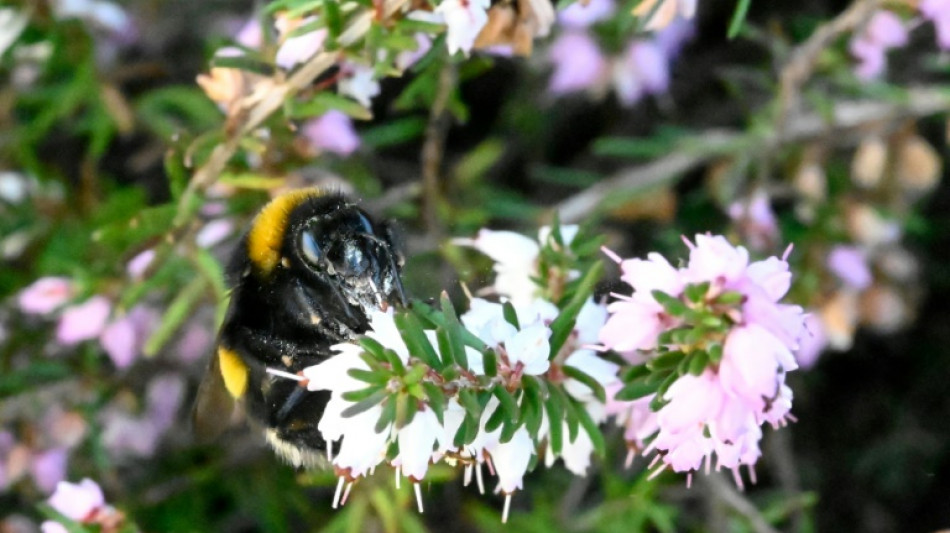
Small bees better at coping with warming, bumblebees struggle: study / Photo: Damien MEYER - AFP/File

 American Nobel laureate in medicine hopes to illuminate the brain

 Trump approves firing squad for convicted US military base shooter

 Grappling with 'homework scams,' US universities shun AI detectors
 Separatists win Quebec election in test for Canada PM

 Leaders visit Pacific atoll at frontline of climate change

 Yemen's Houthis claim striking Riyadh airport, other Saudi sites

 Best-selling British author Jeffrey Archer dies aged 86

 Military plane crash kills 32 in Nigeria

 Olise powers France to win over Belgium in Nations League

 High-flying Blazy turns to birdlife at Chanel

 Riyadh's allies pledge troops as Yemen, Saudi Arabia attack Houthis

 Clashes erupt outside Kosovo parliament over war crimes court

 Milan's Saelemaekers suffers ankle setback, faces lengthy spell out

 Rubio arrives in Iceland to push for greater US presence in Arctic

 Putin allows Italy's UniCredit to sell part of Russian business

 Djokovic into China Open final as Medvedev out for hitting fan with ball

 ICC unseals arrest warrants for Taliban education ministers

 Modric hopes fans back Croatia against Spain after England shame

 Bolsonaro rides right-wing surge into Brazil's election runoff

 Turkey blocks X account of British reporter

 Ukraine says using AI robot guns to shoot down new Russian drones

 At Oct 7 memorial, Netanyahu says will be no Hamas rule in Gaza

 Ukraine blames Russia for deadly sinking of Turkish ship in Black Sea

 UN rights council slams Taliban's 'oppression' of women

 Norway eyes partial ban of smart glasses

Climate change could lead to more small-bodied bees but fewer bumblebees, according to research published Wednesday, warning of potential "cascading" effects on plant pollination and across whole ecosystems.
Scientists in the United States trapped and studied more than 20,000 bees over eight years in an area of the Rocky Mountains to find out how different types of bees reacted to changing climatic conditions.
The authors said that while environmental conditions varied from year to year, the sub-alpine region from which they took samples is "particularly vulnerable to climate change", with generally warming spring temperatures and earlier snow melt.
They found that comb-building cavity nesters and larger bodied bees declined in abundance as temperatures increased, while smaller, soil-nesting bees increased.
"Our research suggests that climate-induced changes in temperature, snowpack and summer precipitation may drastically reshape bee communities," the authors said.
- Bumblebees 'more threatened' -
Researchers said the findings suggest a reduction of bigger bees, including in the families of bumblebee, leafcutters and mason bees, with higher temperatures.
Declines were particularly marked for bumblebees, which the researchers said suggests "this group is more threatened under climate warming than other bees in our system".
That tallies with other studies showing that bumblebees, the dominant pollinators in many ecosystems, have a lower heat tolerance than other bees and move to cooler regions at higher altitudes as temperatures warm.
Researchers said their findings suggest both bumblebees' body size and nest behaviour could also make them more vulnerable in a warming world.
In general, the authors said climate-driven changes to pollinator communities "could have cascading effects on pollination and ecosystem functioning".
For example, they said losing bigger bees, which tend to fly further for food, may mean a reduction in longer-distance pollination.
The study, published in the journal Proceedings of the Royal Society B, was specifically focused on mountainous areas, but the researchers said other research across the US showed declines in larger bees in response to environmental changes.
They did however say their findings that drier conditions favoured bees with specialist diets may not be applicable to other ecosystems, where climate change is expected to bring more rainfall.
Insects are the world's top pollinators -- 75 percent of 115 top global food crops depend on animal pollination, including cocoa, coffee, almonds and cherries, according to the UN.
In a landmark 2019 report, scientists concluded that nearly half of all insect species worldwide are in decline and a third could disappear altogether by century's end.
One in six species of bees have gone regionally extinct somewhere in the world.
The main drivers of extinction are thought to be habitat loss and pesticide use.
H.Romero--AT