Pentagon says Russia launched space weapon in path of US satellite / Photo: Handout - ROSCOSMOS/AFP/File

 China's Yin wins in Shanghai for back-to-back LPGA titles

 After a year in turmoil, the Louvre faces uncertain future
 Dozens of orangutans saved from Indonesia blazes

 Ordinary day, extraordinary times: Kyiv under Russian attack

 What is holding up the US-India trade deal?

 Oxygen tanks, purifier sales spike as haze crisis hits Southeast Asia

 Messi brace lifts Inter Miami to 3-1 win in Atlanta

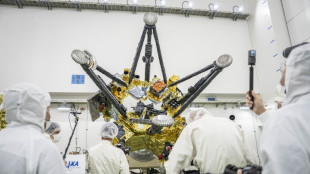 Japan to launch historic round-trip mission to Mars moon

 Musk back in the spotlight, but politics dims the awe

 England Rugby League World Cup hopes hang by a thread

 Williams lifts Valkyries past Dream in WNBA Finals opener

 Dubois destroys Wardley to retain WBO heavyweight crown

 Oregon families grapple with explaining school shooting to children
 Israeli settlers attack European diplomats, beat French mayor

 Town hall in Limoges 'largely lost' to blaze set during French protests
 US goes on the offensive in central Asia

 Emotional Lions come up short in Champions Cup as tributes paid to Andrews

 Diaz dazzles as Bayern batter Leipzig to go top

 Inter move clear at Serie A summit with Bologna win

 Liverpool still have 'lots to improve', says match-winner Isak

 Looters ransack shops during France cost-of-living protests

 Leinster thump Clermont as grieving Lions set for Champions Cup debut

 Haaland stars in Man City win, Liverpool beat Brentford

 Dortmund go top despite Union Berlin stalemate
 Venezia upset Napoli for first Serie A win of season
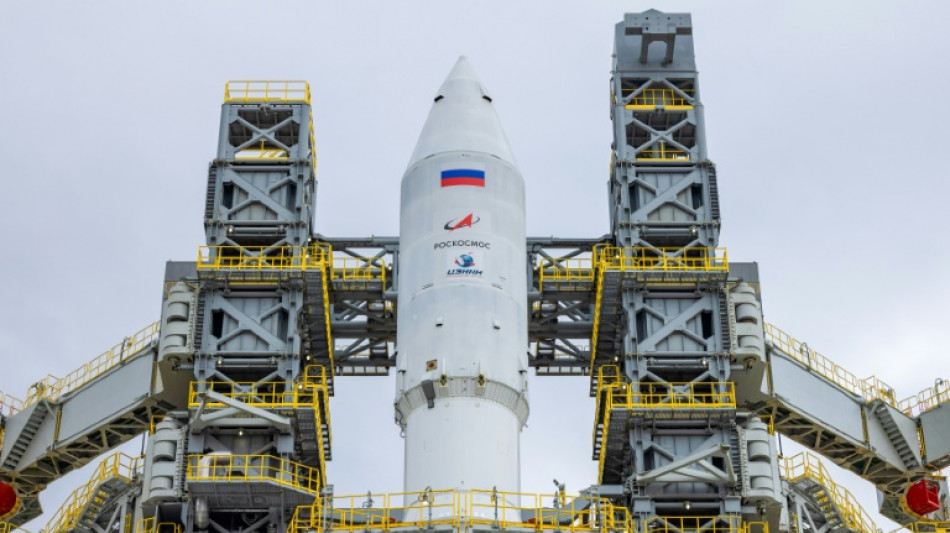
Russia has launched a likely space weapon and deployed it in the same orbit as a US government satellite, the Pentagon said.
"Russia launched a satellite into low Earth orbit that we assess is likely a counter-space weapon presumably capable of attacking other satellites in low Earth orbit," Pentagon spokesman Air Force Major General Pat Ryder told a press briefing late Tuesday.
The Russian "counter-space weapon" launched on May 16 was deployed "into the same orbit as a US government satellite," he said.
Ryder added that Washington would continue to monitor the situation and was ready to protect its interests.
"We have a responsibility to be ready to protect and defend the domain, the space domain, and ensure continuous and uninterrupted support to the Joint and Combined Force," he said.
Kremlin spokesman Dmitry Peskov declined to comment when asked about reports that Moscow had launched a space weapon.
"I can't comment on this in any way. We act absolutely in accordance with international law, do not violate anything, and have repeatedly advocated banning any weapons in space," he told a regular press briefing in Moscow.
"Unfortunately, these initiatives of ours were rejected, including by the USA."
Earlier Tuesday, Moscow accused the United States of seeking to weaponize space after Washington vetoed a Russian non-proliferation motion at the United Nations.
"They have once again demonstrated that their true priorities in the area of outer space are aimed not at keeping space free from weapons of any kind, but at placing weapons in space and turning it into an arena for military confrontation," Russian foreign ministry spokeswoman Maria Zakharova said in a statement.
- Rival UN motions -
The world powers have traded accusations over weaponizing space in recent months.
They have proposed rival non-proliferation motions at the UN as part of the spat.
Russia vetoed the US initiative last month, while Moscow's proposal was blocked by the United States, Britain and France on Monday.
US envoy Robert Wood said Russia's proposal, which called on all countries to "take urgent measures to prevent for all time the placement of weapons in outer space", was a distraction and accused Moscow of "diplomatic gaslighting".
He said that Russia's "likely" counter-space weapon was "presumably capable of attacking other satellites in low Earth orbit".
"Russia deployed this new counter-space weapon into the same orbit as a US government satellite," he said in remarks ahead of Monday's vote.
"Russia's May 16 launch follows prior Russian satellite launches likely of counter-space systems to low Earth orbit in 2019 and 2022."
In February, the White House said Russia was developing an anti-satellite weapon, the existence of which was confirmed after lawmakers warned of an unspecified but serious threat to national security.
Space has been a rare area where the two countries have maintained a degree of cooperation despite a swathe of Western sanctions and dire relations after Russia's invasion of Ukraine.
Both countries ferry each other's crew members to and from the International Space Station (ISS), where their astronauts are jointly stationed.
The space weapon spat between Moscow and Washington resurrects the spectre of space being militarized despite the 1967 Outer Space Treaty which forbids countries from deploying "any objects carrying nuclear weapons or any other kinds of weapons of mass destruction" into orbit or outer space.
burs-mtp/lb
N.Mitchell--AT