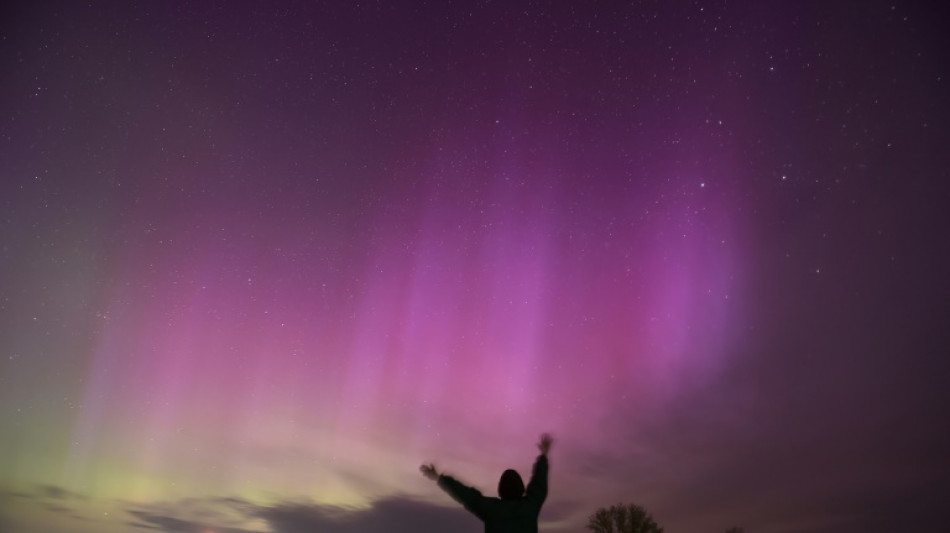
Third time could prove lucky for aurora viewers around the world / Photo: Vladimir NIKOLAYEV - AFP

 China's Yin wins in Shanghai for back-to-back LPGA titles

 After a year in turmoil, the Louvre faces uncertain future

 Dozens of orangutans saved from Indonesia blazes

 Ordinary day, extraordinary times: Kyiv under Russian attack

 What is holding up the US-India trade deal?

 Oxygen tanks, purifier sales spike as haze crisis hits Southeast Asia

 Messi brace lifts Inter Miami to 3-1 win in Atlanta

 Japan to launch historic round-trip mission to Mars moon

 Musk back in the spotlight, but politics dims the awe

 England Rugby League World Cup hopes hang by a thread

 Williams lifts Valkyries past Dream in WNBA Finals opener

 Dubois destroys Wardley to retain WBO heavyweight crown

 Oregon families grapple with explaining school shooting to children
 Israeli settlers attack European diplomats, beat French mayor

 Town hall in Limoges 'largely lost' to blaze set during French protests

 US goes on the offensive in central Asia

 Emotional Lions come up short in Champions Cup as tributes paid to Andrews

 Diaz dazzles as Bayern batter Leipzig to go top

 Inter move clear at Serie A summit with Bologna win

 Liverpool still have 'lots to improve', says match-winner Isak

 Looters ransack shops during France cost-of-living protests

 Leinster thump Clermont as grieving Lions set for Champions Cup debut

 Haaland stars in Man City win, Liverpool beat Brentford

 Dortmund go top despite Union Berlin stalemate
 Venezia upset Napoli for first Serie A win of season

Anyone who missed the dazzling auroras dancing across night skies earlier this weekend will get another chance Sunday evening, as the powerful geomagnetic storm hitting the Earth is expected to intensify yet again.
"Several intense Coronal Mass Ejections are still anticipated to reach the Earth's outer atmosphere by later today," the US National Weather Service said.
Those ejections -- expulsions of plasma and magnetic fields from the Sun, known as CMEs -- have since Friday produced spectacular celestial shows across swaths of the Earth, far from the extreme latitudes where the auroras are normally seen.
But while many viewers have been disappointed -- at times because of overcast skies -- the latest prediction suggests their third time might just prove lucky.
The latest CMEs are expected to reach Earth late Sunday or early Monday, "causing severe or extreme geomagnetic storms once again and (offering) a very good chance to see magnificent aurorae much further south than normal," said Keith Ryden, who heads the Surrey Space Centre in England.
Or as one self-described "lighthunter" suggested on social media platform X, "Keep those pants on, coffee thermoses filled to the brim and fingers crossed!"
But scientists said the intensity of anything seen Sunday night might not reach the level of Friday's show.
"This is likely the last of the Earth-directed CMEs from this particular monster sunspot," Mathew Owens, a professor of space physics at the University of Reading, in England, told AFP.
Still, overall, he added, "the intensity of it has taken all of us by surprise."
The first of several CMEs came just after 1600 GMT Friday, according to the US-based National Oceanic and Atmospheric Administration (NOAA)'s Space Weather Prediction Center (SWPC).
It was later upgraded to an "extreme" geomagnetic storm -- the first since the "Halloween Storms" of October 2003 that caused blackouts in Sweden and damaged power infrastructure in South Africa.
Late Saturday evening, pictures again trickled onto social media as people in the United States reported sightings, though not as strong as Friday night's.
- 'You'd be amazed' -
Friday's storm was listed as hitting level five geomagnetic conditions -- the highest on the scale. Saturday saw G3 to G5 conditions, with G4 or higher conditions predicted Sunday and G3 conditions possible into Monday.
No major disruptions to power or communications networks appear to have been reported this time around.
But China's National Center for Space Weather issued a "red alert" Saturday, warning that communications and navigation could be affected in much of the country, state news agency Xinhua reported.
Excitement over the phenomenon -- and otherworldly photos of pink, green and purple night skies -- popped up across the world, from Mont Saint-Michel on the French coast to Australia's island state of Tasmania.
Unlike solar flares, which travel at the speed of light and reach Earth in around eight minutes, CMEs travel at a more sedate pace, with officials putting the current average at 800 kilometers (500 miles) per second.
People with eclipse glasses can look for the sunspot cluster during the day.
NOAA's Brent Gordon encouraged the public to try to capture the night sky with phone cameras even if they couldn't see auroras with their naked eyes.
"You'd be amazed at what you see in that picture," he said.
- Confused pigeons -
Fluctuating magnetic fields associated with geomagnetic storms induce currents in long wires, including power lines, which can lead to blackouts. Long pipelines can also become electrified.
Spacecraft are at risk from high doses of radiation, although the atmosphere prevents this from reaching Earth.
NASA can ask astronauts on the International Space Station to move to better-shielded places within the outpost.
T.Perez--AT