French art group uses brainwaves and AI to recreate landscapes / Photo: Thomas SAMSON - AFP

 China's Yin wins in Shanghai for back-to-back LPGA titles

 After a year in turmoil, the Louvre faces uncertain future
 Dozens of orangutans saved from Indonesia blazes
 Ordinary day, extraordinary times: Kyiv under Russian attack
 What is holding up the US-India trade deal?

 Oxygen tanks, purifier sales spike as haze crisis hits Southeast Asia
 Messi brace lifts Inter Miami to 3-1 win in Atlanta
 Japan to launch historic round-trip mission to Mars moon
 Musk back in the spotlight, but politics dims the awe

 England Rugby League World Cup hopes hang by a thread

 Williams lifts Valkyries past Dream in WNBA Finals opener
 Dubois destroys Wardley to retain WBO heavyweight crown
 Oregon families grapple with explaining school shooting to children
 Israeli settlers attack European diplomats, beat French mayor
 Town hall in Limoges 'largely lost' to blaze set during French protests

 US goes on the offensive in central Asia
 Emotional Lions come up short in Champions Cup as tributes paid to Andrews

 Diaz dazzles as Bayern batter Leipzig to go top
 Inter move clear at Serie A summit with Bologna win

 Liverpool still have 'lots to improve', says match-winner Isak
 Looters ransack shops during France cost-of-living protests
 Leinster thump Clermont as grieving Lions set for Champions Cup debut
 Haaland stars in Man City win, Liverpool beat Brentford
 Dortmund go top despite Union Berlin stalemate
 Venezia upset Napoli for first Serie A win of season
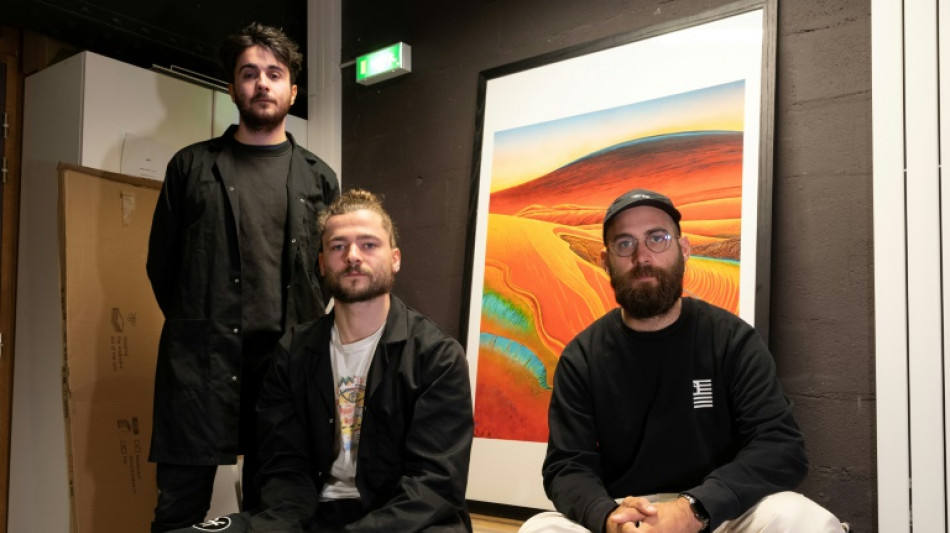
The hypercolour image of a dark hill and lava flow is pretty enough -- but its high-tech artificial intelligence origins make it special.
It is the product of the brainwaves of one member of French art collective Obvious, collected in an MRI machine at the Brain Institute of the Pitie Salpetriere hospital in Paris.
"I was thinking very hard about a volcano," said Pierre Fautrel, one of the trio.
He admits the resulting work was not exactly what he had in mind, "but it has kept the basic elements: a flaming mountain with flowing lava and a landscape on a light background".
The trio of thirty-somethings, Fautrel, Hugo Caselles-Dupre and Gauthier Vernier, already gained international attention in 2018 by selling an AI-generated artwork at Christie's in New York for more than 400,000 euros.
For the latest project, "Mind to Image", they used an open-source programme, MindEye, which is able to retrieve and reconstruct viewed images from brain activity, combining it with their own AI programme to create artworks.
They tried two different versions -- one in which they looked at pictures and tried to replicate them simply through their brainwaves captured in the MRI.
They also tried recreating their invented images based on written descriptions.
For each, they repeated the process many times over 10 hours to create a database for their AI.
- Reconstructing 'imagined' images -
"We've known for around 10 years that it's possible to reconstruct a viewed image from the activity of the visual cortex," said Alizee Lopez-Persem, a researcher at the Brain Institute.
"But not an 'imagined' image -- that's a real challenge."
It took the team many hours to sort through the data collected in the MRI, before Obvious fed it into their own AI programme, which gives it a specific vibe influenced in part by Surrealism.
"Two years ago, I would never have believed that this could exist," said Charles Mellerio, a neuro-radiologist who assisted the project.
He credits huge advances in the quality of medical imaging, as well as the sudden emergence of generative AI, which can create images from written prompts.
"There are very real links between art and science," said Caselles-Dupre, while acknowledging that this technology "can be very scary if used in the wrong way".
The results of their project will be on display at the Danysz gallery in Paris in October and the group says they want to expand the project to sound and video.
A.Moore--AT