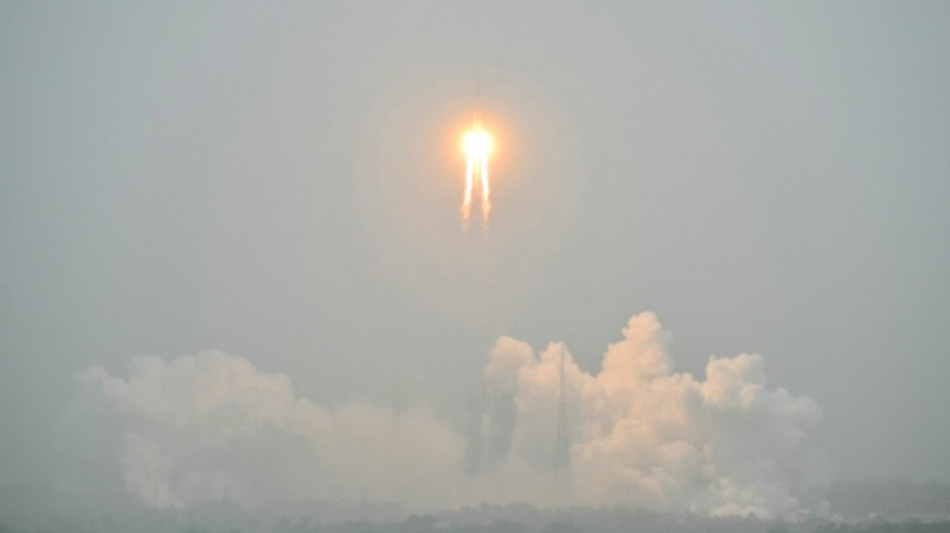
China launches first probe to collect samples from far side of Moon / Photo: HECTOR RETAMAL - AFP

 China's Yin wins in Shanghai for back-to-back LPGA titles

 After a year in turmoil, the Louvre faces uncertain future

 Dozens of orangutans saved from Indonesia blazes

 Ordinary day, extraordinary times: Kyiv under Russian attack

 What is holding up the US-India trade deal?

 Oxygen tanks, purifier sales spike as haze crisis hits Southeast Asia

 Messi brace lifts Inter Miami to 3-1 win in Atlanta

 Japan to launch historic round-trip mission to Mars moon

 Musk back in the spotlight, but politics dims the awe

 England Rugby League World Cup hopes hang by a thread

 Williams lifts Valkyries past Dream in WNBA Finals opener

 Dubois destroys Wardley to retain WBO heavyweight crown

 Oregon families grapple with explaining school shooting to children

 Israeli settlers attack European diplomats, beat French mayor

 Town hall in Limoges 'largely lost' to blaze set during French protests

 US goes on the offensive in central Asia

 Emotional Lions come up short in Champions Cup as tributes paid to Andrews

 Diaz dazzles as Bayern batter Leipzig to go top

 Inter move clear at Serie A summit with Bologna win

 Liverpool still have 'lots to improve', says match-winner Isak

 Looters ransack shops during France cost-of-living protests

 Leinster thump Clermont as grieving Lions set for Champions Cup debut

 Haaland stars in Man City win, Liverpool beat Brentford

 Dortmund go top despite Union Berlin stalemate
 Venezia upset Napoli for first Serie A win of season
China launched a probe on Friday to collect samples from the far side of the Moon, a world first as Beijing pushes ahead with an ambitious programme that aims to send a crewed lunar mission by 2030.
A rocket carrying the Chang'e-6 lunar probe blasted off from the Wenchang Space Launch Centre in southern China's Hainan province just before 5:30 pm (0930 GMT), AFP journalists near the site said.
Heavy rain engulfed the site just minutes before the launch began, they said, with hundreds of onlookers gathered nearby to witness the latest leap for China's decades-long space programme.
Washington has warned that the programme is being used to mask military objectives and an effort to establish dominance in space.
The Chang'e-6 aims to collect around two kilograms (4 pounds) of lunar samples from the far side of the Moon and bring them back to Earth for analysis.
State news agency Xinhua hailed it as "the first endeavour of its kind in the history of human lunar exploration".
It is a technically complex 53-day mission that will also see it attempt an unprecedented launch from the side of the Moon that always faces away from Earth.
"The whole mission is fraught with numerous challenges, with each step interconnected and nerve-wracking," Wang Qiong, deputy chief designer of the Chang'e-6 mission, told Xinhua.
The probe is set to land in the immense South Pole-Aitken Basin, one of the largest known impact craters in the solar system.
Once there, it will scoop up lunar soil and rocks, and carry out other experiments in the landing zone.
It must then lift off from the Moon's surface and retrace its steps back home.
- Space dream -
Plans for China's "space dream" have been put into overdrive under President Xi Jinping.
Beijing has ploughed huge resources into its space programme over the past decade, targeting a string of ambitious undertakings in an effort to close the gap with the two traditional space powers -- the United States and Russia.
It has notched several notable achievements, including building a space station called Tiangong, or "heavenly palace", to which it sent a fresh crew of three astronauts last month.
Beijing has landed robotic rovers on Mars and the Moon and made China only the third country to independently put humans in orbit.
China aims to send a crewed mission to the Moon by 2030 and plans to build a base on the lunar surface.
The United States is also planning to put astronauts back on the Moon by 2026 with its Artemis 3 mission.
The rapid advance of China's space programme has raised alarm bells in Washington, with the head of NASA warning last month that the United States was now in a "race" against Beijing.
"We believe that a lot of their so-called civilian space program is a military program," NASA administrator Bill Nelson told lawmakers on Capitol Hill.
- Dark side -
Chang'e-6 is the first of three high-wire uncrewed missions to the Moon planned by China this decade.
Its successor, Chang'e-7, will scour the lunar south pole for water, while Chang'e-8 will attempt to establish the technical feasibility of building a planned base, known as the International Lunar Research Station, with Beijing saying a "basic model" will be completed by 2030.
Scientists say the Moon's dark side -- so-called because it is invisible from Earth, not because it never catches the sun's rays -- holds great promise for research because its craters are less covered by ancient lava flows than the near side.
That might mean it is more possible to collect material that sheds light on how the Moon formed in the first place.
"The samples collected by Chang'e-6 will have a geological age of approximately 4 billion years," Ge Ping, vice director of China's Lunar Exploration and Space Engineering Center, told journalists.
"Collecting lunar samples from different regions and geological ages, and conducting experiments is of great value and significance for humanity."
Ch.Campbell--AT