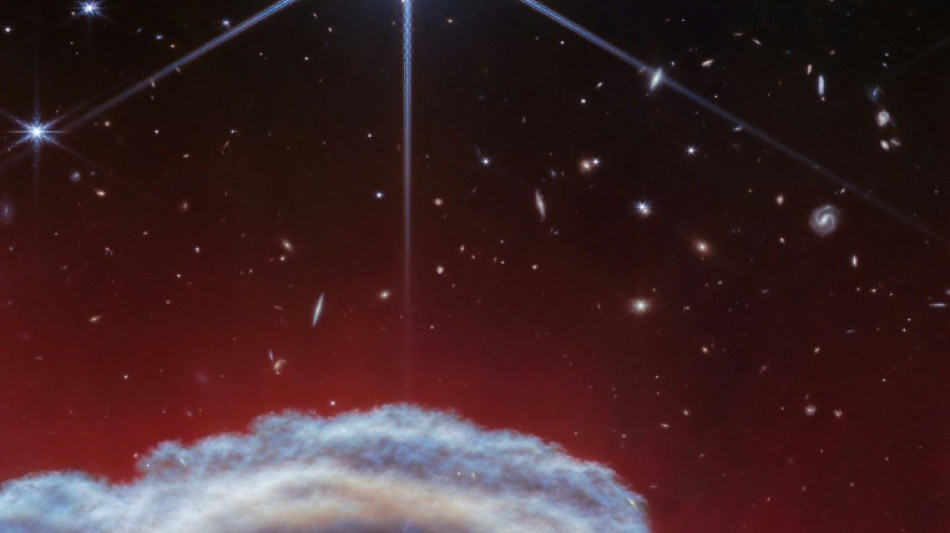
Webb telescope takes stunning images of Horsehead Nebula's 'mane' / Photo: - - ESA, NASA, CSA, STScI/AFP

 China's Yin wins in Shanghai for back-to-back LPGA titles

 After a year in turmoil, the Louvre faces uncertain future

 Dozens of orangutans saved from Indonesia blazes
 Ordinary day, extraordinary times: Kyiv under Russian attack
 What is holding up the US-India trade deal?

 Oxygen tanks, purifier sales spike as haze crisis hits Southeast Asia
 Messi brace lifts Inter Miami to 3-1 win in Atlanta
 Japan to launch historic round-trip mission to Mars moon
 Musk back in the spotlight, but politics dims the awe

 England Rugby League World Cup hopes hang by a thread

 Williams lifts Valkyries past Dream in WNBA Finals opener

 Dubois destroys Wardley to retain WBO heavyweight crown

 Oregon families grapple with explaining school shooting to children
 Israeli settlers attack European diplomats, beat French mayor

 Town hall in Limoges 'largely lost' to blaze set during French protests

 US goes on the offensive in central Asia

 Emotional Lions come up short in Champions Cup as tributes paid to Andrews

 Diaz dazzles as Bayern batter Leipzig to go top

 Inter move clear at Serie A summit with Bologna win

 Liverpool still have 'lots to improve', says match-winner Isak

 Looters ransack shops during France cost-of-living protests

 Leinster thump Clermont as grieving Lions set for Champions Cup debut
 Haaland stars in Man City win, Liverpool beat Brentford
 Dortmund go top despite Union Berlin stalemate
 Venezia upset Napoli for first Serie A win of season
NASA's James Webb telescope has captured the most detailed infrared images ever taken of the Horsehead Nebula, one of the most majestic and recognizable objects in the night sky, the space agency said Monday.
The new observations show the top of the "horse's mane," revealing for the first time the small scale structures on the edge of the giant cloud of dust and gas.
Located roughly 1,300 light years away in the constellation Orion ("The Hunter"), the iconic silhouette of a horse's head and neck rises from what look like churning waves of interstellar foam.
Webb, the most powerful space observatory ever built, is able to detect infrared light at unprecedented resolutions, revealing objects that cannot be seen using the visible spectrum in optical telescopes.
"An international team of astronomers has revealed for the first time the small-scale structures of the illuminated edge of the Horsehead," a NASA statement said.
As ultraviolet light evaporates the dust cloud, particles are swept away by the outflow of heated gas -- a process Webb has now shown in action.
The observations have also given astronomers new insights into how dust blocks and emits light, and a better idea of the nebula's multidimensional shape.
The work was the result of an study led by Karl Misselt of the University of Arizona, and published Monday in Astronomy & Astrophysics.
The Horsehead Nebula has fascinated space enthusiasts since its discovery in 1888 by the renowned Scottish astronomer Williamina Fleming.
While it appears shadowy in optical light, the nebula comes to life when viewed through infrared wavelengths, taking on transparent and ethereal hues.
This delicate pillar of hydrogen gas infused with dust is being steadily worn away by the radiation of a nearby star. Astronomers estimate the Horsehead will disappear in another five million years.
F.Ramirez--AT