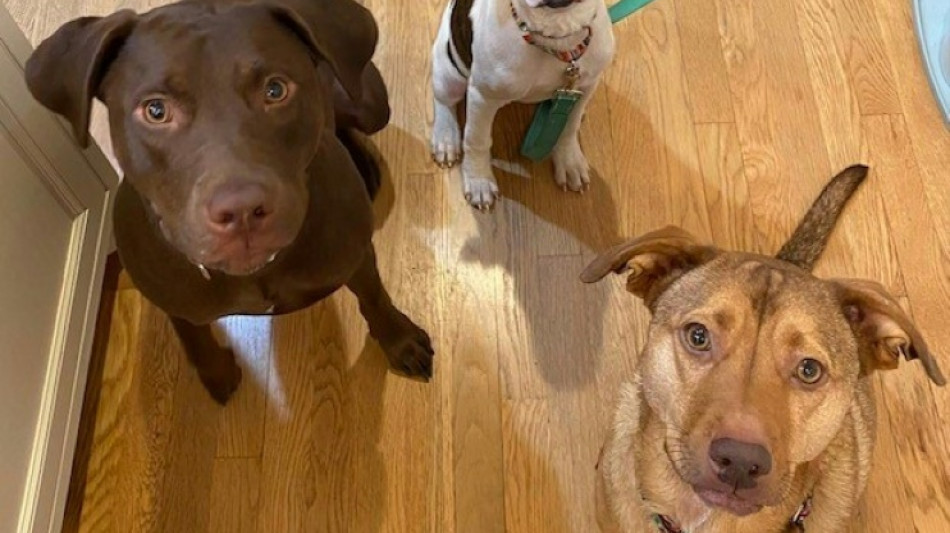
In US, every dog has its... DNA test / Photo: Handout - AFP

 American Nobel laureate in medicine hopes to illuminate the brain

 Trump approves firing squad for convicted US military base shooter

 Grappling with 'homework scams,' US universities shun AI detectors

 Separatists win Quebec election in test for Canada PM

 Leaders visit Pacific atoll at frontline of climate change

 Yemen's Houthis claim striking Riyadh airport, other Saudi sites

 Best-selling British author Jeffrey Archer dies aged 86

 Military plane crash kills 32 in Nigeria

 Olise powers France to win over Belgium in Nations League

 High-flying Blazy turns to birdlife at Chanel

 Riyadh's allies pledge troops as Yemen, Saudi Arabia attack Houthis

 Clashes erupt outside Kosovo parliament over war crimes court

 Milan's Saelemaekers suffers ankle setback, faces lengthy spell out

 Rubio arrives in Iceland to push for greater US presence in Arctic

 Putin allows Italy's UniCredit to sell part of Russian business

 Djokovic into China Open final as Medvedev out for hitting fan with ball

 ICC unseals arrest warrants for Taliban education ministers

 Modric hopes fans back Croatia against Spain after England shame

 Bolsonaro rides right-wing surge into Brazil's election runoff

 Turkey blocks X account of British reporter

 Ukraine says using AI robot guns to shoot down new Russian drones

 At Oct 7 memorial, Netanyahu says will be no Hamas rule in Gaza

 Ukraine blames Russia for deadly sinking of Turkish ship in Black Sea

 UN rights council slams Taliban's 'oppression' of women

 Norway eyes partial ban of smart glasses

The routine is now a familiar one: Open the kit, swirl a swab around, put it in solution and wait impatiently for the results. Except this time it's not a test for Covid -- it's a DNA test for dogs.
The kits, which are used foremost to learn a dog's breeds, first appeared some 15 years ago and their popularity has since exploded in the United States, where nearly 40 percent of all families have at least one canine companion.
"Having a dog and integrating them as a member of your family, you want to know where they're from," said Mila Bartos, a Washington lawyer.
One of the most popular test brands, Embark Vet, told AFP it experienced 235 percent growth between 2019 and 2020 alone. And the pandemic has only amplified the trend.
At around $100 to $200 a pop, the tests are not cheap. But in a country where dogs are king, the price hasn't been a major deterrent for many pet owners.
In 2020 alone, Americans spent nearly $104 billion on their animal companions, according to the American Pet Products Association -- a sum that is the equivalent of the GDP of Slovakia.
- 'You want to know' -
The tests are simple: a saliva sample is taken from inside a dog's jowl and sent by mail, with results coming back generally two weeks to a month later.
Sometimes, when a new pup parent has adopted a purebred dog, the test is meant to verify that there has been no error in the dog's one-breed lineage.
But for the owners of shelter pets, the burning question is -- what IS my dog?
Bartos, 51, adopted three dogs -- Natty, Maisie and Mabel -- and did a DNA test for each.
Natty, she discovered, is a mix of pit bull, beagle, chow-chow and German shepherd. Results showed she even had a cousin living nearby in Baltimore.
With a luxuriously glossy brown coat, Maisie meanwhile turned out to be a descendant of a long line of show dogs.
Levi Novey, a 42-year-old consultant in the state of Virginia, said that getting a test allowed him to make more sense of his tiny dog Summer's behavior.
"For instance, her athleticism, prey drive, interest in retrieving balls, and selective choice in people she wants to be cuddly and sweet with became easier to understand given her ancestry," he said of the little black pup, who weighs only 13 pounds (six kilograms).
When New Jersey native Ashley Ternyila decided the German shepherd she adopted from a breeder looked a little too much like a wolf, she got a DNA test.
"He had quite a few wolf-like properties so for the fun of it and to put rumors to bed, we got him tested," said Ternyila.
Allen McConnell, professor of psychology specializing in the relationship of humans and their pets, said "the owner's desire to understand, predict and anticipate their dog's actions makes wanting to know something about its breed useful in the owner's eyes."
Dog breeds carry stereotypes -- Labradors as are good with children, pit bulls are aggressive watch dogs -- which can often be inaccurate but also help guide understanding of the animal, he explained.
- Genetic marker -
In addition to revealing a dog's breeds, DNA tests can also uncover predisposition to genetic disease.
The most expensive tests allow users to review their pet's DNA in search of genes that cause heart abnormalities, kidney disorders and premature deafness, among other problems.
But beware, warns veterinarian Sarah Bowman of Washington: "Just because they have a genetic marker doesn't necessarily mean they also have the condition."
The tests make it possible to be cognizant of the risk and to exercise greater caution, she said.
The American Veterinary Medical Association said it encourages owners "to consult with their veterinarians before making any decisions based on their pets' test results."
Pet parents should also consider possible ramifications of finding out their dog's breed. In many countries, certain breeds are seen as aggressive, such as pit bulls or Staffordshire terriers, and are banned from apartment buildings.
If the adoptee is half pit bull "could be an issue" with a landlord, Bartos the lawyer warned.
"If you don't want to know that information, then you probably shouldn't run a breed DNA on it" Bartos said.
H.Romero--AT