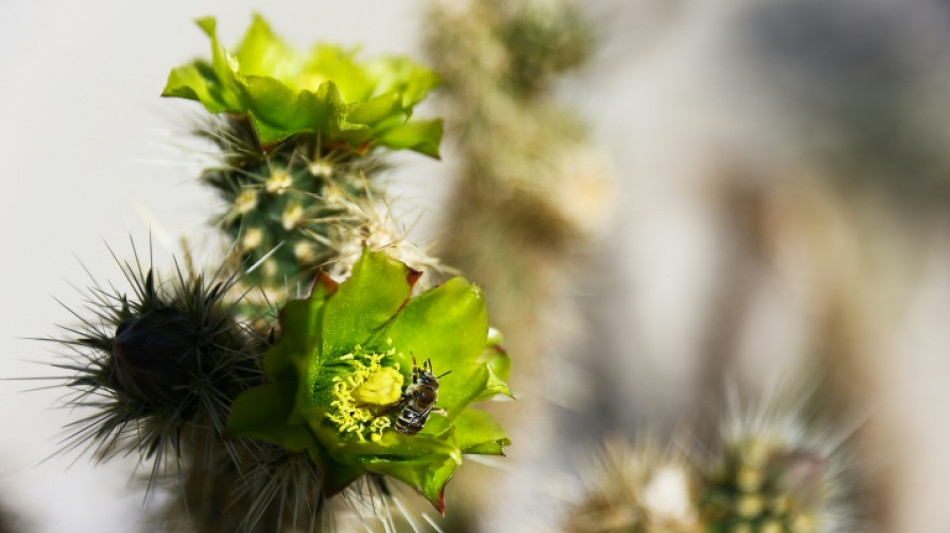
Global warming: even cacti can't take the heat / Photo: MARIO TAMA - GETTY IMAGES NORTH AMERICA/AFP/File

 American Nobel laureate in medicine hopes to illuminate the brain

 Trump approves firing squad for convicted US military base shooter

 Grappling with 'homework scams,' US universities shun AI detectors

 Separatists win Quebec election in test for Canada PM

 Leaders visit Pacific atoll at frontline of climate change

 Yemen's Houthis claim striking Riyadh airport, other Saudi sites

 Best-selling British author Jeffrey Archer dies aged 86

 Military plane crash kills 32 in Nigeria

 Olise powers France to win over Belgium in Nations League

 High-flying Blazy turns to birdlife at Chanel

 Riyadh's allies pledge troops as Yemen, Saudi Arabia attack Houthis

 Clashes erupt outside Kosovo parliament over war crimes court

 Milan's Saelemaekers suffers ankle setback, faces lengthy spell out

 Rubio arrives in Iceland to push for greater US presence in Arctic

 Putin allows Italy's UniCredit to sell part of Russian business

 Djokovic into China Open final as Medvedev out for hitting fan with ball

 ICC unseals arrest warrants for Taliban education ministers

 Modric hopes fans back Croatia against Spain after England shame

 Bolsonaro rides right-wing surge into Brazil's election runoff

 Turkey blocks X account of British reporter

 Ukraine says using AI robot guns to shoot down new Russian drones

 At Oct 7 memorial, Netanyahu says will be no Hamas rule in Gaza

 Ukraine blames Russia for deadly sinking of Turkish ship in Black Sea

 UN rights council slams Taliban's 'oppression' of women

 Norway eyes partial ban of smart glasses

Sixty percent of cactus species will wind up in less hospitable climates over the coming decades as global warming sets in, according to new research challenging the long-held assumption the iconic desert plants will thrive with more heat.
By 2070, up to 90 percent could be threatened with extinction due to climate change, habitat loss and other stressors, triple the current percentage, scientists reported in Nature Plants.
Some 1,500 species of cacti spread across the Americas live in varying climes, ranging from sea-level deserts to the high Andes mountains, from bone-dry ecosystems to humid tropical forests.
Biodiversity hotspots rich in species and numbers include central Mexico and the Brazilian Atlantic Forest.
To test the notion that cacti will benefit from a warmer and more drought-prone world, researchers led by Michiel Pillet from the University of Arizona examined data on more than 400 species and ran models projecting how they would fare at mid-century and beyond under different greenhouse gas emissions scenarios.
The findings "paint a more pessimistic future," according to the study, published Thursday.
Currently, the main threat to cacti is expanding agriculture, along with land degradation, biodiversity loss and harvesting for various uses.
Even without climate change, cacti "is one of the most endangered groups of organisms on the planet," with more than 30 percent classified as at risk of extinction, the authors note.
Under a moderate emissions scenario in line with current policies, global warming will soon be a significant threat as well.
"Our results suggest that climate change will become a primary driver of cactus extinction risk, with 60 to 90 percent of species assessed negatively impacted" by global warming, the researchers reported.
Within four or five decades, some 25 percent of cacti species could experience unfamiliar climates over a quarter of their current range.
Earlier studies have shown impaired photosynthesis -- the process by which plants use sunlight to make foods from CO2 and water -- with only two degrees Celsius of global warming.
Earth's average surface temperature, including oceans, is already 1.1C warmer than preindustrial times, and about 1.7C warmer over land only.
A.Anderson--AT