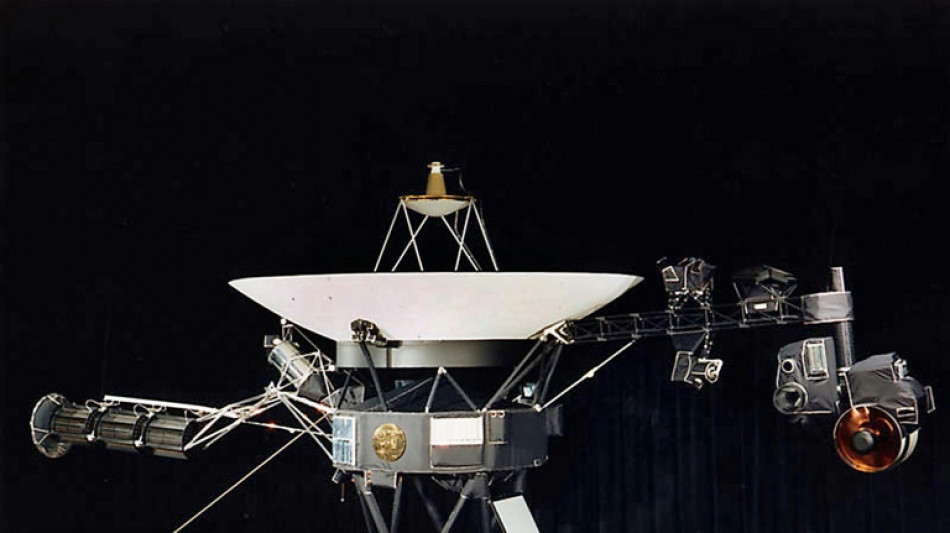
NASA's Voyager 1 phones home after months / Photo: NASA - NASA/AFP/File

 China's Yin wins in Shanghai for back-to-back LPGA titles

 After a year in turmoil, the Louvre faces uncertain future

 Dozens of orangutans saved from Indonesia blazes

 Ordinary day, extraordinary times: Kyiv under Russian attack

 What is holding up the US-India trade deal?

 Oxygen tanks, purifier sales spike as haze crisis hits Southeast Asia

 Messi brace lifts Inter Miami to 3-1 win in Atlanta

 Japan to launch historic round-trip mission to Mars moon

 Musk back in the spotlight, but politics dims the awe

 England Rugby League World Cup hopes hang by a thread

 Williams lifts Valkyries past Dream in WNBA Finals opener

 Dubois destroys Wardley to retain WBO heavyweight crown

 Oregon families grapple with explaining school shooting to children
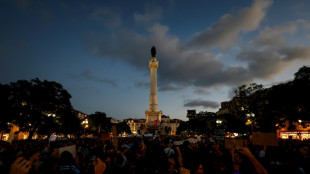
 Israeli settlers attack European diplomats, beat French mayor

 Town hall in Limoges 'largely lost' to blaze set during French protests

 US goes on the offensive in central Asia

 Emotional Lions come up short in Champions Cup as tributes paid to Andrews

 Diaz dazzles as Bayern batter Leipzig to go top

 Inter move clear at Serie A summit with Bologna win

 Liverpool still have 'lots to improve', says match-winner Isak

 Looters ransack shops during France cost-of-living protests

 Leinster thump Clermont as grieving Lions set for Champions Cup debut

 Haaland stars in Man City win, Liverpool beat Brentford

 Dortmund go top despite Union Berlin stalemate
 Venezia upset Napoli for first Serie A win of season

NASA's Voyager 1 probe -- the most distant man-made object in the universe -- is returning usable information to ground control following months of spouting gibberish, the US space agency announced Monday.
The spaceship stopped sending readable data back to Earth on November 14, 2023, even though controllers could tell it was still receiving their commands.
In March, teams working at NASA's Jet Propulsion Laboratory discovered that a single malfunctioning chip was to blame, and devised a clever coding fix that worked within the tight memory constraints of its 46-year-old computer system.
"Voyager 1 spacecraft is returning usable data about the health and status of its onboard engineering systems," the agency said.
"The next step is to enable the spacecraft to begin returning science data again."
Launched in 1977, Voyager 1 was mankind's first spacecraft to enter the interstellar medium, in 2012, and is currently more than 15 billion miles from Earth. Messages sent from Earth take about 22.5 hours to reach the spacecraft.
Its twin, Voyager 2, also left the solar system in 2018.
Both Voyager spacecraft carry "Golden Records" -- 12-inch, gold-plated copper disks intended to convey the story of our world to extraterrestrials.
These include a map of our solar system, a piece of uranium that serves as a radioactive clock allowing recipients to date the spaceship's launch, and symbolic instructions that convey how to play the record.
The contents of the record, selected for NASA by a committee chaired by legendary astronomer Carl Sagan, include encoded images of life on Earth, as well as music and sounds that can be played using an included stylus.
Their power banks are expected to be depleted sometime after 2025. They will then continue to wander the Milky Way, potentially for eternity, in silence.
W.Stewart--AT