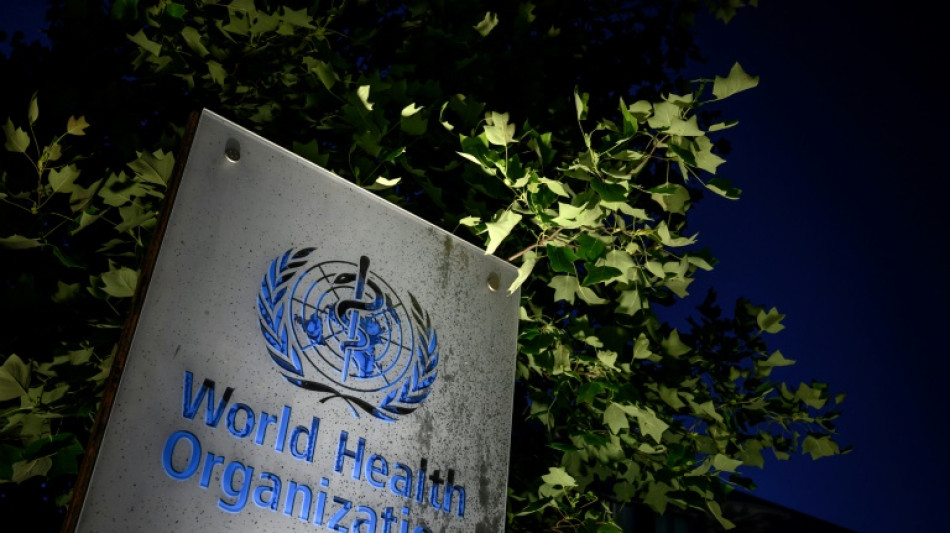
WHO clarifies terminology for air-transmitted pathogens / Photo: Fabrice COFFRINI - AFP

 China's Yin wins in Shanghai for back-to-back LPGA titles

 After a year in turmoil, the Louvre faces uncertain future

 Dozens of orangutans saved from Indonesia blazes

 Ordinary day, extraordinary times: Kyiv under Russian attack

 What is holding up the US-India trade deal?

 Oxygen tanks, purifier sales spike as haze crisis hits Southeast Asia

 Messi brace lifts Inter Miami to 3-1 win in Atlanta

 Japan to launch historic round-trip mission to Mars moon

 Musk back in the spotlight, but politics dims the awe

 England Rugby League World Cup hopes hang by a thread

 Williams lifts Valkyries past Dream in WNBA Finals opener

 Dubois destroys Wardley to retain WBO heavyweight crown

 Oregon families grapple with explaining school shooting to children

 Israeli settlers attack European diplomats, beat French mayor

 Town hall in Limoges 'largely lost' to blaze set during French protests

 US goes on the offensive in central Asia

 Emotional Lions come up short in Champions Cup as tributes paid to Andrews

 Diaz dazzles as Bayern batter Leipzig to go top

 Inter move clear at Serie A summit with Bologna win

 Liverpool still have 'lots to improve', says match-winner Isak

 Looters ransack shops during France cost-of-living protests

 Leinster thump Clermont as grieving Lions set for Champions Cup debut

 Haaland stars in Man City win, Liverpool beat Brentford

 Dortmund go top despite Union Berlin stalemate

 Venezia upset Napoli for first Serie A win of season
The World Health Organization on Thursday announced a new, catch-all terminology for pathogens that transmit through the air, erasing a distinction that caused dangerous confusion during the Covid pandemic.
During the Covid-19 crisis the standoff between experts arguing over whether the SARS-CoV-2 virus spread through droplets or through an aerosol mist proved a crucial public health challenge.
In the initial months of the pandemic in early 2020, the WHO and other experts said the virus was spreading via droplets, emitted through coughs and sneezes.
It was understood that such droplets did not linger in the air but sank to cover surfaces that others might touch. That meant the main advice to ward off infection was frequent and thorough handwashing.
It took a while before most experts acknowledged that the virus was spreading more easily through the air, which required other precautions.
But as experts argued over whether or not Covid was airborne, it became apparent that there was a lack of a common understanding and terminology across scientific disciplines to describe the transmission of pathogens through the air.
"Varying terminologies highlighted gaps in common understanding and contributed to challenges in public communication and efforts to curb the transmission of the pathogen," the WHO said in a statement.
- 'Infectious respiratory particles' -
The WHO said that after more than two years of consultations, it had been agreed that all pathogen particles transmitted through the air, regardless of size, should be referred to as "infectious respiratory particles", or IRPs.
The new terminology will apply not just to the Covid virus, but to other respiratory infections such as tuberculosis, influenza and measles.
Broad agreement on the new terminology across the scientific community should improve understanding and make collaboration easier across disciplines, WHO chief scientist Jeremy Farrar told reporters in Geneva.
"It is difficult to make scientific progress unless we all agree with the terminology," he said.
The new terminology should simplify "the categorisation, so that we no longer have what I think were, to some degree, false dichotomies", he added.
Rather than distinguishing between two modes of transmission based on the size of the particles being transmitted, it is important to recognise there are many other factors driving transmission, he said. These factors included air humidity, temperature and airflow.
Agreeing on a single term was like reaching "base camp", Farrar said. From there, there was still a long climb to agreeing the best measures to take to avoid infection in hospitals, schools and transport systems.
The WHO said it did however maintain the distinction between two types of through-the-air transmission.
The first was airborne transmission or inhalation, when IRPs are expelled into the air and inhaled by another person.
The second was direct deposition, when IRPs are expelled into the air from an infectious person and then directly deposited on the exposed mouth, nose or eyes of another person nearby.
B.Torres--AT