Polish researchers invent anti-smog sound cannon

 American Nobel laureate in medicine hopes to illuminate the brain

 Trump approves firing squad for convicted US military base shooter

 Grappling with 'homework scams,' US universities shun AI detectors

 Separatists win Quebec election in test for Canada PM

 Leaders visit Pacific atoll at frontline of climate change

 Yemen's Houthis claim striking Riyadh airport, other Saudi sites

 Best-selling British author Jeffrey Archer dies aged 86

 Military plane crash kills 32 in Nigeria

 Olise powers France to win over Belgium in Nations League

 High-flying Blazy turns to birdlife at Chanel

 Riyadh's allies pledge troops as Yemen, Saudi Arabia attack Houthis

 Clashes erupt outside Kosovo parliament over war crimes court

 Milan's Saelemaekers suffers ankle setback, faces lengthy spell out

 Rubio arrives in Iceland to push for greater US presence in Arctic

 Putin allows Italy's UniCredit to sell part of Russian business

 Djokovic into China Open final as Medvedev out for hitting fan with ball

 ICC unseals arrest warrants for Taliban education ministers

 Modric hopes fans back Croatia against Spain after England shame

 Bolsonaro rides right-wing surge into Brazil's election runoff

 Turkey blocks X account of British reporter

 Ukraine says using AI robot guns to shoot down new Russian drones

 At Oct 7 memorial, Netanyahu says will be no Hamas rule in Gaza

 Ukraine blames Russia for deadly sinking of Turkish ship in Black Sea

 UN rights council slams Taliban's 'oppression' of women

 Norway eyes partial ban of smart glasses

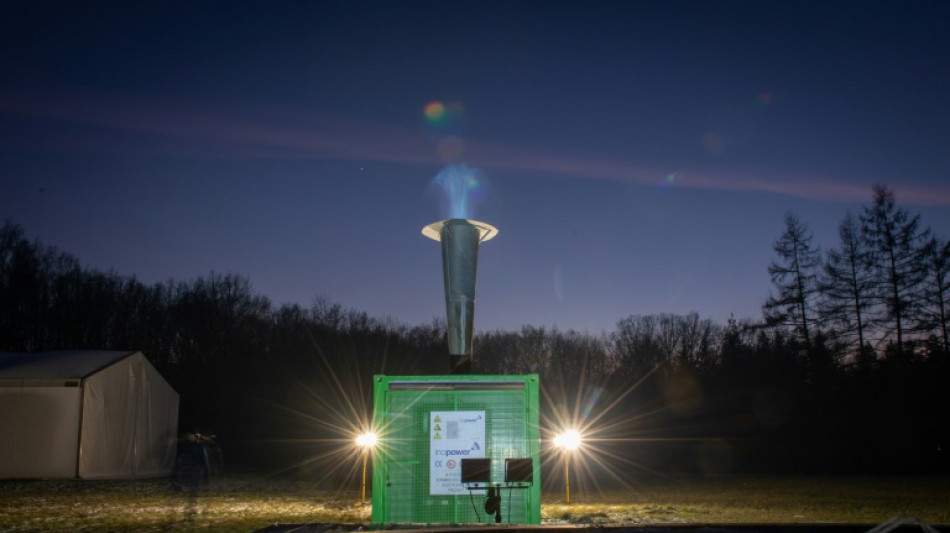
In a battle against Poland's constant smog, scientists are testing out a new "cannon" that uses soundwaves to push toxic particles higher into the atmosphere to allow residents to breathe.
Installed on top of a metal container, the experimental device consists of a large upside-down cone that makes a loud sound every six seconds.
The aim is to chase the smog from Kalwaria Zebrzydowska, which like many Polish towns and cities faces the problem every winter when residents fire up highly polluting heating systems.
When the sun goes down, a heavy smog descends on the town as chimneys belch out thick smoke.
Poland is one of the most polluted countries in Europe, breaching EU norms by hundreds of percentage points at the worst times of year.
By creating soundwaves, researchers say that the "cannon" helps reduce the concentration of harmful PM2.5 and PM10 particles in the town's air.
"We are using a vertical shockwave that is created by the combustion of acetylene and air," said Dominik Grybos from the Academy of Mining and Metallurgy in Krakow, one of the inventors.
"The wave projects the polluted air higher," he told AFP.
The toxic particles are sent up several hundred metres (yards) higher, making them harmless for residents.
"We have found that if we use the cannon for between half an hour and an hour, the pollution is reduced by 15-30 percent within a perimeter of two-three kilometres (1.2-1.9 miles) from the cannon," Grybos said, adding that the effects last for "between one and three hours".
Researchers are trying to work out the required frequency of the blasts, as well as the duration and the time needed for the entire procedure.
The price is estimated at 1,000-1,500 zloty ($250-$375) for one hour of use.
Grybos said he hopes the invention could find a commercial use, particularly in Poland.
Residents of Kalwaria Zebrzydowska are broadly in favour of the idea despite the sound.
"The smog is very heavy here. We can't air our flats because it stinks so much. So, if it can help, let them do the tests," said Jolanta Walkowicz, a 43-year-old accountant.
"We can barely hear the sound -- it's like fireworks going off," she added.
N.Walker--AT