S. Korea says second spy satellite placed in orbit / Photo: Handout - South Korean Defence Ministry/AFP

 China's Yin wins in Shanghai for back-to-back LPGA titles

 After a year in turmoil, the Louvre faces uncertain future

 Dozens of orangutans saved from Indonesia blazes

 Ordinary day, extraordinary times: Kyiv under Russian attack

 What is holding up the US-India trade deal?

 Oxygen tanks, purifier sales spike as haze crisis hits Southeast Asia

 Messi brace lifts Inter Miami to 3-1 win in Atlanta

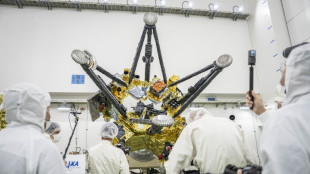 Japan to launch historic round-trip mission to Mars moon

 Musk back in the spotlight, but politics dims the awe

 England Rugby League World Cup hopes hang by a thread

 Williams lifts Valkyries past Dream in WNBA Finals opener

 Dubois destroys Wardley to retain WBO heavyweight crown

 Oregon families grapple with explaining school shooting to children

 Israeli settlers attack European diplomats, beat French mayor

 Town hall in Limoges 'largely lost' to blaze set during French protests

 US goes on the offensive in central Asia

 Emotional Lions come up short in Champions Cup as tributes paid to Andrews

 Diaz dazzles as Bayern batter Leipzig to go top

 Inter move clear at Serie A summit with Bologna win

 Liverpool still have 'lots to improve', says match-winner Isak

 Looters ransack shops during France cost-of-living protests

 Leinster thump Clermont as grieving Lions set for Champions Cup debut

 Haaland stars in Man City win, Liverpool beat Brentford

 Dortmund go top despite Union Berlin stalemate

 Venezia upset Napoli for first Serie A win of season

South Korea put its second domestically made spy satellite into orbit, Seoul's defence ministry said Monday, after it launched from an American space centre on a SpaceX Falcon 9 rocket.
The satellite successfully communicated with an overseas ground station shortly afterwards, the ministry said.
"Our military's second reconnaissance satellite successfully separated from the launch vehicle at around 09:02 (1202 GMT) and entered the target orbit," the defence ministry said in a statement.
The satellite "successfully established contact with an overseas ground station at approximately 10:57 (0157 GMT)", it added.
Seoul's military said its "independent intelligence, surveillance and reconnaissance capabilities have been further strengthened," by the successful launch.
"We will proceed with future satellite launches without a hitch," it added.
Seoul launched its first military spy satellite in December, which was also carried by one of Elon Musk's SpaceX Falcon 9 rockets.
The latest developments intensify a space race on the Korean peninsula after North Korea launched its first military eye in the sky last November.
Seoul's defence minister said the military was closely monitoring the North for further satellite launches, which it had originally expected in March.
"It seems they are taking additional supplementary measures," Defence Minister Shin Won-sik said after the launch, adding that an April launch by Pyongyang seemed likely.
"If these measures proceed without issue, a mid-April launch is highly possible. April 15 holds special significance for North Korea, so they might attempt a launch then," he said.
April 15 is the birthday of the North's founding leader Kim Il Sung, and is celebrated as Day of the Sun in the country, typically marked with military parades or other mass events.
"It's also reasonable to extend the window to late April to ensure all supplementary measures are fully implemented," Shin said.
- Five more -
South Korea's first satellite has transmitted high-resolution images of central Pyongyang to Seoul and is expected to commence its full mission stages as early as June, according to Yonhap news agency.
Seoul plans to launch a total of five military spy satellites by 2025 to better monitor the North.
Once all five enter orbit and commence their missions, the South Korean military will have the capability to monitor key facilities in North Korea using imagery sent around every two hours, according to a report by Seoul's government-run broadcaster KTV.
North Korea has claimed its spy satellite has sent images of a US naval base at Hawaii's Pearl Harbor and "major target" sites across South Korea.
The North's launch of the "Malligyong-1" was Pyongyang's third attempt at putting such a satellite into orbit, after two failures in May and August last year.
Seoul has said the North received technical help from Russia for the launch in return for weapons for use in the war in Ukraine.
Experts have said putting a working reconnaissance satellite into orbit would improve North Korea's intelligence-gathering capabilities, particularly over South Korea, and provide crucial data in any military conflict.
Pyongyang this year has declared South Korea its "principal enemy", jettisoned agencies dedicated to reunification and outreach, and threatened war over "even 0.001 mm" of territorial infringement.
W.Nelson--AT