Milei reignites debate on Argentine dictatorship, military / Photo: Luis ROBAYO - AFP/File

 China's Yin wins in Shanghai for back-to-back LPGA titles

 After a year in turmoil, the Louvre faces uncertain future
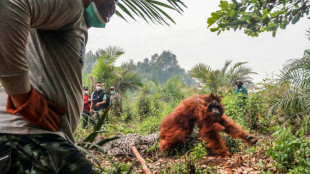 Dozens of orangutans saved from Indonesia blazes

 Ordinary day, extraordinary times: Kyiv under Russian attack
 What is holding up the US-India trade deal?

 Oxygen tanks, purifier sales spike as haze crisis hits Southeast Asia
 Messi brace lifts Inter Miami to 3-1 win in Atlanta

 Japan to launch historic round-trip mission to Mars moon
 Musk back in the spotlight, but politics dims the awe

 England Rugby League World Cup hopes hang by a thread

 Williams lifts Valkyries past Dream in WNBA Finals opener

 Dubois destroys Wardley to retain WBO heavyweight crown
 Oregon families grapple with explaining school shooting to children
 Israeli settlers attack European diplomats, beat French mayor
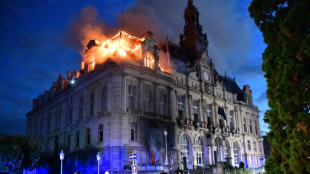 Town hall in Limoges 'largely lost' to blaze set during French protests
 US goes on the offensive in central Asia
 Emotional Lions come up short in Champions Cup as tributes paid to Andrews

 Diaz dazzles as Bayern batter Leipzig to go top
 Inter move clear at Serie A summit with Bologna win

 Liverpool still have 'lots to improve', says match-winner Isak
 Looters ransack shops during France cost-of-living protests

 Leinster thump Clermont as grieving Lions set for Champions Cup debut

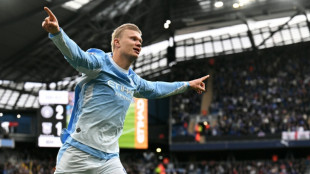 Haaland stars in Man City win, Liverpool beat Brentford

 Dortmund go top despite Union Berlin stalemate
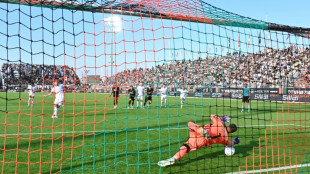 Venezia upset Napoli for first Serie A win of season
President Javier Milei's government has rekindled debate over Argentina's military dictatorship by questioning the number of its victims, while also seeking a greater role for the armed forces in tackling ongoing security issues.
This week, at an event with veterans of the Falklands War that Argentina lost to the United Kingdom in 1982, Milei lashed out at what he said was a policy under previous governments of "harassing and humiliating" the military.
"That time is over," he said. "They will have the respect that has been long denied to them."
But Milei, a political outsider who won the presidency in November, is also facing pushback -- both on the streets and from some of his own conservative allies, including his vice president.
His comments at the Falklands event came after his government recently released a short documentary questioning the number of the 30,000 victims that rights groups estimate disappeared under the 1976-83 military junta, which employed brutal tactics to crack down on leftist dissent.
And, last month, Milei announced he was planning a legal reform that would allow the armed forces to intervene in domestic security operations.
The measure is aimed at fighting what the government dubs "narcoterrorism" in Rosario, a city mired in drug violence 300 kilometers (186 miles) northwest of the capital.
"The country has to be able to leave its wounds behind and move towards the future. The armed forces today are an integral part of our democracy," said Security Minister Patricia Bullrich.
- 'Drug traffickers in flip-flops' -
The effort to give greater powers to the army has hit a sensitive nerve, and is rejected by large sectors of society across the political spectrum.
Vice President Victoria Villarruel, who comes from a military family and has close ties to the armed forces, has spoken against Milei's plan, saying: "The role of the armed forces is not to fight civilians."
Villarruel's criticism comes even as she has also questioned the number of missing and backs the "two demons theory" which justifies the violence meted out by the military regime as having been necessary to combat leftist guerilla groups.
Critics argue that this theory minimizes state violence from the junta era, such as torture, disappearances, extrajudicial killings and the theft of babies from pregnant prisoners.
Since 1991, the army in Argentina has only been allowed to provide equipment and technical support to the police, without intervening directly in domestic affairs.
"We have to ask ourselves if the level of drug violence in Rosario warrants the use of the armed forces. Here we are talking about drug traffickers in flip-flops," said Jorge Luis Vidal, a specialist in public security management and the fight against drug trafficking.
- 'The full story' -
Efforts to change the role of the armed forces coincide with a review of their actions during the dictatorship and its victims.
Milei argues that 8,753 people went missing under military rule, far less than the 30,000 estimated as disappeared by rights groups and parties across the political spectrum.
The president's figure is closer to the 8,961 recorded in the report by the National Commission on the Disappearance of Persons (Conadep), published in 1984 and described as "an open list."
Marcela Perelman, a researcher at the Center for Legal and Social Studies, told AFP "this is not a new discussion, it has happened in other political eras."
She said the debate was not about uncovering the truth, but "accusing the victims of a lack of information that in any case is the state's responsibility."
In the video released by the government on March 24, the 48th anniversary of the coup, the government called for "the full story" of the dictatorship to be told.
That same day tens of thousands of people protested across the country, holding up signs reading "They are 30,000," in one of the biggest demonstrations marking the anniversary in years.
H.Gonzales--AT