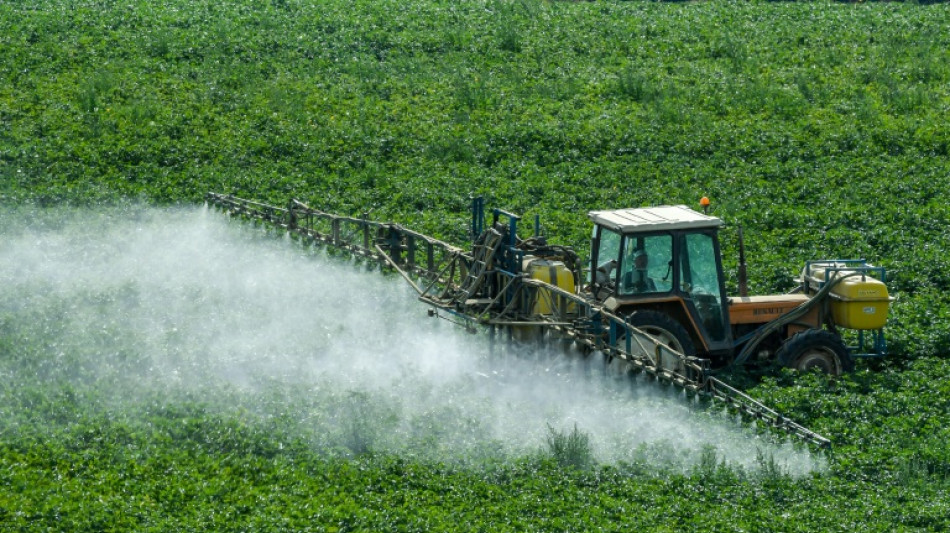
New research shows unintended harms of organic farming / Photo: Philippe HUGUEN - AFP/File

 China's Yin wins in Shanghai for back-to-back LPGA titles
 After a year in turmoil, the Louvre faces uncertain future

 Dozens of orangutans saved from Indonesia blazes

 Ordinary day, extraordinary times: Kyiv under Russian attack

 What is holding up the US-India trade deal?

 Oxygen tanks, purifier sales spike as haze crisis hits Southeast Asia

 Messi brace lifts Inter Miami to 3-1 win in Atlanta

 Japan to launch historic round-trip mission to Mars moon

 Musk back in the spotlight, but politics dims the awe

 England Rugby League World Cup hopes hang by a thread

 Williams lifts Valkyries past Dream in WNBA Finals opener

 Dubois destroys Wardley to retain WBO heavyweight crown

 Oregon families grapple with explaining school shooting to children

 Israeli settlers attack European diplomats, beat French mayor

 Town hall in Limoges 'largely lost' to blaze set during French protests

 US goes on the offensive in central Asia

 Emotional Lions come up short in Champions Cup as tributes paid to Andrews

 Diaz dazzles as Bayern batter Leipzig to go top

 Inter move clear at Serie A summit with Bologna win

 Liverpool still have 'lots to improve', says match-winner Isak

 Looters ransack shops during France cost-of-living protests

 Leinster thump Clermont as grieving Lions set for Champions Cup debut

 Haaland stars in Man City win, Liverpool beat Brentford

 Dortmund go top despite Union Berlin stalemate

 Venezia upset Napoli for first Serie A win of season

Organic farming is often touted as a more sustainable solution for food production, leveraging natural forms of pest control to promote eco-friendly cultivation.
But a new study published in Science on Thursday finds that expanding organic cropland can lead to increased pesticide use in surrounding non-organic fields, offsetting some environmental benefits.
These harmful "spillover effects" can be mitigated if organic farms are clustered together and geographically separated from conventional farms, the researchers found.
"Despite policy pushes to increase the amount of organic agriculture, there remain key knowledge gaps regarding how organic agriculture impacts the environment," said lead author Ashley Larsen, of the University of California, Santa Barbara.
Although organic agricultural practices generally improve environmental conditions such as soil and water quality, the trade-offs aren't very well understood.
For example, organic fields could harbor more beneficial species that prey on insects, such birds, spiders and predatory beetles and fewer pests. Or, the lack of chemical pesticides and genetically modified seeds could mean they harbor more pests.
To find out, Larsen and colleagues analyzed data on some 14,000 fields in Kern County, California, across seven years.
Kern County produces high-value crops including grapes, watermelons, citrus, tomatoes, potatoes and much more, making it one of the most valuable crop producing regions in the United States.
The team paired digitized maps of fields and the crops grown on them with records of pesticide applications and whether a field had an organic certification.
"Surrounding organic agriculture leads to an increase in pesticide use on conventional fields, but also leads to a larger decrease on nearby organic fields," said Larsen, with the effect manifesting primarily in insecticides, which specifically target insects.
The level of pesticides in conventional fields decreased the further away they were from organic fields.
But the situation could be completely remedied if organic fields were grouped together, the researchers found, based on a less-detailed national level analysis they also carried out.
"Spatially clustering organic fields and spatially separating organic and conventional fields could reduce the environmental footprint of both organic and conventional cropland," the team concluded.
Writing in a related commentary, Erik Lichtenberg of the University of Maryland said that the authors had shown farmers' decisions about pesticide are influenced by the presence of nearby organic fields -- but it's not fully clear why.
The value of the crops, their susceptibility to pests, and farmers' personal risk tolerances likely all play roles.
"Which mobile pests are involved, where they originate in the landscape, or how and why they move across the landscape are poorly understood," said Lichtenberg, calling for more research in this area.
E.Rodriguez--AT