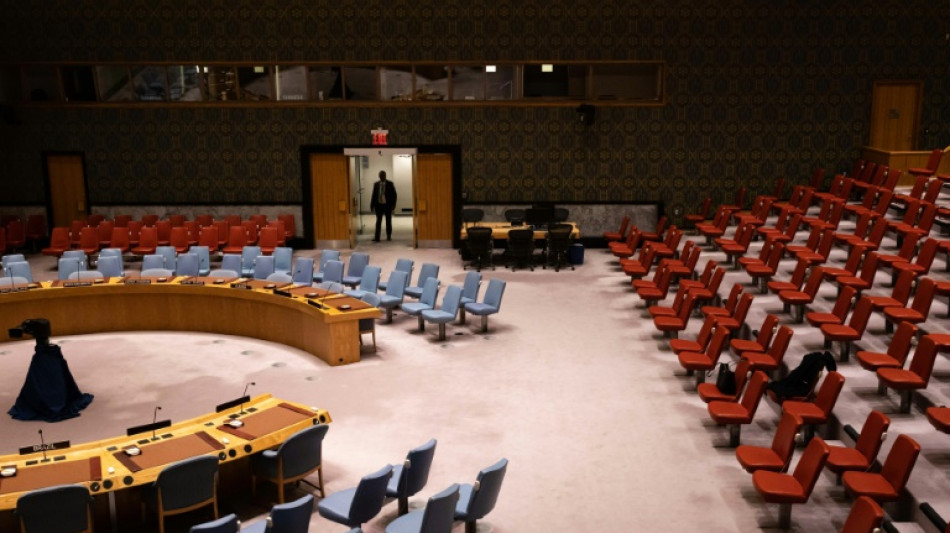
UN General Assembly calls for guidelines on AI's risks, rewards / Photo: Yuki IWAMURA - AFP/File

 China's Yin wins in Shanghai for back-to-back LPGA titles

 After a year in turmoil, the Louvre faces uncertain future
 Dozens of orangutans saved from Indonesia blazes

 Ordinary day, extraordinary times: Kyiv under Russian attack

 What is holding up the US-India trade deal?

 Oxygen tanks, purifier sales spike as haze crisis hits Southeast Asia

 Messi brace lifts Inter Miami to 3-1 win in Atlanta

 Japan to launch historic round-trip mission to Mars moon

 Musk back in the spotlight, but politics dims the awe

 England Rugby League World Cup hopes hang by a thread

 Williams lifts Valkyries past Dream in WNBA Finals opener

 Dubois destroys Wardley to retain WBO heavyweight crown

 Oregon families grapple with explaining school shooting to children

 Israeli settlers attack European diplomats, beat French mayor

 Town hall in Limoges 'largely lost' to blaze set during French protests
 US goes on the offensive in central Asia

 Emotional Lions come up short in Champions Cup as tributes paid to Andrews

 Diaz dazzles as Bayern batter Leipzig to go top

 Inter move clear at Serie A summit with Bologna win

 Liverpool still have 'lots to improve', says match-winner Isak

 Looters ransack shops during France cost-of-living protests

 Leinster thump Clermont as grieving Lions set for Champions Cup debut

 Haaland stars in Man City win, Liverpool beat Brentford

 Dortmund go top despite Union Berlin stalemate
 Venezia upset Napoli for first Serie A win of season

The UN General Assembly on Thursday called for the development of a set of international guidelines to address the risks and benefits of artificial intelligence.
The resolution, co-sponsored by dozens of countries and adopted by consensus, emphasizes the necessity of guidelines "to promote safe, secure and trustworthy artificial intelligence systems," while excluding military AI from its purview.
On the whole, the resolution, prepared by the United States, focuses more on the technology's positive potential, and calls for special care "to bridge the artificial intelligence and other digital divides between and within countries."
It also seeks "to promote, not hinder, digital transformation and equitable access" to AI in order to achieve the UN's Sustainable Development Goals, which aim to ensure a better future for humanity by 2030.
"As AI technologies rapidly develop, there is urgent need and unique opportunities for member states to meet this critical moment with collective action," US Ambassador to the UN Linda Thomas-Greenfield said earlier, reading a joint statement by the dozens of co-sponsor countries.
According to Richard Gowan, an analyst at the International Crisis Group, "the emphasis on development is a deliberate effort by the US to win goodwill among poorer nations."
"It is easier to talk about how AI can help developing countries progress rather than tackle security and safety topics head-on as a first initiative," he said.
- 'Male-dominated algorithms' -
The resolution does highlight the technology's threats when misused with the intent to cause harm, and also recognizes that without guarantees, AI risks eroding human rights, reinforcing prejudices and endangering personal data protection.
It therefore asks member states and stakeholders "to refrain from or cease the use of artificial intelligence systems that are impossible to operate in compliance with international human rights law or that pose undue risks to the enjoyment of human rights."
Warnings against the technology have become increasingly prevalent, particularly when it comes to generative AI tools and the risks they pose for democracy and society, particularly via fake images and speech shared in a bid to interfere in elections.
UN Secretary-General Antonio Guterres has made AI regulation a priority, calling for the creation of a UN entity modelled on other UN organizations such as the International Atomic Energy Agency (IAEA).
He has regularly highlighted the potential for disinformation and last week warned of bias in technologies designed mainly by men, which can result in algorithms that ignore the rights and needs of women.
"Male-dominated algorithms could literally program inequalities into activities from urban planning to credit ratings to medical imaging for years to come," he said.
Gowan of the International Crisis Group said he didn't "think the US wants Guterres leading this conversation, because it is so sensitive" and was therefore "stepping in to shape the debate."
A race is underway between various UN member states, the United States, China and South Korea, to be at the forefront of the issue.
In October, the White House unveiled a set of measures intended to ensure that the United States leads the way in AI regulation, with President Joe Biden insisting on the need to govern the technology.
Th.Gonzalez--AT