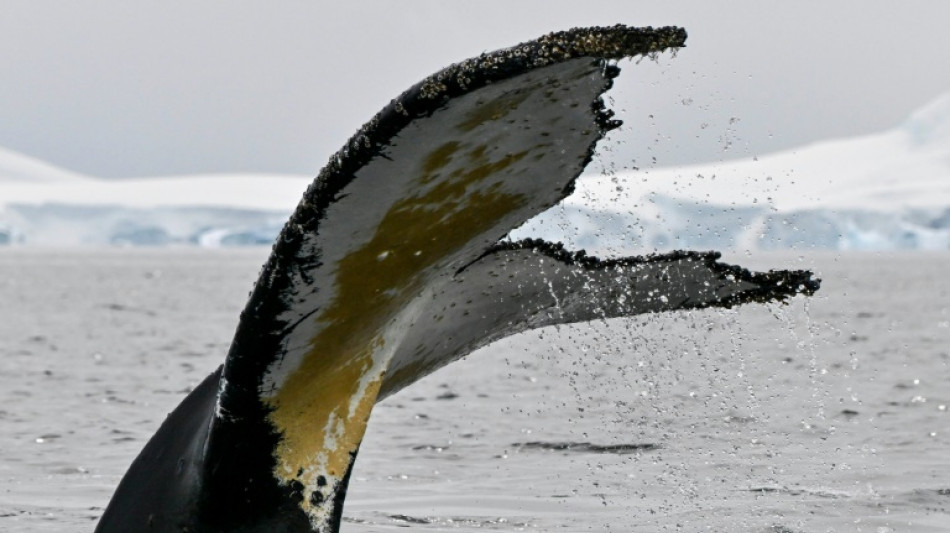
Whale of a tail: Scientists track unique humpback 'fingerprint' / Photo: Juan BARRETO - AFP

 China's Yin wins in Shanghai for back-to-back LPGA titles

 After a year in turmoil, the Louvre faces uncertain future

 Dozens of orangutans saved from Indonesia blazes

 Ordinary day, extraordinary times: Kyiv under Russian attack

 What is holding up the US-India trade deal?

 Oxygen tanks, purifier sales spike as haze crisis hits Southeast Asia

 Messi brace lifts Inter Miami to 3-1 win in Atlanta

 Japan to launch historic round-trip mission to Mars moon

 Musk back in the spotlight, but politics dims the awe

 England Rugby League World Cup hopes hang by a thread

 Williams lifts Valkyries past Dream in WNBA Finals opener

 Dubois destroys Wardley to retain WBO heavyweight crown

 Oregon families grapple with explaining school shooting to children

 Israeli settlers attack European diplomats, beat French mayor

 Town hall in Limoges 'largely lost' to blaze set during French protests

 US goes on the offensive in central Asia

 Emotional Lions come up short in Champions Cup as tributes paid to Andrews

 Diaz dazzles as Bayern batter Leipzig to go top

 Inter move clear at Serie A summit with Bologna win

 Liverpool still have 'lots to improve', says match-winner Isak

 Looters ransack shops during France cost-of-living protests

 Leinster thump Clermont as grieving Lions set for Champions Cup debut

 Haaland stars in Man City win, Liverpool beat Brentford

 Dortmund go top despite Union Berlin stalemate
 Venezia upset Napoli for first Serie A win of season

In Antarctica, a scientist waits patiently for two frolicking humpback whales to poke their tails out of the icy waters so she can take a photographic "fingerprint" of the unique colors and patterns that allow researchers to identify individuals of the species.
Andrea Bonilla, a Colombian scientist at Cornell University in the United States, has been working with a team of researchers since 2014 to catalog humpback whales from a visual analysis of their tails -- or flukes.
"What we are doing is tracking the history of each individual," Bonilla told AFP onboard the ARC Simon Bolivar during a scientific expedition by the Colombian navy.
Over the years, the team has identified 70 whales, and hopes to see some of them again to record any physical changes that could provide clues to their migratory patterns, population sizes, health and sexual maturity.
On the tail, "the coloration and patterns that each whale has is unique, it is like a fingerprint, so what we do is look at the different marks they have, the different scars" to identify an individual, said Bonilla.
Global populations of humpbacks have bounced back after once being decimated by commercial whaling, but the ocean giants remain under threat from vessel strikes, illegal fishing, pollution and underwater noise.
Today there are about 84,000 adult specimens in the world, according to the International Union for Conservation of Nature.
The importance of tail identification was highlighted in a study published last month in the Royal Society Open Science journal which showed the number of humpback whales in the North Pacific had plummeted 20 percent in less than a decade.
Tracking some 33,000 whales through photos of their flukes, scientists noted the steep decline which they speculate was due to starvation because of marine heat waves.
- 'Accumulating energy' -
Photo identification is common in the study of marine mammals, although the use of fluke identification is most used with humpbacks both because of their unique markings, and their habit of raising their tails out off the water while diving.
Different populations of humpback whales live across the world's oceans, carrying out mammoth migrations from warmer breeding spots to feeding grounds in polar waters.
"They take advantage of this great biomass of food that is here (in Antarctica) and for several months they are simply accumulating energy," said Bonilla.
Using photographs, the scientist draws reproductions of the details of the tails of the enormous marine mammals, which can reach up to 18 meters (59 feet) long and weigh about 40 tons.
On a computer, she zooms in on the details of the flukes, which can reveal attacks from other animals, "if there is some type of skin disease" or information about their diet.
The inventory allows scientists to track the movement of specific whales, which is crucial for conservation initiatives.
"If a whale always comes to the same area to reproduce, it is important to protect those areas. If they cease to exist or are disturbed, that whale will have nowhere to go," warned Bonilla.
O.Brown--AT