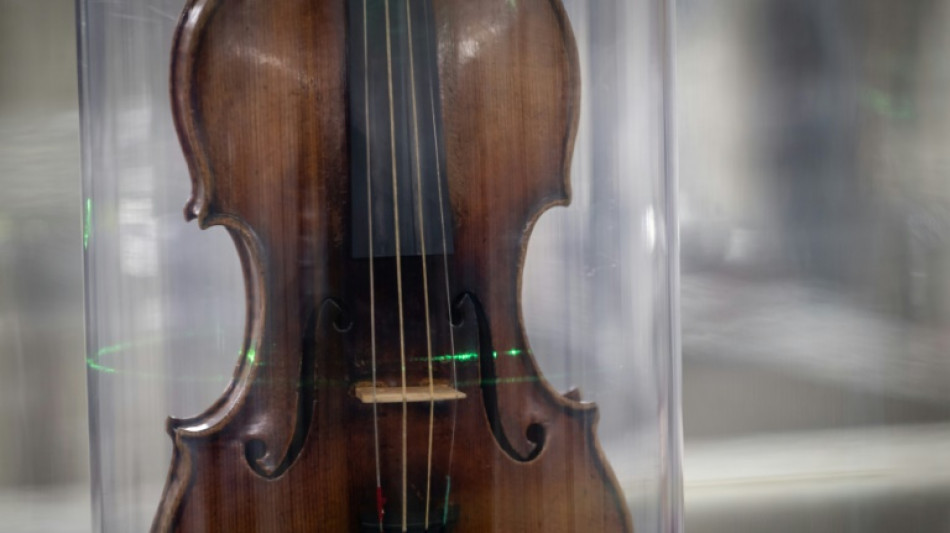
Paganini's violin gets X-ray treatment in quest of sound secrets / Photo: JEAN-PHILIPPE KSIAZEK - AFP

 China's Yin wins in Shanghai for back-to-back LPGA titles

 After a year in turmoil, the Louvre faces uncertain future

 Dozens of orangutans saved from Indonesia blazes

 Ordinary day, extraordinary times: Kyiv under Russian attack

 What is holding up the US-India trade deal?

 Oxygen tanks, purifier sales spike as haze crisis hits Southeast Asia

 Messi brace lifts Inter Miami to 3-1 win in Atlanta

 Japan to launch historic round-trip mission to Mars moon
 Musk back in the spotlight, but politics dims the awe

 England Rugby League World Cup hopes hang by a thread

 Williams lifts Valkyries past Dream in WNBA Finals opener

 Dubois destroys Wardley to retain WBO heavyweight crown

 Oregon families grapple with explaining school shooting to children

 Israeli settlers attack European diplomats, beat French mayor

 Town hall in Limoges 'largely lost' to blaze set during French protests

 US goes on the offensive in central Asia

 Emotional Lions come up short in Champions Cup as tributes paid to Andrews

 Diaz dazzles as Bayern batter Leipzig to go top

 Inter move clear at Serie A summit with Bologna win

 Liverpool still have 'lots to improve', says match-winner Isak

 Looters ransack shops during France cost-of-living protests

 Leinster thump Clermont as grieving Lions set for Champions Cup debut

 Haaland stars in Man City win, Liverpool beat Brentford

 Dortmund go top despite Union Berlin stalemate
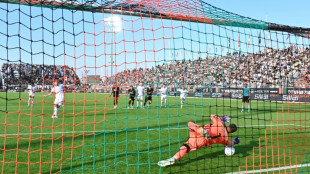 Venezia upset Napoli for first Serie A win of season

French experts fired X-rays at a 18th-century violin worth millions this weekend hoping to discover the secret of its magical sound, they said Monday.
The violin, dubbed "Il Cannone" (the cannon) because of its powerful sound, was Italian composer and violin virtuoso Niccolo Paganini's favourite.
The maestro from the Italian city of Genoa played it for decades before it became the property of his home city after his death in 1840.
The violin, made by instrument maker Giuseppe Bartolomeo Guarneri del Gesu in 1743, is now only brought out from time to time for the world's best to play, including the winners of Genoa's Premio Paganini international violin competition.
The European Synchrotron Radiation Facility (ESRF), a particle accelerator in the southeastern city of Grenoble, scanned the instrument down to the cellular structure of its wood.
The idea is to create a 3D model of the violin in and out of which people can zoom, down to a micron, or millionth of a metre.
"The first goal is conservation," said Paul Tafforeau of the ESRF.
"If ever any flaws need repairing, we will have all the details."
But they also hoped the "non-destructive analysis" would help shed light on why it plays so beautifully.
"It's an exceptional instrument in terms of its sound qualities," Tafforeau said.
"With this data, we hope to better understand why."
The detailed analysis of the X-rays will take several months.
"Working on this violin is like a dream," Tafforeau said.
Luigi Paolasini, who was in charge of the project at the ESRF, said the violin had been insured for a value of 30 million euros ($32 million) to travel from Genoa to Grenoble.
"The logistics were very complicated because we're not a museum that would have experience in moving works of art around," Paolasini said.
Whatever the outcome of the analysis, the guiding principle for any restoration work on the instrument is "to exercise extreme caution, or abstain altogether", said Alberto Giordano, a curator of precious instruments in Genoa.
"I get older, but the violin stays the same, and that's the way it should be," he said.
"Just like the picture of Dorian Gray, it stays fresh as a rose," Giordano added in reference to a novel by Oscar Wilde in which a painting of a man ages in his stead in an attic, allowing him to remain eternally young.
G.P.Martin--AT