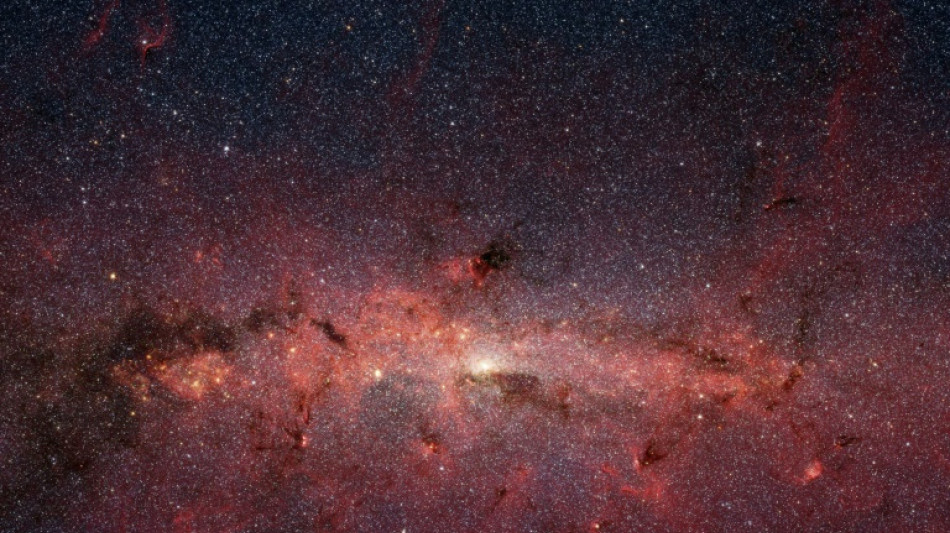
Object found in the Milky Way 'unlike anything astronomers have seen'

 American Nobel laureate in medicine hopes to illuminate the brain

 Trump approves firing squad for convicted US military base shooter

 Grappling with 'homework scams,' US universities shun AI detectors

 Separatists win Quebec election in test for Canada PM

 Leaders visit Pacific atoll at frontline of climate change

 Yemen's Houthis claim striking Riyadh airport, other Saudi sites

 Best-selling British author Jeffrey Archer dies aged 86

 Military plane crash kills 32 in Nigeria

 Olise powers France to win over Belgium in Nations League

 High-flying Blazy turns to birdlife at Chanel

 Riyadh's allies pledge troops as Yemen, Saudi Arabia attack Houthis

 Clashes erupt outside Kosovo parliament over war crimes court

 Milan's Saelemaekers suffers ankle setback, faces lengthy spell out

 Rubio arrives in Iceland to push for greater US presence in Arctic

 Putin allows Italy's UniCredit to sell part of Russian business

 Djokovic into China Open final as Medvedev out for hitting fan with ball

 ICC unseals arrest warrants for Taliban education ministers

 Modric hopes fans back Croatia against Spain after England shame

 Bolsonaro rides right-wing surge into Brazil's election runoff

 Turkey blocks X account of British reporter

 Ukraine says using AI robot guns to shoot down new Russian drones

 At Oct 7 memorial, Netanyahu says will be no Hamas rule in Gaza

 Ukraine blames Russia for deadly sinking of Turkish ship in Black Sea

 UN rights council slams Taliban's 'oppression' of women

 Norway eyes partial ban of smart glasses

Australian researchers have discovered a strange spinning object in the Milky Way they say is unlike anything astronomers have ever seen.
The object, first spotted by a university student working on his undergraduate thesis, releases a huge burst of radio energy three times every hour.
The pulse comes "every 18.18 minutes, like clockwork," said astrophysicist Natasha Hurley-Walker, who led the investigation after the student's discovery, using a telescope in the Western Australian outback known as the Murchison Widefield Array.
While there are other objects in the universe that switch on and off -- such as pulsars -- Hurley-Walker said 18.18 minutes is a frequency that has never been observed before.
Finding this object was "kind of spooky for an astronomer," she said, "because there's nothing known in the sky that does that."
The research team is now working to understand what they have found.
Trawling back through years of data, they have been able to establish a few facts: the object is about 4,000 light-years from Earth, is incredibly bright and has an extremely strong magnetic field.
But there are still many mysteries to untangle.
"If you do all of the mathematics, you find that they shouldn't have enough power to produce these kind of radio waves every 20 minutes," Hurley-Walker said.
"It just shouldn't be possible."
The object may be something researchers have theorised could exist but have never seen called an "ultra-long period magnetar".
It could also be a white dwarf, a remnant of a collapsed star.
"But that's quite unusual as well. We only know of one white dwarf pulsar, and nothing as great as this," Hurley-Walker said.
"Of course, it could be something that we've never even thought of -- it could be some entirely new type of object."
On the question of whether the powerful, consistent radio signal from space could have been sent by some other life form, Hurley-Walker conceded: "I was concerned that it was aliens."
But the research team was able to observe the signal across a wide range of frequencies.
"That means it must be a natural process, this is not an artificial signal," Hurley-Walker said.
The next step for the researchers is to look for more of these strange objects across the universe.
"More detections will tell astronomers whether this was a rare one-off event or a vast new population we'd never noticed before," Hurley-Walker said.
The team's paper on the object has been published in the latest edition of the journal Nature.
H.Romero--AT