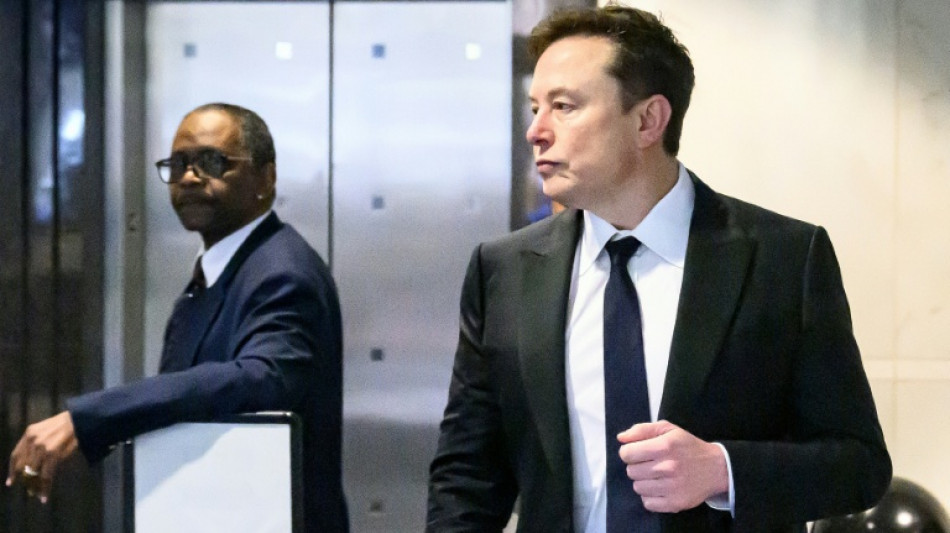
Four takeaways from Musk vs OpenAI trial / Photo: JOSH EDELSON - AFP

 Gauteng Health Department Warns of Rising Antibiotic Resistance Threat

 Bishop Museum Races to Save Rare Megamouth Shark Specimen

 InterContinental Hotels Group PLC Announces Transaction in Own Shares - November 26

 Twickenham Grounds Team Prepares Pitch for Six Matches in Three Days

 Luxembourg Pay Rise Delayed as Regional and World Headlines Develop

 Audience to Choose the Set List at Luxembourg's First FAMIL Jukebox Night

 Raheem Sterling Receives Suspended Sentence After Lamborghini Crash

 Black Friday Discounts Cut Prices on Two Top-Rated Wiper Blades

 TCC Network Linked to 200% Surge in Global School Attacks
After three weeks of intense hearings,Silicon Valley's first major AI trial -- over the lawsuit filed by Elon Musk against the co-founders of OpenAI -- is nearing an end. It is expected to go to the jury on Monday.
Here are four scenes that defined the trial:
Musk blames his own naivety
At the opening of the trial on April 28, Musk portrayed himself as a selfless benefactor and Good Samaritan concerned with protecting humanity from an AI that, if left in the wrong hands, could "kill us all."
"I came up with the idea, the name, recruited the key people, taught them everything I know, provided all of the initial funding," the SpaceX CEO said regarding OpenAI's founding in 2015.
"I gave $38 million essentially for nothing, which they used to build a company worth $800 billion. I was literally an idiot," he said, blaming his own naivety.
Musk was visibly annoyed during the trial as he called out OpenAI's lawyer for asking questions "designed to trap me."
"Mr. Musk, you are a brilliant man," said OpenAI's lawyer William Savitt, as he doubled down on his attacks, disguised with a show of courtesy.
Altman strikes back
Swapping his usual T-shirt, jeans and sneakers for a dark suit and tie, OpenAI CEO and co-founder Sam Altman sat stone-faced in the front row of the Oakland courtroom for most of the proceedings.
But on May 12, it was finally his turn. Musk's lawyer, Steven Molo, was waiting for him, asking if he had always told the truth.
Altman responded: "I'm sure there have been times in my life when I didn't."
But then, with a blank expression and wide eyes, he struck back, saying Musk in 2017 had demanded "90 percent of the equity" and "refused to commit in writing" to sharing power.
Altman said he had no choice as "we did not think that artificial general intelligence should be under the control of a single person."
Brockman's notebook
Every day in the courtroom, Greg Brockman, the president and co-founder of OpenAI, took extensive notes on yellow notepads.
During his questioning on May 4, old journals he kept from years ago took center stage, with Musk's lawyer highlighting some of the most embarrassing excerpts.
Brockman wanted to make money, writing, "financially, what will take me to $1B?" He also wanted "to convert to a b-corp without him (Musk)," a reference to a private company with social and environmental standards.
The journal recorded his concerns about a plan to "steal the non-profit from him (Musk)" as "pretty morally bankrupt."
"There's nothing in there I'm ashamed of," Brockman hit back, claiming that the journal did not include details of an outburst from Musk in 2017.
"I really thought he was going to hit me," Brockman said of the incident. Musk did not touch him, but took a painting of a Tesla, a gift from one of the co-founders, down from the wall and left the room, he said.
Brockman's shares in the company are now worth $30 billion.
The secret go-between
Shivon Zilis -- the mother of four of Musk's children -- is a woman in the shadows, rarely appearing in public.
So her May 6 appearance in the courtroom attracted intense curiosity.
Zilis, who was appointed to the OpenAI board from 2020 to 2023, was asked about her awkward role as both Musk's colleague at Neuralink and Altman's friend.
At the time, her mysterious relationship with Musk was secret. Their children were conceived through in vitro fertilization.
OpenAI accuses her of working as a mole for Musk.
Zilis responded to questions briefly and, at times, sarcastically.
"Relationship is a relative term," she said when asked about her relationship with Musk, before conceding, "there have been romantic moments."
But ultimately, her testimony may matter less than the content of her messages to Musk and Altman.
Those could lead the jury to conclude that Musk, having been sufficiently informed by Zilis, knew of OpenAI's direction long before 2023. If so, his lawsuit could be thrown out before the jury even starts deliberating the merits of the case.
N.Walker--AT
