Spacecraft to probe how Earth fends off raging solar winds
/ Photo: NASA - NASA/AFP/File

 Thousands march fearing return of a Bolsonaro presidency in Brazil

 French PM denies police ordered to confront student protesters

 Rubio touts US power, calls on Europe to emerge from 'slumber'

 Trump says 'we don't think' Russian plague is bio-weapon

 Five children among 26 killed in Ukraine after Russian strikes

 Man City should 'accept' punishment for rule breaches, says Lineker

 US woman who survived botched execution is awake and speaking

 From 1800s to modern pharma: a Nobel-winning chemistry quest

 Southampton boss Eckert given suspended ban over 'Spygate'

 Russia warns of 'false' information as second plague case reported

 IEA ready to release more oil reserves if necessary

 HSBC 'consults' over UK unit job cuts amid AI adoption

 UK court quashes five ex-traders' Libor rate rigging convictions

 XM Receives “Global Customer Experience Leader Award 2026” at the TrustFinance Performance Awards

 Stocks slide as oil climbs on Mideast flareup

 Heavy casualties in Ukraine after Russian strikes

 French wine harvest set to hit historic low

 Kyiv 'cannot agree' to EU membership limiting food exports: minister
 Arteta targets more Arsenal glory after signing new deal until 2030

 Russell hit with Singapore grid penalty for taking new power unit

 Spotify expands audiobooks to more than 180 markets
 French-Japanese duo wins chemistry Nobel for solving molecular 'mystery'

 England's Nations League surge helps heal World Cup wounds

 Mayor of opposition stronghold Izmir defects to Erdogan party

 Mertens beats Gauff to set up Swiatek clash at China Open

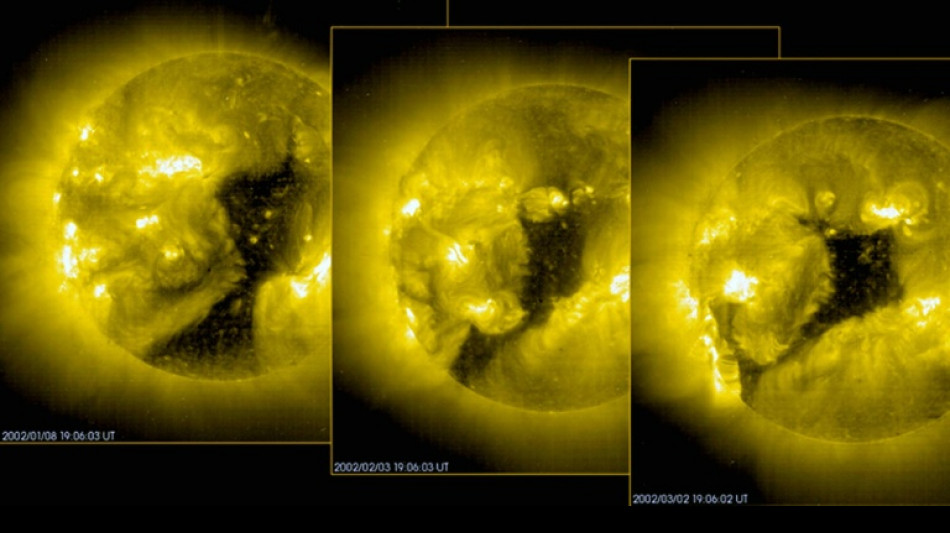
A joint European-Chinese spacecraft is set to blast off Tuesday to investigate what happens when extreme winds and giant explosions of plasma shot out from the Sun slam into Earth's magnetic shield.
Particularly fierce solar storms can knock out satellites, threaten astronauts -- and create colourful auroras in the skies of northern and southern latitudes.
To find out more about this little-understood space weather, the van-sized SMILE spacecraft is tasked with making the first-ever X-ray observations of Earth's magnetic field.
The spacecraft is scheduled to launch on a Vega-C rocket at 0352 GMT on Tuesday from Europe's spaceport in Kourou, French Guiana, on the northeastern coast of South America.
Lift-off was originally planned for April 9, but was postponed due to a technical issue.
SMILE -- or the Solar Wind Magnetosphere Ionosphere Link Explorer -- is a joint mission between the European Space Agency (ESA) and the Chinese Academy of Sciences.
"What we want to study with SMILE is the relationship between the Earth and the Sun," explained Philippe Escoubet, an ESA scientist working on the project.
- Here comes the Sun -
Solar wind is a stream of charged particles shot out from the Sun. Sometimes this wind is kicked up into a huge storm by massive eruptions of plasma called coronal mass ejections.
Hurtling at around two million kilometres (1.2 million miles) an hour, these powerful blasts take a day or two to reach Earth. When they arrive, Earth's magnetic field acts as a shield, deflecting most of the charged particles.
However during particularly intense events, some particles can penetrate our atmosphere, where they have the potential to take out power grids or communication networks. They also create dazzling auroras known as the northern or southern lights.
During the worst geomagnetic storm on record in 1859, bright auroras were seen as far south as Panama -- and telegraph operators around the world were given electric shocks.
Solar winds can now also pose a danger to satellites orbiting Earth, as well as astronauts sheltering inside space stations.
Given these threats, scientists want to learn more about space weather, so the world can better forecast and prepare for big blasts in the future.
To help with this endeavour, the SMILE mission plans to detect the X-rays emitted when charged particles from the Sun interact with the neutral particles of Earth's upper atmosphere.
- Poles apart -
The spacecraft will observe this phenomenon from several important locations, including the magnetopause -- where the magnetic shield deflects solar particles.
It will also soar above the Earth's poles, where X-ray photons are visible, according to Dimitra Koutroumpa of France's CNRS institute who is working on the mission.
On Tuesday, the spacecraft will be placed 700 kilometres above Earth before heading on an extremely elliptical orbit.
SMILE will be at an altitude of 5,000 kilometres when it flies over the South Pole, where it will transmit data to a research station in Antarctica called Bernardo O'Higgins.
But the spacecraft will be 121,000 kilometres above Earth when it swings over the North Pole, to take in a far wider view over a longer period of time.
Among other things, this will allow the mission to "observe the northern lights non-stop for 45 hours at a time for the first time ever", according to the ESA.
The spacecraft has four scientific instruments, including a UK-built X-ray imager, as well as a UV imager, ion analyser and magnetometer all made by the Chinese Academy of Sciences.
SMILE is expected to start collecting data just an hour after it is put into orbit.
The mission is designed to run for three years, but could be extended if all goes well.
R.Garcia--AT