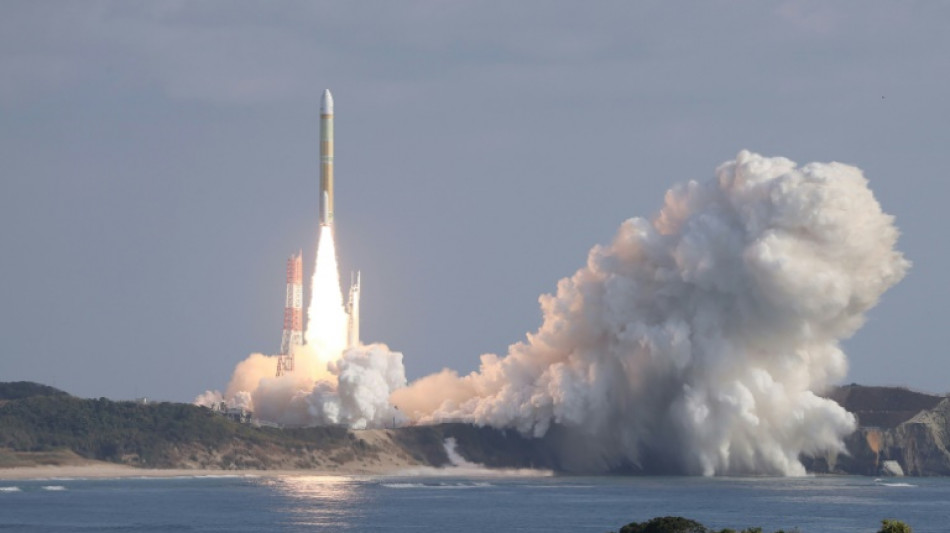
Japan successfully launches next-gen H3 rocket / Photo: STR - JIJI Press/AFP

 Dozens of orangutans saved from Indonesia blazes as region grapples with haze

 Pope addresses crowd in Vatican after cancer surgery

 Russia-US diesel deal delivery to take 15-20 days: Russia

 China's Yin wins in Shanghai for back-to-back LPGA titles

 After a year in turmoil, the Louvre faces uncertain future

 Dozens of orangutans saved from Indonesia blazes

 Ordinary day, extraordinary times: Kyiv under Russian attack

 What is holding up the US-India trade deal?

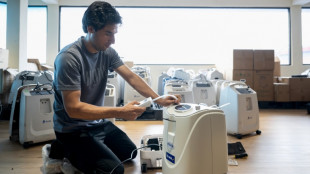 Oxygen tanks, purifier sales spike as haze crisis hits Southeast Asia

 Messi brace lifts Inter Miami to 3-1 win in Atlanta

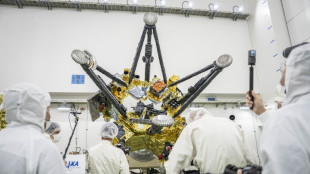 Japan to launch historic round-trip mission to Mars moon

 Musk back in the spotlight, but politics dims the awe

 England Rugby League World Cup hopes hang by a thread

 Williams lifts Valkyries past Dream in WNBA Finals opener

 Dubois destroys Wardley to retain WBO heavyweight crown

 Oregon families grapple with explaining school shooting to children

 Israeli settlers attack European diplomats, beat French mayor

 Town hall in Limoges 'largely lost' to blaze set during French protests

 US goes on the offensive in central Asia

 Emotional Lions come up short in Champions Cup as tributes paid to Andrews

 Diaz dazzles as Bayern batter Leipzig to go top

 Inter move clear at Serie A summit with Bologna win

 Liverpool still have 'lots to improve', says match-winner Isak

 Looters ransack shops during France cost-of-living protests

 Leinster thump Clermont as grieving Lions set for Champions Cup debut

Japan's space agency toasted a successful blast-off for its new flagship rocket on Saturday, making it third time lucky after years of delays and two previous failed attempts.
The next-generation H3 has been mooted as a rival to SpaceX's Falcon 9, and could one day deliver cargo to bases on the Moon.
"I've been in the space industry for a long time, but I've never felt so happy before, and I've never felt so relieved," said Hiroshi Yamakawa, president of space agency JAXA.
The latest launch follows Japan's successful landing last month of an unmanned probe on the Moon -- albeit at a wonky angle -- making it just the fifth country to land a craft on the lunar surface.
The H3 launched from the Tanegashima Space Center in southwestern Japan at 9:22 am (0022 GMT).
Cheers and applause could be heard from the JAXA control centre after the agency's live stream announced the H3's engines had successfully burned, meaning the rocket had made it into orbit.
Developed jointly by JAXA and Mitsubishi Heavy Industries, the H3 is the successor to the H-IIA launch system, which debuted in 2001.
Designed for "high flexibility, high reliability, and high cost performance", the craft will "maintain Japan's autonomous access to space", JAXA says.
Unlike the reusable Falcon 9, the H3 is expendable, but scientists say the trial of its world-first technology is significant.
"The H3 rocket has a unique and novel first-stage engine that delivers greater thrust compared to state-of-the-art rockets," said Michele Trenti, director of the Melbourne Space Laboratory at the University of Melbourne.
The H3 "has the potential to be the most cost-effective rocket", making the exploration of the solar system more affordable.
Its maiden launch has been beset by mishaps.
A February 2023 launch was abandoned after ignition issues left the rocket standing motionless on the ground.
On the second try in March last year, technical problems meant a destruct command was issued shortly after blast-off.
Even this latest launch was postponed by four days due to bad weather.
The rocket which took off successfully on Saturday was carrying two small satellites.
One of the microsatellites is expected to contribute to disaster prevention by taking photos and videos.
The other, equipped with a sensor to detect infrared rays, is intended to track the operation conditions of factories on the ground.
Separation of the microsatellites was also confirmed, according to JAXA's live stream.
"We will keep analysing the sequences after successfully putting the rocket into orbit," a JAXA official said.
- Greater thrust -
H3 will be "an all-rounder -- able to launch satellites into Earth orbit, serve as a supply vehicle for space stations, and go to the Moon", said associate professor Alice Gorman, a space exploration expert at Flinders University.
The successful launch bolsters JAXA's reputation after a string of failures, including of a different rocket, a solid-fuel model called the Epsilon-6.
Japan succeeded in landing its SLIM spacecraft nicknamed "Moon Sniper" on the lunar surface last month, although the craft's solar panels were facing the wrong way.
Despite recent failures, overall, Japan's space programme punches above its weight, said Adrian Michael Cruise, an honorary professor of astrophysics at the University of Birmingham.
The country "has future ambitions for space exploration challenging some of the major players", he said.
"However, space payloads are getting heavier and heavier, and to remain competitive in the missions it can mount, Japan needs access to more powerful launch vehicles, like H3."
N.Mitchell--AT