
Apollo to Artemis: Why America is betting big on private space / Photo: Luis ROBAYO - AFP/File

 Dozens of orangutans saved from Indonesia blazes as region grapples with haze

 Pope addresses crowd in Vatican after cancer surgery

 Russia-US diesel deal delivery to take 15-20 days: Russia

 China's Yin wins in Shanghai for back-to-back LPGA titles

 After a year in turmoil, the Louvre faces uncertain future

 Dozens of orangutans saved from Indonesia blazes

 Ordinary day, extraordinary times: Kyiv under Russian attack

 What is holding up the US-India trade deal?

 Oxygen tanks, purifier sales spike as haze crisis hits Southeast Asia

 Messi brace lifts Inter Miami to 3-1 win in Atlanta

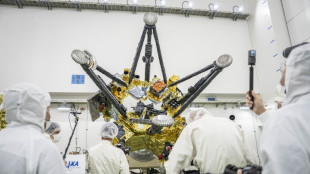 Japan to launch historic round-trip mission to Mars moon

 Musk back in the spotlight, but politics dims the awe

 England Rugby League World Cup hopes hang by a thread

 Williams lifts Valkyries past Dream in WNBA Finals opener

 Dubois destroys Wardley to retain WBO heavyweight crown

 Oregon families grapple with explaining school shooting to children

 Israeli settlers attack European diplomats, beat French mayor

 Town hall in Limoges 'largely lost' to blaze set during French protests

 US goes on the offensive in central Asia

 Emotional Lions come up short in Champions Cup as tributes paid to Andrews

 Diaz dazzles as Bayern batter Leipzig to go top

 Inter move clear at Serie A summit with Bologna win

 Liverpool still have 'lots to improve', says match-winner Isak

 Looters ransack shops during France cost-of-living protests

 Leinster thump Clermont as grieving Lions set for Champions Cup debut

A private Houston-based company is set this week to lead a mission to the Moon which, if successful, will mark America's first lunar landing since the end of the Apollo era five decades ago.
Reputation will be on the line when Intuitive Machines' Nova-C spaceship will launch atop a SpaceX rocket on Wednesday, following recent completed touchdowns by China, India and Japan.
So why entrust such tasks to the commercial sector, especially after an attempt by another company with similar goals, Astrobotic, failed just last month?
The answer lies in the way NASA has fundamentally reorganized itself for Artemis, the agency's flagship Moon-to-Mars program.
During the Cold War, the space agency was handed blank checks and managed industrial contracts down to the last bolt -- but the new paradigm bets on America's mighty market economy to deliver breakthroughs at a fraction of historic costs.
While the current approach has borne some fruit, it also carries the risk of the United States falling behind its principal space rival, China, in achieving major milestones -- namely the next crewed mission to the Moon, and getting the first rocks back from Mars.
- SpaceX success -
The focus on fledgling companies under NASA's Commercial Lunar Payload Services (CLPS) initiative builds on the example set by the meteoric rise of SpaceX, which was derided in its startup phase as reckless, but is now arguably the agency's favorite contractor.
Scott Pace, a former member of the National Space Council, told AFP that NASA had intentionally adopted a policy that prioritized "more shots on goal" at lower costs.
"The reliability that SpaceX has now is as a result of painfully blowing up multiple rockets along the way," he said.
SpaceX launches are currently the only way astronauts launch from US soil, following the end of the NASA-led space shuttle program in 2011 that left NASA reliant on Russia's Soyuz rockets.
Elon Musk's company beat heavily-favored aerospace giant Boeing in certifying its system first, proving for experts the value of competition between companies providing different options.
Each space shuttle launch cost over $2 billion, adjusted for inflation, according to a study in the journal Nature, while the estimated average cost for NASA to buy a seat on a SpaceX flight is around $55 million, according to a government audit.
- On to Artemis -
During the Apollo era, NASA was given more than $300 billion, according to an analysis by Casey Dreier of the nonprofit Planetary Society -- far more than the $93 billion to be spent by 2025 on Artemis.
Rather than telling private industry exactly what to build, the agency now purchases services from companies -- though this at-times piecemeal approach carries certain drawbacks.
While NASA owns the giant Space Launch System (SLS) rocket and the Orion crew capsule, it has contracted with SpaceX an unconventional and as yet unproven landing system based on the company's next-generation Starship rocket, to provide the first crewed lunar touchdown.
Starship has yet to complete a flight test without blowing up -- and it requires ultra-cold refueling multiple times while in orbit before it travels to the Moon, independently of SLS, to dock with Orion and pick up the astronauts.
Futuristic space fuel depots could be a great way to facilitate long-range missions to Mars -- the founding ideal of SpaceX, which Musk pursues with messianic fervor -- but getting it right could well delay the return of American boots to the Moon.
NASA has said this could take place by 2026 at the earliest, though that timeline threatens to drag. China, meanwhile, has set a deadline of 2030 for its own crewed landing -- and has lately stuck to its promises.
The Chinese "don't go through all of the shenanigans the US has, which is extreme polarization followed by government shutdown threats, followed by continuing resolutions," G. Scott Hubbard, a former top NASA official, told AFP.
For better or worse, America is locked into its new public-private paradigm.
Artemis was intentionally designed with an array of international partnerships -- Europe, Canada, Japan, the United Arab Emirates and more -- in order to prevent it from being scrapped, said Dreier.
Moreover, a previous Moon-to-Mars program called Constellation that was conceived in the 2000s and managed more like Apollo was canceled, largely due to budget constraints, so there is little realistic alternative.
W.Moreno--AT