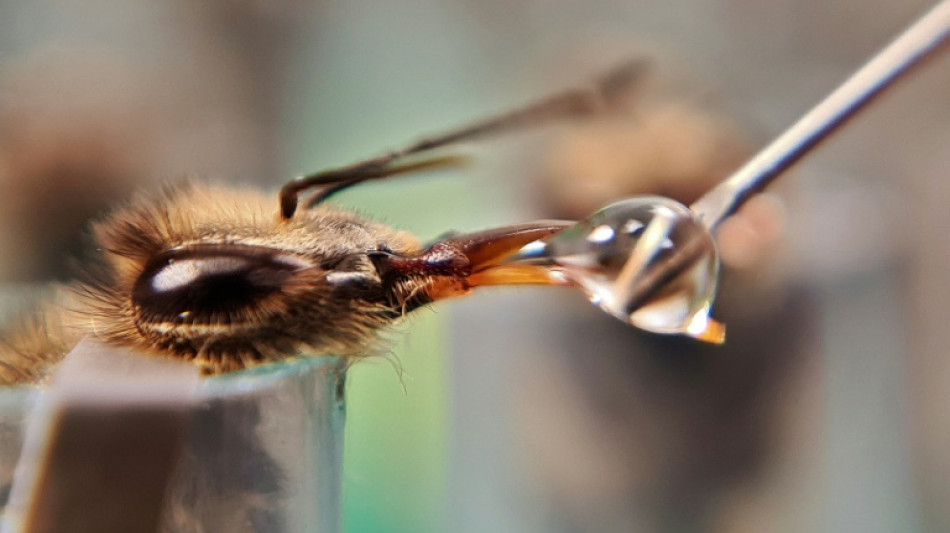
Colombian researchers seek safety for bees in urban jungle

 American Nobel laureate in medicine hopes to illuminate the brain

 Trump approves firing squad for convicted US military base shooter

 Grappling with 'homework scams,' US universities shun AI detectors

 Separatists win Quebec election in test for Canada PM

 Leaders visit Pacific atoll at frontline of climate change

 Yemen's Houthis claim striking Riyadh airport, other Saudi sites

 Best-selling British author Jeffrey Archer dies aged 86

 Military plane crash kills 32 in Nigeria

 Olise powers France to win over Belgium in Nations League

 High-flying Blazy turns to birdlife at Chanel

 Riyadh's allies pledge troops as Yemen, Saudi Arabia attack Houthis

 Clashes erupt outside Kosovo parliament over war crimes court

 Milan's Saelemaekers suffers ankle setback, faces lengthy spell out

 Rubio arrives in Iceland to push for greater US presence in Arctic

 Putin allows Italy's UniCredit to sell part of Russian business

 Djokovic into China Open final as Medvedev out for hitting fan with ball

 ICC unseals arrest warrants for Taliban education ministers

 Modric hopes fans back Croatia against Spain after England shame

 Bolsonaro rides right-wing surge into Brazil's election runoff

 Turkey blocks X account of British reporter

 Ukraine says using AI robot guns to shoot down new Russian drones

 At Oct 7 memorial, Netanyahu says will be no Hamas rule in Gaza

 Ukraine blames Russia for deadly sinking of Turkish ship in Black Sea

 UN rights council slams Taliban's 'oppression' of women

 Norway eyes partial ban of smart glasses

Far from the flowery fields that are their natural home, honey bees imperiled by pesticides in rural Colombia are finding sanctuary on university campuses in the bustling capital Bogota.
Even though hives are banned from the city due to the risk the insects' stings can pose to humans, universities enjoy an exemption for research purposes.
At the University of Rosario, biologist Andre Riveros very carefully feeds a bee some sugar water, watching attentively as it stretches its straw-like tongue, or proboscis, towards the sweet liquid.
The university boasts a rooftop apiary in a bamboo structure some six meters (nearly 20 feet) high, surrounded by trees and flowers.
Here, Riveros and his team study a colony of bees in the hopes of developing a food supplement that will offer the critical crop pollinators protection from insecticides
"Pesticides end up affecting some (neurological) regions that, for example, affect learning and memory and (the bees) end up with damage very similar to Alzheimer's," Riveros told AFP.
"We are trying to find a solution for the problem of bee disappearances," he added. "We seek to shield the bees, in essence."
The team's work focuses on the Apis mellifera, or Western Honey Bee, one of about 20,000 known species worldwide.
Hundreds of hives have been killed off in Colombia in recent years, and investigations into the cause have pointed to fipronil, an insecticide banned in Europe and restricted in the United States and China.
Fipronil has been widely used in a profitable avocado and citrus boom in Colombia, though the Latin American country suspended its use in some crops for six months last year.
- 'Fleeing the fields' -
Elsewhere in Bogota, the EAN University boasts its own hives, perched on a six-story building overlooking the city of eight million people.
Beekeeper Gino Cala extracts honey from the hives as part of his work to instruct and assist universities in the management of urban apiaries.
But Cala told AFP Colombia's bees "are fleeing the fields" partly due to the "indiscriminate use of agrochemicals."
"These insects are extremely relevant and important... because they help guarantee part of the food security of Colombia and the world," he added.
From the EAN University grounds, Cala's bees help to pollinate plants in surrounding areas.
About 1.4 billion jobs and three-quarters of all crops around the world, according to a 2016 study, depend on pollinators -- mainly bees -- which provide free fertilization services worth billions of dollars.
In recent years, bees in North America, Europe, Russia, South America and elsewhere have started dying off from "colony collapse disorder," a mysterious scourge blamed partly on pesticides but also on mites, viruses and fungi.
The UN warns that nearly half of insect pollinators, particularly bees and butterflies, risk global extinction.
Despite the city ban, there are private beekeepers in Bogota who sell products such as honey, pollen or beeswax.
The fire department of Bogota says it attends to eight bee sting-related emergencies on average every day.
P.Hernandez--AT