Hubble finds water vapor in small planet's atmosphere / Photo: NASA - AFP/File

 Kremlin says Ukrainian attacks won't change war aims as Kyiv hits Saint Petersburg

 Martinez starts for Man Utd after outburst

 Alberta separatists rally ahead of independence vote

 Diesel shortage raises petroleum share of India’s exports to three-year high

 France assesses protest damage after 1,800 arrests

 Gord launches four AI tools for sustainability and emissions management

 Doha 2036 bid sets out sport-led social legacy

 Conservation teams rescue orangutans from Indonesian wildfires

 Truck ploughs into Hindu festival crowd in India, killing 13

 Kuwait announces maintenance closures in Nuzha, Surra and Rai

 Moody’s lifts OYO parent Prism outlook to positive before planned IPO

 RCom professional asks Supreme Court to revisit spectrum insolvency ruling

 Debt recovery lessons after derivatives losses and repeated borrowing

 Katie Alexander reportedly leaves flat shared with Eamonn Holmes

 Body found in search for missing Glasgow teenager

 Andi King recounts late-life transition after decades behind an “alpha male” identity

 Bromsgrove Repair Cafe reports nearly 80% repair success rate

 B.C. Lions focus on playoff momentum after Calgary defeat

 Tata Trusts plans network of 40 to 50 not-for-profit hospitals

 Bajaj Finance set to report second-quarter results on October 19

 Messi reaches 936 career goals after Inter Miami brace

 Indian petrol and diesel prices remain unchanged on October 18

 Australia elect to bowl against South Africa in second Test

 Dozens of orangutans saved from Indonesia blazes as region grapples with haze

 Pope addresses crowd in Vatican after cancer surgery

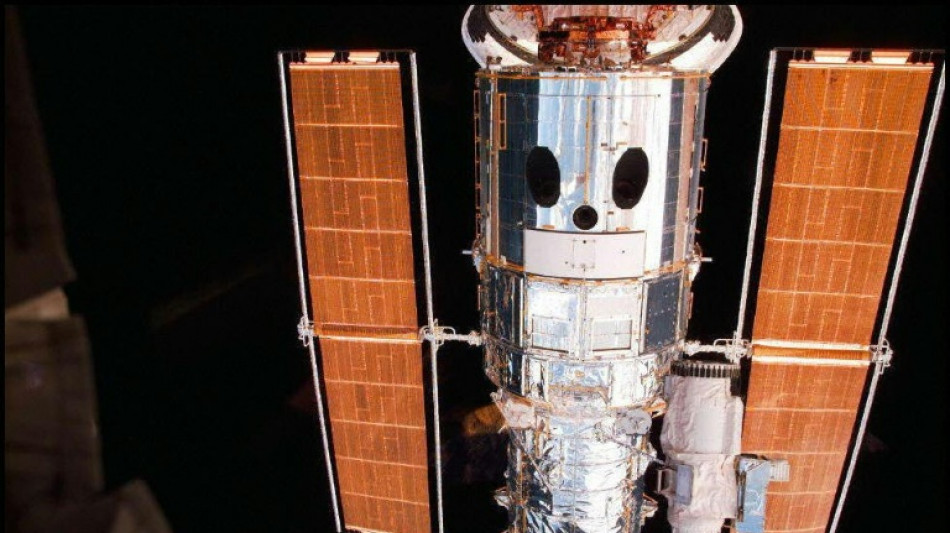
The Hubble Space Telescope has observed the smallest planet outside our solar system to contain water vapor in its atmosphere, a "landmark discovery" that brings astronomy a step closer to characterizing Earth-like worlds.
At around twice Earth's diameter, planet GJ 9827d orbits a red dwarf star 97 light-years away in the constellation Pisces, NASA and the European Space Agency (ESA) said in statements on Thursday.
The team behind the finding are examining two scenarios: either the planet is a "mini-Neptune" with a hydrogen-rich atmosphere laced with water, or it's a warmer version of Jupiter's moon Europa, which contains twice as much water as Earth under its crust.
"The planet GJ 9827d could be half water, half rock," said Bjorn Benneke of the Universite de Montreal, who co-led the research. "And there would be a lot of water vapor on top of some smaller rocky body."
"Until now, we had not been able to directly detect the atmosphere of such a small planet. And we're slowly getting in this regime now," he added.
Over a period of three years, Hubble observed the planet during 11 transients, or events in which it crossed in front of its star.
During transients, starlight is filtered through the planet's atmosphere, allowing astronomers to use Hubble's instruments to analyze the patterns of colors (wavelengths), which revealed the telltale signature of water molecules.
Even if GJ 9827d has a water-rich atmosphere, its hot, Venus-like temperature of 800 degrees Fahrenheit (425 Celsius) would make it an uninhabitable steamy world.
Nevertheless, the Hubble discovery paves the way to future study of GJ 9827d and similar planets, especially by the James Webb Space Telescope, which can use its high resolution infrared images to look for more atmospheric molecules including carbon dioxide, and methane.
"Water on a planet this small is a landmark discovery," added co-leader Laura Kreidberg of Max Planck Institute for Astronomy in Germany.
"It pushes closer than ever to characterizing truly Earth-like worlds."
K.Hill--AT