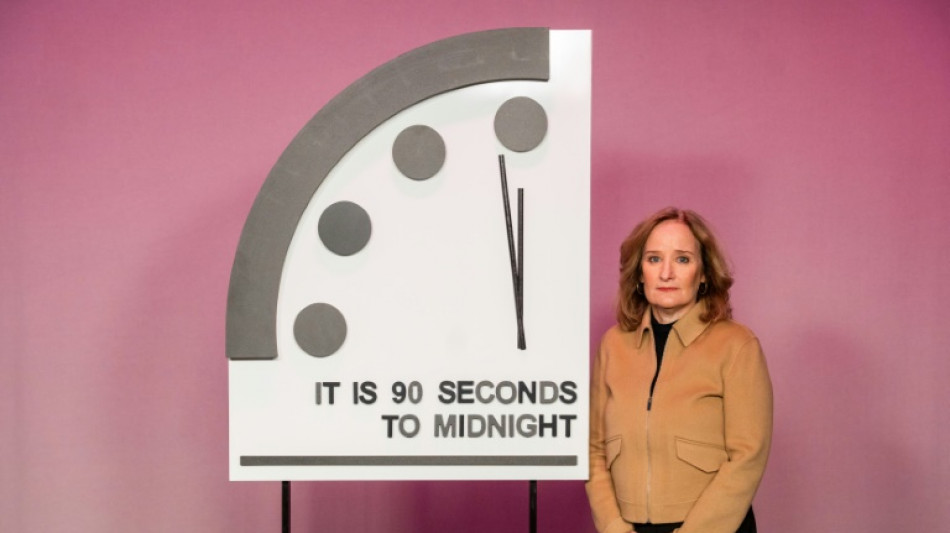
'Doomsday Clock' remains at 90 seconds to midnight / Photo: Handout - Hastings Group Media/AFP

 Kremlin says Ukrainian attacks won't change war aims as Kyiv hits Saint Petersburg
 Martinez starts for Man Utd after outburst
 Alberta separatists rally ahead of independence vote
 Diesel shortage raises petroleum share of India’s exports to three-year high
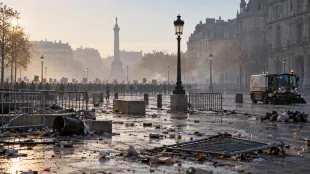
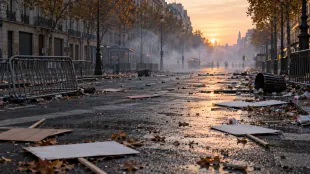 France assesses protest damage after 1,800 arrests

 Gord launches four AI tools for sustainability and emissions management
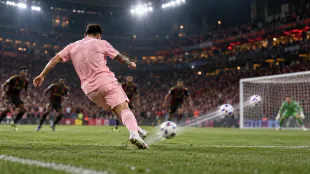
 Doha 2036 bid sets out sport-led social legacy

 Conservation teams rescue orangutans from Indonesian wildfires

 Truck ploughs into Hindu festival crowd in India, killing 13

 Kuwait announces maintenance closures in Nuzha, Surra and Rai
 Moody’s lifts OYO parent Prism outlook to positive before planned IPO

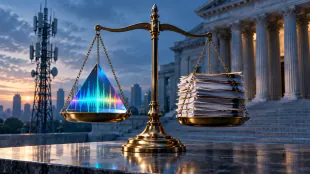 RCom professional asks Supreme Court to revisit spectrum insolvency ruling

 Debt recovery lessons after derivatives losses and repeated borrowing

 Katie Alexander reportedly leaves flat shared with Eamonn Holmes

 Body found in search for missing Glasgow teenager
 Andi King recounts late-life transition after decades behind an “alpha male” identity

 Bromsgrove Repair Cafe reports nearly 80% repair success rate
 B.C. Lions focus on playoff momentum after Calgary defeat

 Tata Trusts plans network of 40 to 50 not-for-profit hospitals

 Bajaj Finance set to report second-quarter results on October 19
 Messi reaches 936 career goals after Inter Miami brace

 Indian petrol and diesel prices remain unchanged on October 18

 Australia elect to bowl against South Africa in second Test
 Dozens of orangutans saved from Indonesia blazes as region grapples with haze
 Pope addresses crowd in Vatican after cancer surgery
The symbolic "Doomsday Clock" was held at 90 seconds to midnight Tuesday, reflecting existential threats to humanity posed by potential nuclear escalation from the war in Ukraine and the multiplying impacts of the climate crisis following Earth's hottest recorded year.
Set by top scientists and security experts, the timing of the clock remains the same as last year and the closest it has ever been to midnight in its more than 75-year-history.
"Trends continue to point ominously towards global catastrophe," said Rachel Bronson, president and CEO of the Bulletin of Atomic Scientists. "The war in Ukraine poses an ever present risk of nuclear escalation, and the October 7 attack in Israel and war in Gaza provides further illustration of the horrors of modern war, even without nuclear escalation."
Rather than abandoning nuclear weapons, countries that possess them are upgrading their arsenals, while massive floods, fires and other climate disasters threatened billions of lives and livelihoods in a year that saw record-shattering temperatures caused by mankind's reluctance to turn away from fossil fuels.
"Biological research aimed at preventing future pandemics has proven useful, but also presents the risks of causing one," Bronson said, while recent advances in artificial intelligence (AI) raise questions about how to control a technology "that could improve or threaten civilization in countless ways."
-War in Ukraine looms large -
Russia's invasion of Ukraine, now just a month away from its second anniversary, was the principal reason behind the clock being moved to 90 seconds before midnight in 2023, and continued to overshadow this year's update.
Moscow's thinly veiled threats of nuclear war, its attacks on nuclear sites, and its erosion of international norms of conduct have all contributed to heightened risk, the Bulletin said, while Israel's war in Gaza threatens to evolve into a wider regional conflict involving nuclear states.
Meanwhile, "traditional nuclear arms control really has come to an end for now," said Alex Glaser, a Princeton University professor of mechanical and aerospace engineering. Russia withdrew from the New Strategic Arms Reduction Treaty (New START) and the Comprehensive Nuclear-Test-Ban Treaty (CTBT), which the United States never ratified to begin with.
China is increasing its arsenal, which now stands at 500 nuclear weapons, "and for the first time, at least in my adult life, there is now talk in Washington that the US nuclear arsenal will have to increase also in order to match... Russia and China combined," Glaser added.
On climate, Ambuj Sagar, a professor at the Indian Institute of Technology Delhi said there had been a "mixed story," hailing $1.7 trillion invested in clean energy at the climate COP in Dubai as a sign of moving in the right direction, albeit "not as fast or as deeply" as required.
The clock was originally set at seven minutes to midnight in 1947.
The furthest from midnight it has ever been is 17 minutes, following the end of the Cold War in 1991.
The Bulletin was founded in 1945 by Albert Einstein, J. Robert Oppenheimer and other scientists who worked on the Manhattan Project, which produced the first nuclear weapons. The idea of the clock symbolizing global vulnerability to catastrophe followed two years later.
R.Lee--AT