Japan's 'Moon Sniper' lands but power running low / Photo: Handout - JAPAN AEROSPACE EXPLORATION AGENCY (JAXA)/AFP/File

 Kremlin says Ukrainian attacks won't change war aims as Kyiv hits Saint Petersburg

 Martinez starts for Man Utd after outburst

 Alberta separatists rally ahead of independence vote

 Diesel shortage raises petroleum share of India’s exports to three-year high

 France assesses protest damage after 1,800 arrests

 Gord launches four AI tools for sustainability and emissions management

 Doha 2036 bid sets out sport-led social legacy

 Conservation teams rescue orangutans from Indonesian wildfires

 Truck ploughs into Hindu festival crowd in India, killing 13

 Kuwait announces maintenance closures in Nuzha, Surra and Rai

 Moody’s lifts OYO parent Prism outlook to positive before planned IPO

 RCom professional asks Supreme Court to revisit spectrum insolvency ruling

 Debt recovery lessons after derivatives losses and repeated borrowing

 Katie Alexander reportedly leaves flat shared with Eamonn Holmes

 Body found in search for missing Glasgow teenager

 Andi King recounts late-life transition after decades behind an “alpha male” identity

 Bromsgrove Repair Cafe reports nearly 80% repair success rate

 B.C. Lions focus on playoff momentum after Calgary defeat

 Tata Trusts plans network of 40 to 50 not-for-profit hospitals

 Bajaj Finance set to report second-quarter results on October 19

 Messi reaches 936 career goals after Inter Miami brace

 Indian petrol and diesel prices remain unchanged on October 18

 Australia elect to bowl against South Africa in second Test

 Dozens of orangutans saved from Indonesia blazes as region grapples with haze

 Pope addresses crowd in Vatican after cancer surgery

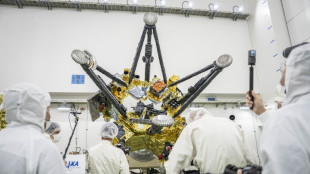
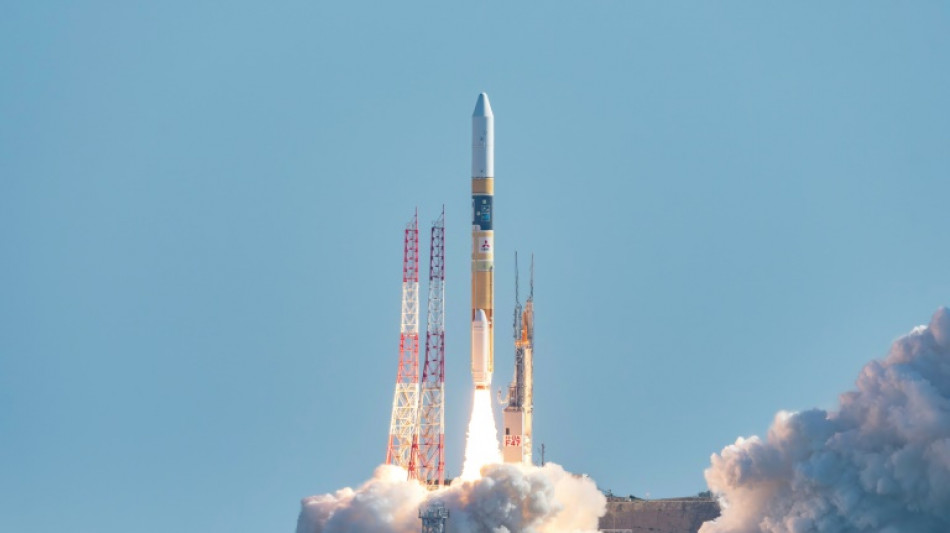
Japan on Saturday became only the fifth nation to achieve a soft lunar landing, but its "Moon Sniper" spacecraft was running out of power due to a solar battery problem.
After a nail-biting 20-minute descent, space agency JAXA said its Smart Lander for Investigating Moon (SLIM) had touched down and communication had been established.
But without the solar cells functioning, JAXA official Hitoshi Kuninaka said the craft -- dubbed the "Moon Sniper" for its precision technology -- would only have power for "several hours".
As mission control prioritised acquiring data while they could, Kuninaka suggested that once the angle of the sun changed, the batteries might work again.
"It is unlikely that the solar battery has failed. It's possible that it is not facing in the originally planned direction," he told a news conference.
"If the descent was not successful, it would have crashed at a very high speed. If that were the case, all functionality of the probe would be lost," he said.
"But data is being sent to Earth."
SLIM is one of several new lunar missions that have been launched by countries and private firms, 50 years after the first human Moon landing.
Crash landings, communication failures and other technical problems are rife, and only four other nations have made it to the Moon: the United States, the Soviet Union, China and most recently India.
NASA chief Bill Nelson tweeted his "congratulations (to Japan) on being the historic fifth country to land successfully on the Moon".
"We value our partnership in the cosmos and continued collaboration," he added.
- 'Big success' -
JAXA hopes to analyse data acquired during the landing, which will help determine whether the craft achieved the aim of landing within 100 metres (yards) of its intended landing spot.
SLIM was aiming for a crater where the Moon's mantle, the usually deep inner layer beneath its crust, is believed to be exposed on the surface.
Two probes detached successfully, JAXA said -- one with a transmitter and another designed to trundle around the lunar surface beaming images to Earth.
This shape-shifting mini-rover, slightly bigger than a tennis ball, was co-developed by the firm behind the Transformer toys.
While the accuracy of the touchdown needs to be verified, "I think the mission is a big success," said Jonathan McDowell, astronomer at the Harvard–Smithsonian Center for Astrophysics.
Several things could have caused the solar panel problem, he told AFP.
"A wire came loose, a wire was connected the wrong way, or the lander is upside down and can't see the sun for some reason," McDowell speculated.
The scientist added that "hopefully" JAXA had been able to download the landing images, but an experiment to study the composition of local rocks may be a lost cause.
"But frankly, that experiment was a bonus and not really that important to the mission," he said.
- Renewed interest -
This month, US firm Astrobotic's Peregrine lunar lander began leaking fuel after takeoff, dooming its mission.
On Thursday, contact with the spaceship was lost over a remote area of the South Pacific after it likely burned up in the Earth's atmosphere on its return.
NASA has also postponed plans for crewed lunar missions under its Artemis programme.
Russia, China and other countries from South Korea to the United Arab Emirates are also trying their luck to reach the Moon.
Two previous Japanese lunar missions -- one public and one private -- have failed.
In 2022, the country unsuccessfully sent a lunar probe named Omotenashi as part of the United States' Artemis 1 mission.
In April, Japanese startup ispace tried in vain to become the first private company to land on the Moon, losing communication with its craft after what it described as a "hard landing".
burs-kaf/cwl
Ch.P.Lewis--AT