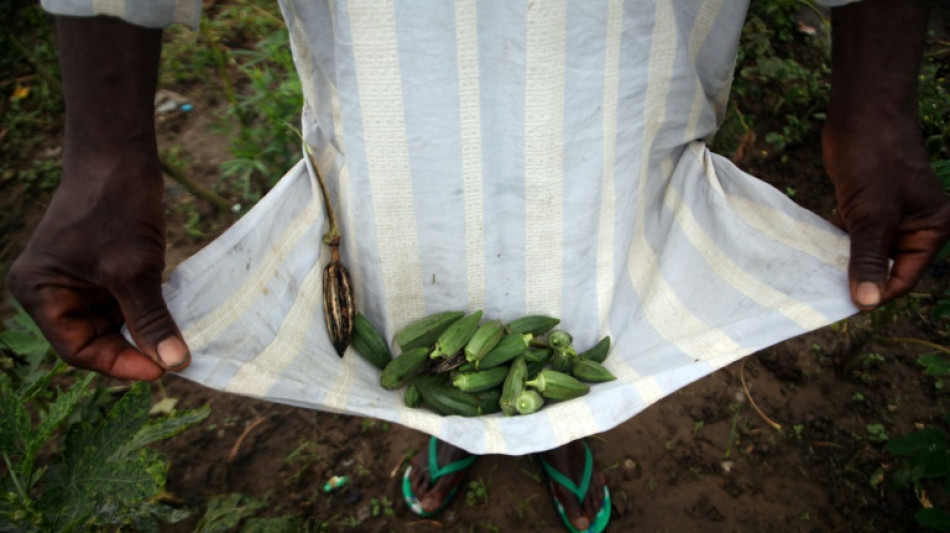
Chemists cook up way to remove microplastics using okra

 American Nobel laureate in medicine hopes to illuminate the brain

 Trump approves firing squad for convicted US military base shooter

 Grappling with 'homework scams,' US universities shun AI detectors

 Separatists win Quebec election in test for Canada PM

 Leaders visit Pacific atoll at frontline of climate change

 Yemen's Houthis claim striking Riyadh airport, other Saudi sites

 Best-selling British author Jeffrey Archer dies aged 86

 Military plane crash kills 32 in Nigeria

 Olise powers France to win over Belgium in Nations League

 High-flying Blazy turns to birdlife at Chanel

 Riyadh's allies pledge troops as Yemen, Saudi Arabia attack Houthis

 Clashes erupt outside Kosovo parliament over war crimes court

 Milan's Saelemaekers suffers ankle setback, faces lengthy spell out

 Rubio arrives in Iceland to push for greater US presence in Arctic

 Putin allows Italy's UniCredit to sell part of Russian business

 Djokovic into China Open final as Medvedev out for hitting fan with ball
 ICC unseals arrest warrants for Taliban education ministers

 Modric hopes fans back Croatia against Spain after England shame

 Bolsonaro rides right-wing surge into Brazil's election runoff

 Turkey blocks X account of British reporter

 Ukraine says using AI robot guns to shoot down new Russian drones

 At Oct 7 memorial, Netanyahu says will be no Hamas rule in Gaza

 Ukraine blames Russia for deadly sinking of Turkish ship in Black Sea

 UN rights council slams Taliban's 'oppression' of women

 Norway eyes partial ban of smart glasses

Extracts of okra and other slimy plants commonly used in cooking can help remove dangerous microplastics from wastewater, scientists said Tuesday.
The new research was presented at the spring meeting of the American Chemical Society, and offers an alternative to the synthetic chemicals currently used in treatment plants that can themselves pose risks to health.
"In order to go ahead and remove microplastic or any other type of materials, we should be using natural materials which are non-toxic," lead investigator Rajani Srinivasan, of Tarleton State University, said in an explainer video.
Okra is used as a thickening agent in many cuisines, such as Gumbo, a stew from Louisiana. It's also a staple of cuisine in South Asia, where it's called bhindi.
Srinivasan's past research had examined how the goo from okra and other plants could remove textile-based pollutants from water and even microorganisms, and she wanted to see if that would equally apply to microplastics.
Ingested microplastics -- defined as pieces five millimeters or smaller -- have been shown to harm fish in several ways, from disrupting their reproductive systems to stunting growth and causing liver damage.
The source of microplastics is the estimated eight billion tons of plastic produced since the 1950s, less than 10 percent of which has been recycled.
The rest eventually breaks down and is today found in every corner of the globe, from oceans and waterways to the air and soil, as well as our food.
It is feared there could be health impacts on humans, though more research is needed. Microplastics can also be carcinogenic and mutagenic, meaning they can potentially increase risks of cancer and DNA mutations.
Typical wastewater treatment removes microplastics in two steps.
First, those that float are skimmed off the top of the water. These however account for only a small fraction, and the rest are removed using flocculants, or sticky chemicals that attract microplastics into larger clumps.
The clumps sink to the bottom and can then be separated from the water.
The problem is that these synthetic flocculants, such as polyacrylamide, can break down into toxic chemicals.
So, Srinivasan and colleagues set about investigating how extracts of supermarket-bought okra, aloe, cactus, and fenugreek, tamarind and psyllium would perform.
They tested chains of carbohydrates, known as polysaccharides, from the individual plants, as well as in combination, on various microplastic-contaminated water, examining before and after microscopic images to determine how many particles had been removed.
They found that polysaccharides from okra paired with those from fenugreek could best remove microplastics from ocean water, while polysaccharides from okra paired with tamarind worked best in freshwater samples.
Overall, the plant-based polysaccharides worked just as well or better than polyacrylamide. Crucially, the plant-based chemicals are both non-toxic and can be used in existing treatment plants.
Ultimately, said Srinivasan, she hopes to scale up and commercialize the process, enabling greater access to clean and safer drinking water.
F.Wilson--AT