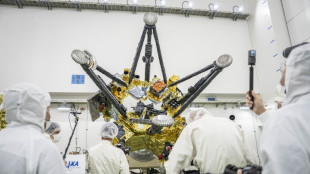
NASA lab hopes to find life's building blocks in asteroid sample / Photo: Mark Felix - AFP

 Kings' Ben Simmons tears Achilles in training

 Lula, Bolsonaro set for first debate showdown in bitter election race

 Mbappe hits two as Real Madrid rout Sevilla

 Browns edge Ravens for division lead, Texans beat Jags

 Lyon go top of Ligue 1 as Monaco fall to first defeat of the season

 Venezuela opposition alliance reaffirms Nobel laureate Machado as leader

 'Street Fighter' wins N. America box office, buzzy doc stuns in 2nd

 NFL: Paris game to go ahead despite protests in France

 Arteta hails Arsenal 'finishers' after Madueke fells Forest

 Trump backs ally Netanyahu ahead of Israel's tight election

 Madueke strikes late as below-par Arsenal sink Forest

 Second day of street clashes in Milan

 Dupont's Toulouse hold off Exeter as English Champions Cup woes continue

 Zelensky speaks to US envoys amid Trump spat

 Paris police in new battles with protesters and looters

 Multiple deaths, injuries at western Canada military base: minister

 Boland strikes twice for Australia in rain-hit South Africa Test

 Marseille put Angers to the sword in Ligue 1

 Albanian PM refuses to quit as violent protests enter sixth day

 Chwalinska fights back to win Wuhan Open in title breakthrough

 Kulusevski on brink of return for Spurs after 17-month absence

 Ukraine sets Saint Petersburg refinery ablaze in large-scale drone attack

 Spain's in-form Chacarra wins DP World India Championship

 PSG rally past Strasbourg to take Ligue 1 lead

 Moody’s lifts OYO parent Prism outlook to positive before planned IPO

Eager scientists and a gleaming lab awaits.
A sample from the asteroid Bennu, which could be key to understanding the formation of the solar system and our own planet, is set to be analyzed at NASA's Johnson Space Center in Houston after it reaches Earth in late September.
The precious cargo is currently aboard OSIRIS-REx, a US space probe launched in 2016 to Bennu, which orbits the Sun at an average distance of about 105 million miles (168 million kilometers).
Long white sleeves hang from the huge metal and glass box in which the sample will be handled.
Scientists will separate pieces of the rock and dust for study now, while carefully storing away the rest for future generations equipped with better technology -- a practice first started during the Apollo missions to the Moon.
"We don't expect there to be anything living but (rather) the building blocks of life," Nicole Lunning, lead OSIRIS-Rex sample curator, told AFP.
"That's really what motivated going to this type of asteroid, to understand what the precursors were that may have fostered life in our solar system and on Earth."
Once the return vessel arrives at the Texas "cleanroom," Lunning's job will be to carefully disassemble it and separate the contents, all while keeping the material pure and uncontaminated.
- Origins of life -
The spacecraft is scheduled to land in the Utah desert on September 24, carrying an estimated 8.8 ounces, or 250 grams of material -- just over a cupful.
Obtaining it involved a high-risk operation in October 2020: the probe came into contact with the asteroid for a few seconds, and a blast of compressed nitrogen was emitted to raise the dust sample which was then captured.
The whole mission was imperiled when NASA realized a few days later that the valve of the collection compartment was failing to close, letting fragments escape into space.
But the precious cargo was finally secured after being transferred to a capsule fixed in the spacecraft's center.
The first samples brought to Earth by asteroids were carried out by Japanese probes in 2010 and 2020, with the latter found to contain uracil, one of the building blocks of RNA.
The finding lent weight to a longstanding theory that life on Earth may have been seeded from outer space when asteroids crashed into our planet carrying fundamental elements.
Cosmochemist Eve Berger can't wait to get to work on the Bennu material.
"These samples haven't hit the Earth. They haven't been exposed to our atmosphere. They haven't been exposed to really anything except harsh space for billions of years," she said.
Ultimately they "will help us to determine whether what we really think is true, is true," said Berger.
Not only might the Bennu sample add to our knowledge of the ingredients that brought life to our world, but "if we can figure out what happened here on the Earth, that helps us to extrapolate to other bodies where we might look or how we might interpret what we're seeing," she added.
Could Bennu bring back something that's never been seen before? "You never know," said Berger.
"Bennu is a trickster, so we'll know more in a few months when the sample comes back -- that would be exciting!"
W.Morales--AT