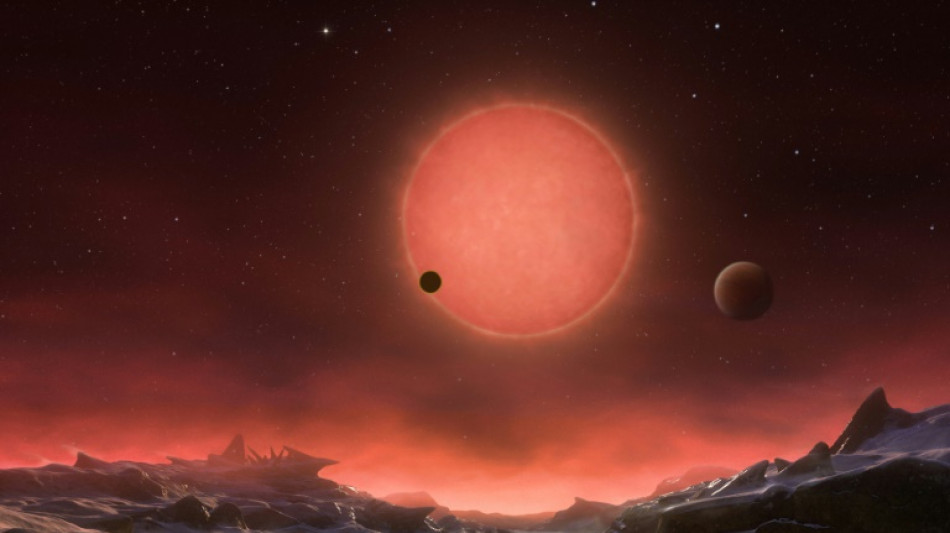
Webb measures temperature of rocky exoplanet for first time / Photo: HO - European Southern Observatory/AFP/File

 'I call it a bribe': Pennsylvania residents spurn $10,000 data center checks

 In a former US steel city, ordinary people struggle to get by

 'Liar,' 'clown': Lula and Bolsonaro spar in Brazil poll debate

 Record El Nino? Depends who's counting

 On the front line of ocean conservation off Portugal's Madeira

 Wembanyama targets title breakthrough as NBA season tips off

 With LeBron on board it's title or bust for Philly fans

 One year after Louvre heist, where are the missing jewels?

 Knicks face tall task in NBA championship repeat bid

 Warriors' Curry 'fine' after limping out of practice - Kerr

 Zelensky speaks to US envoys as Trump lashes out

 'Surprise package' Lazio crush Juve to keep pace with Serie A leaders Inter

 China growth expected to miss official target in third quarter

 Lazio crush Juventus to move level with Serie A leaders Inter

 Leeds draw feels like 'fresh start' for Man Utd's Carrick

 Macron denounces 'unbridled' violence as France hit by new clashes

 Hurzeler lauds 'hard worker' Gomez after Brighton goal from halfway line

 Toulouse hold off Exeter, Northampton save English Champions Cup blushes

 Arsenal snatch late win to keep pressure on Man City as Man Utd held

 Arsenal strike late to keep pressure on Man City as Man Utd held

 Four soldiers dead, dozens injured in fire at Canada military base

 Ton-up Agha helps Pakistan down Sri Lanka in tri-series opener

 Man Utd draw at Leeds keeps pressure on Carrick

 Barca defenders Garcia, Kounde injured before key games

 Lula, Bolsonaro to face off in first debate of bruising election

The James Webb Space Telescope has measured the temperature of a rocky exoplanet for the first time, finding that a "cousin" of Earth most likely lacks an atmosphere, researchers said Monday.
When the Trappist-1 system was discovered in 2017, astronomers were excited at the prospect that some of its seven rocky planets -- which are roughly similar to Earth in size and mass -- could be habitable.
Just 40 light years from Earth, the planets orbit much closer to their ultracool red dwarf star than the rocky planets in our Solar System. But their star gives off far less energy than our Sun.
The system made an obvious target for the piercing gaze of the Webb telescope, which has unleashed a torrent of scientific discovery since releasing its first observations in July last year.
Astronomers focused on Trappist-1b, the closest planet to the red dwarf, because it was the easiest to spot.
Webb's Mid-Infrared Instrument (MIRI) measured the change in brightness when the planet moved behind its star, in what is known as a secondary eclipse.
"Just before disappearing behind the star, the planet gives off the most light because it almost exclusively shows its 'day' side," Elsa Ducrot, a co-author of a new study published in the journal Nature, told AFP.
By subtracting the brightness of the star, the researchers calculated how much infrared light the planet was giving off.
The MIRI instrument was therefore able to act like "a giant touch-free thermometer," NASA said in a statement.
- 'Perfect for baking pizza' -
The planet's dayside temperature was determined to be 230 degrees Celsius (450 Fahrenheit) -- "just about perfect for baking pizza," NASA added.
France's Atomic Energy Commission (CEA) said that the heat was not redistributed throughout this "cousin" of Earth, a role normally provided by an atmosphere.
The scientists therefore concluded that Trappist-1b "has little or no atmosphere," said Ducrot, a CEA astrophysicist. She emphasised that other wavelengths would need to be analysed to confirm the result.
But it was certain that the atmosphere did not contain carbon dioxide, because that would have absorbed some of the light, she added.
The Spitzer Space Telescope was not able to rule out an atmosphere on Trappist-1b despite observing 28 secondary eclipses, Ducrot said.
"The James Webb saw it in a single eclipse!"
The ability to analyse the potential atmospheres of such rocky exoplanets opens "a new era" in the study of planets outside our Solar System, she added.
It was already known that Trappist-1b was uninhabitable, as it is too close to its star.
But Trappist-1e, Trappist-1f and Trappist-1g are all thought to be in what is called the "goldilocks zone".
Planets in this zone have a moderate temperature which could support liquid water -- considered essential for life anywhere.
F.Wilson--AT