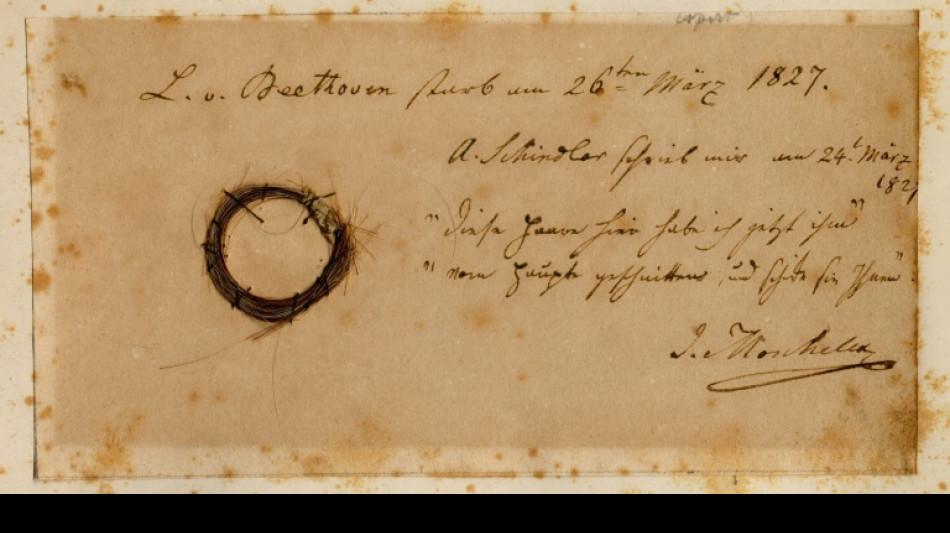
DNA analysis of Beethoven's hair provides clues to his death / Photo: Ira F. Brilliant - Center for Beethoven Studies, San Jose State University/AFP

 Australia's new Ghost Shark submarines grow some 'teeth'

 'I call it a bribe': Pennsylvania residents spurn $10,000 data center checks

 In a former US steel city, ordinary people struggle to get by

 'Liar,' 'clown': Lula and Bolsonaro spar in Brazil poll debate

 Record El Nino? Depends who's counting

 On the front line of ocean conservation off Portugal's Madeira

 Wembanyama targets title breakthrough as NBA season tips off

 With LeBron on board it's title or bust for Philly fans

 One year after Louvre heist, where are the missing jewels?

 Knicks face tall task in NBA championship repeat bid

 Warriors' Curry 'fine' after limping out of practice - Kerr

 Zelensky speaks to US envoys as Trump lashes out

 'Surprise package' Lazio crush Juve to keep pace with Serie A leaders Inter

 China growth expected to miss official target in third quarter

 Lazio crush Juventus to move level with Serie A leaders Inter

 Leeds draw feels like 'fresh start' for Man Utd's Carrick

 Macron denounces 'unbridled' violence as France hit by new clashes

 Hurzeler lauds 'hard worker' Gomez after Brighton goal from halfway line

 Toulouse hold off Exeter, Northampton save English Champions Cup blushes

 Arsenal snatch late win to keep pressure on Man City as Man Utd held

 Arsenal strike late to keep pressure on Man City as Man Utd held

 Four soldiers dead, dozens injured in fire at Canada military base

 Ton-up Agha helps Pakistan down Sri Lanka in tri-series opener

 Man Utd draw at Leeds keeps pressure on Carrick

 Barca defenders Garcia, Kounde injured before key games

Ludwig van Beethoven died in Vienna nearly 200 years ago after a lifetime of composing some of the most influential works in classical music.
Ever since, biographers have sought to explain the causes of the German composer's death at the age of 56, his progressive hearing loss and his well-documented struggles with chronic illness.
A team of researchers who sequenced Beethoven's genome using locks of the German composer's hair may now have some answers.
Liver failure, or cirrhosis, was the likely cause of Beethoven's death brought about by a number of factors, including his alcohol consumption, they said.
"We looked at possible genetic causes of his three main symptom complexes -- the progressive hearing loss, the gastrointestinal symptoms and the liver disease ultimately leading to his death due to liver failure," said Markus Nothen of the Institute of Human Genetics at the University Hospital of Bonn, one of the co-authors.
Beethoven, Nothen said, had "a strong genetic disposition to liver disease" and sequences of the hepatitis B virus were detected in his hair.
"We believe the disease arose from an interplay of genetic disposition, well documented chronic alcohol consumption and hepatitis B infection," Nothen said.
Johannes Krause of the Max Planck Institute for Evolutionary Anthropology said hepatitis B "was probably quite common at that time in the early 19th century."
"At least in the last few months before his death he was infected with hepatitis B virus," Krause said.
The authors of the study, published in the Cell Press journal Current Biology on Wednesday, were unable to determine the cause of the hearing loss that eventually left Beethoven profoundly deaf.
The researchers analyzed eight locks of hair said to be from Beethoven and determined that five of them were "almost certainly authentic," said Tristan Begg, a PhD student at the University of Cambridge and the lead author of the study.
"Because we reconstructed the genome from ultra-short DNA fragments, we only confidently mapped about two-thirds of it," he said.
- 'Acute illness' -
Beethoven, who was born in Bonn in 1770 and died in 1827, battled gastrointestinal problems at various times of his life as well as jaundice.
"There were periods of acute illness where he was unable to work, for example, his month-long period of acute illness in the spring of 1825," Begg said.
The researchers, by studying Beethoven's DNA data and archival documents, also uncovered a discrepancy in his legal and biological genealogy.
They found an "extra-pair paternity event" -- a child resulting from an extramarital relationship -- in Beethoven's direct paternal line, said Toomas Kivisild of the Institute of Genomics at the University of Tartu.
Kivisild said it occurred some time within seven generations that separate a common ancestor, Aert van Beethoven, at the end of the 16th century and Beethoven's birth in 1770.
Begg said it was no surprise it was not recorded.
"You wouldn't necessarily expect an extra-pair paternity event to be documented," he said, being "probably clandestine in nature."
"You cannot rule out that Beethoven himself may have been illegitimate," Begg said.
"I'm not advocating that," he stressed. "I'm simply saying that's a possibility and you have to consider it."
Beethoven had asked in an 1802 letter that his health problems, particularly his hearing loss, be described after his death.
"He had the wish to be studied post-mortem," Krause said.
"And it is kind of, basically, his wish that we are fulfilling to some degree with this project."
W.Morales--AT