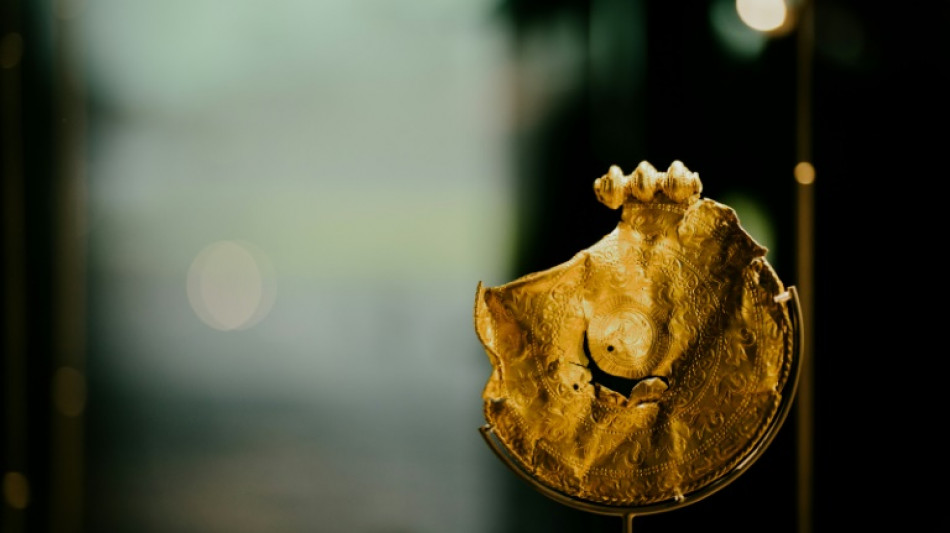
Treasure hunters' gems go on display in Denmark / Photo: Joakim ZUEGER - National Museum of Denmark/AFP

 Australia's new Ghost Shark submarines grow some 'teeth'

 'I call it a bribe': Pennsylvania residents spurn $10,000 data center checks

 In a former US steel city, ordinary people struggle to get by

 'Liar,' 'clown': Lula and Bolsonaro spar in Brazil poll debate

 Record El Nino? Depends who's counting

 On the front line of ocean conservation off Portugal's Madeira

 Wembanyama targets title breakthrough as NBA season tips off
 With LeBron on board it's title or bust for Philly fans

 One year after Louvre heist, where are the missing jewels?

 Knicks face tall task in NBA championship repeat bid

 Warriors' Curry 'fine' after limping out of practice - Kerr

 Zelensky speaks to US envoys as Trump lashes out

 'Surprise package' Lazio crush Juve to keep pace with Serie A leaders Inter

 China growth expected to miss official target in third quarter

 Lazio crush Juventus to move level with Serie A leaders Inter

 Leeds draw feels like 'fresh start' for Man Utd's Carrick

 Macron denounces 'unbridled' violence as France hit by new clashes

 Hurzeler lauds 'hard worker' Gomez after Brighton goal from halfway line

 Toulouse hold off Exeter, Northampton save English Champions Cup blushes

 Arsenal snatch late win to keep pressure on Man City as Man Utd held

 Arsenal strike late to keep pressure on Man City as Man Utd held

 Four soldiers dead, dozens injured in fire at Canada military base

 Ton-up Agha helps Pakistan down Sri Lanka in tri-series opener

 Man Utd draw at Leeds keeps pressure on Carrick

 Barca defenders Garcia, Kounde injured before key games
They may be derided elsewhere but in Denmark, hobby archaeologists who hunt treasures with metal detectors are such an asset the National Museum has dedicated an entire exhibit to their finds.
"What they save now means the world for what we can do in the future and how we can build our museums," exhibit curator Line Bjerg told AFP.
"What they do really matters."
In Denmark's muddy soil, if objects "are not saved, then they are lost to history", she added.
In three rooms on the museum's bottom floor, visitors can learn about "detectorists" and admire some of their discoveries, including rings, necklaces and gold coins, all marked with the name of their finder.
In the Scandinavian country once populated by Vikings, amateurs can use metal detectors almost everywhere as long as they get permission from the landowner. They are not, however, allowed to dig beneath the top layer of soil.
Any archaeological finds have to be turned over to a local museum for an initial evaluation before they are transferred to the National Museum for an in-depth assessment -- and a possible reward.
Detectorists' hauls can be abundant.
"Last year, we had almost 18,000 objects that were sent for treasure trove processing. The year before that it was 30,000 objects," Bjerg said.
Known as "Danefae", any archaeological artefacts found by treasure hunters automatically belong to the state, under an old medieval law.
According to Torben Trier Christiansen, an archaeologist with the Historical Museum of Northern Jutland, the collaboration with the hobbyists is invaluable.
They are "one of the most important collaborators of the museum", he insisted.
There are more than 250 detectorists in his region, with the most active among them handing over around a hundred objects per year.
Arne Hertz, a 64-year-old pensioner who heads a local association of detectorists, said "people are pleased to do the right thing by handing over the findings".
- Writing history together -
The unique collaboration is based on a mutual understanding. On the one hand, archaeological sites won't be looted. On the other, authorities are able to showcase the amateur discoveries.
"Sometimes it's these particular finds that change our history because they add knowledge that we simply did not have before," Bjerg noted.
One section of the biggest exhibition room is dedicated to the "Vindelev Treasure".
Comprised of 22 gold objects, it was buried in the sixth century in southwestern Denmark and found in late 2020 by an amateur who had just bought a metal detector.
The treasure trove includes a bracteate -- a thin coin stamped on one side.
"And on the inscription of the bracteate is mentioned the name of Odin, the Norse god. And it puts Odin 150 years before we actually knew that he existed as a god," Bjerg said.
"We're building our history together in Denmark."
For detectorists, whose finds have on occasion been displayed at local museums, the exhibit at the National Museum is a major recognition.
"It's very impressive to see how the things we've found are displayed -- and to see that we are actually helping a little to enrich Denmark's history," 38-year-old Simon Grevang, who works in online marketing and has been a detectorist for four years, told AFP.
The exhibit has drawn crowds since opening in February.
Annie Lund, a 72-year-old retiree who was enthralled by the jewellery on display, said it was a good way of making history accessible.
"Twenty or forty years ago, this was only for a small group of people, scientists... not for the general public. So I think this is really good," she said.
N.Mitchell--AT