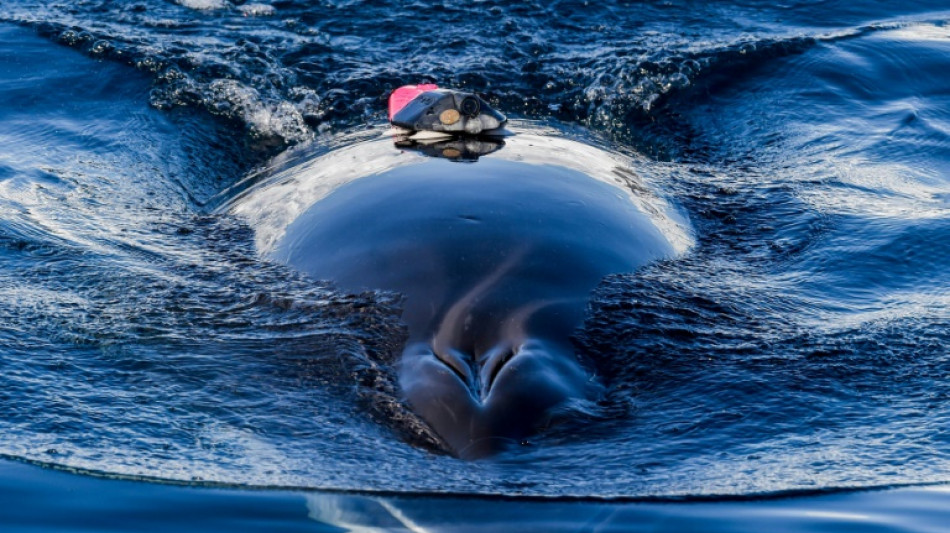
Norway study highlights whale excrement's role in ecosystem / Photo: Ari Friedlaender - Stanford University/Goldbogen Laboratory/AFP/File

 Australia's new Ghost Shark submarines grow some 'teeth'
 'I call it a bribe': Pennsylvania residents spurn $10,000 data center checks

 In a former US steel city, ordinary people struggle to get by
 'Liar,' 'clown': Lula and Bolsonaro spar in Brazil poll debate

 Record El Nino? Depends who's counting

 On the front line of ocean conservation off Portugal's Madeira
 Wembanyama targets title breakthrough as NBA season tips off
 With LeBron on board it's title or bust for Philly fans

 One year after Louvre heist, where are the missing jewels?

 Knicks face tall task in NBA championship repeat bid

 Warriors' Curry 'fine' after limping out of practice - Kerr

 InterContinental Hotels Group PLC Announces Transaction in Own Shares - October 19

 Hemogenyx Pharmaceuticals PLC Announces Feasibility Study Agreement

 Zelensky speaks to US envoys as Trump lashes out

 'Surprise package' Lazio crush Juve to keep pace with Serie A leaders Inter

 China growth expected to miss official target in third quarter

 Lazio crush Juventus to move level with Serie A leaders Inter

 Leeds draw feels like 'fresh start' for Man Utd's Carrick

 Macron denounces 'unbridled' violence as France hit by new clashes

 Hurzeler lauds 'hard worker' Gomez after Brighton goal from halfway line

 Toulouse hold off Exeter, Northampton save English Champions Cup blushes

 Arsenal snatch late win to keep pressure on Man City as Man Utd held

 Arsenal strike late to keep pressure on Man City as Man Utd held

 Four soldiers dead, dozens injured in fire at Canada military base

 Ton-up Agha helps Pakistan down Sri Lanka in tri-series opener

Minke whale excrement is "worth its weight in gold" as it plays an important role in fertilizing phytoplankton and thereby reducing the cetacean's carbon footprint, according to a Norwegian study.
For the first time, researchers from the Norwegian Institute for Marine Research have studied the concentration of nutrients in whale excrement before it is dissolved in seawater.
"It can sound disgusting, but for the ecosystem it's worth its weight in gold," researchers said in a statement Thursday.
"The idea is simply that the faeces fertilize the sea in the same way that cows and sheep do on land," they continued.
The researchers analysed the excrement of minke whales harpooned by whalers -- as Norway is one of few countries allowing the commercial hunting of these cetaceans.
The some 15,000 whales that migrate each summer to the Norwegian archipelago of Svalbard in the Arctic release some 600 tonnes of excrement on the surface of the water each day, at a rate of about 40 kilograms (88 pounds) per animal.
According to the study, the daily excrement releases about 10 tonnes of phosphorus and 7 tonnes of nitrogen into the oceans, nutrients that are essential for the growth of phytoplankton -- microscopic algae that absorb carbon dioxide through photosynthesis and convert it into oxygen.
The scientists concluded that the minke whale excrement contributed to between 0.2 and 4 percent of daily phytoplankton production in the Arctic Svalbard region.
"The real contribution of whales is probably higher because these estimates do not include urine, which is very rich in nitrogen," research leader Kjell Gundersen told AFP.
Each minke whale -- an animal weighing 40-50 tonnes as an adult that feeds by filtering large quantities of water -- releases "several hundred litres of urine" per day.
"If there are fewer whales, there is a risk that there will be less fertilisation of the ocean," Gundersen said.
"More phytoplankton production also means more CO2 is absorbed," he added.
"This is positive for the climate," he noted, "but we don't know the net balance of whales in terms of greenhouse gases" because cetaceans also emit methane when they breathe.
This question, which is still largely unexplored, will be the subject of a European study that will start in June and last four years.
H.Romero--AT