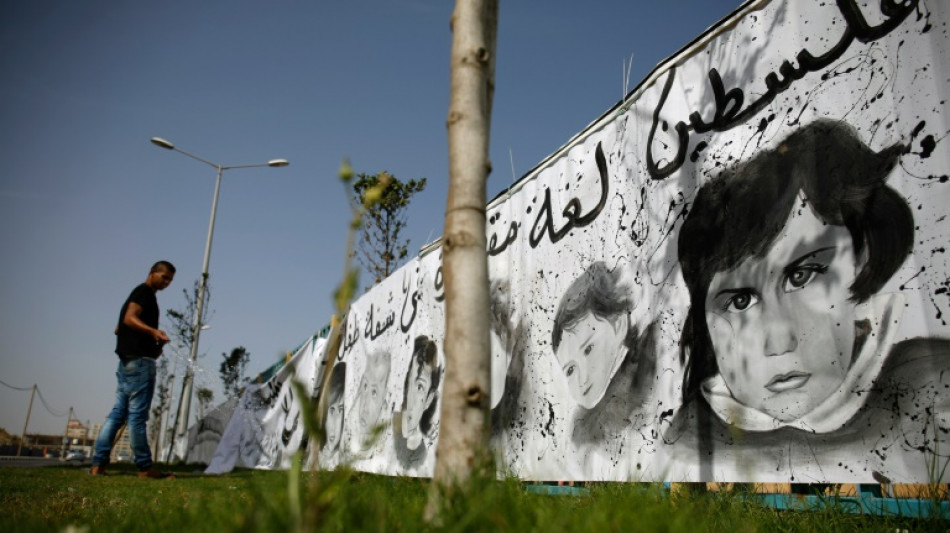
Trying to solve the Israeli-Palestinian conflict

 Demonstrations backing France's protesting students gather strength

 Trump says US Senate as hard to defend as House in midterms
 Suspected Russian drones hit two ships off Bulgaria, 11 missing

 Tech stocks slide on AI jitters

 Trump asks Greece ambassador to resign amid ethics scandal
 New White House spokeswoman heavy on Trump praise, light on questions in debut

 Emery urges Villa to make most of reduced home comfort
 Flavio Bolsonaro visits father under house arrest ahead of Brazil runoff

 France, Eq. Guinea in standoff over luxury Paris mansion

 'Holding our ground': Israel demolishes dozens of Bedouin homes

 Hazlewood takes six as Australia beat South Africa in 1st Test

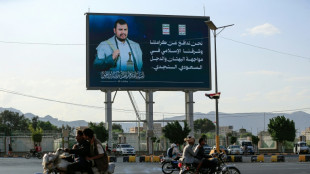 Saudi coalition tells Sanaa residents to flee site before operation

 Zverev defies 'physical issues' to reach Shanghai Masters quarter-finals

 'We're not giving up': Activist Thunberg joins France student protests

 Man City captain Dias defends celebrations after Liverpool win

 B2PRIME Expands Tier-1 Access and Liquidity Architecture for Sophisticated Institutional Flow

 STARTRADER Adds 48 US Stock CFDs with 24-Hour Weekday Trading

 'Ink' director Danny Boyle slams Trump's Truth Social 'lies'

 Coach Kovac extends contract at Dortmund until 2029

 Activist Thunberg joins France student rally after violence at protests

 Archer and Bethell in England squad for Australia ODI series

 Formula One to return to Africa in 'early 2030s' in Rwanda

 US actor Selma Blair charged with assault after alleged flight altercation

 Hungary cuts anti-LGBTQ legislation from Orban-era law

 'Our future is being robbed': Greta Thunberg joins France student protests

A Paris meeting Friday on the Israeli-Palestinian conflict is the latest attempt to tackle one of the world's most stubborn diplomatic issues.
Here is a rundown of past efforts.
Oslo to Camp David
- OSLO ACCORDS: September 13, 1993: After six months of secret talks in Oslo, Israel and the Palestine Liberation Organisation sign in Washington a mutual recognition agreement that allows for five years of Palestinian autonomy aimed at striking a final deal no later than May 1999.
Under the deal, Israel is to withdraw from 70 percent of territory it occupies in the Gaza Strip and West Bank, and in July 1994, PLO leader Yasser Arafat returns from 27 years in exile.
- OSLO II: September 28, 1995: A new interim accord is negotiated in Taba, Egypt and signed in Washington. It foresees a gradual Israeli West Bank withdrawal. But before that happens, Israeli prime minister Yitzhak Rabin is assassinated on November 4 by a Jewish extremist.
- WYE PLANTATION: October 23, 1998: A deal signed at Wye Plantation in the US calls for a gradual Israeli withdrawal from 13 percent of the land it still occupies in the West Bank, which would leave the Palestinians controlling 40 percent. Two months later, Israel freezes the deal after pulling back from two percent of occupied territory.
An accord signed on September 5, 1999 in Sharm el-Sheikh, Egypt, gives the initiative fresh momentum, and targets September 13, 2000 for a final agreement.
- CAMP DAVID: July 11-25, 2000: At a summit at Camp David in the US, Palestinians and Israelis remain deadlocked over the questions of a final status for Jerusalem and compensation for Palestinian refugees from 1948. Two months later, the second Palestinian intifada, or uprising, breaks out, lasting until 2005. The Israeli army temporarily reoccupies almost the entire West Bank.
String of failures
- ARAB INITIATIVE of March 28, 2002: After the failure in January 2001 of a summit in Taba, an Arab summit in Beirut adopts a Saudi initiative offering diplomatic relations between Israel and Arab countries in exchange for an Israeli withdrawal from occupied territories and a solution to the Palestinian refugee issue.
- ROAD MAP of April 30, 2003: A diplomatic quartet comprised of the European Union, Russia, United Nations and United States publishes a document dubbed a "road map" towards a Palestinian state in 2005 once Palestinian attacks and Jewish settler activity cease. Israel and the Palestinians commit to its application on June 4, 2003 in Aqaba, Jordan in the presence of US president George W. Bush.
- ANNAPOLIS SUMMIT of November 27, 2007: Israelis and Palestinians commit to negotiating an agreement by the end of 2008 during a conference that includes Israel and 15 Arab countries for the first time. The Palestinian group Hamas, which now controls the Gaza Strip following Israel's withdrawal in 2005, rejects the agreement. Palestinian Authority envoys pull out of talks after Israel launches an offensive in Gaza in late 2008.
Fresh efforts
- ABORTED DIALOGUE: September 2, 2010: After a 20-month hiatus, direct talks briefly resume in Washington with a meeting between Palestinian president Mahmud Abbas and Israeli Prime Minister Benjamin Netanyahu, who accepted the principle of a Palestinian state in June 2009. The talks break down when Israeli resumes construction of West Bank settlements on September 26.
- NINE MONTHS from July 29, 2013: US Secretary of State John Kerry announces the launch of nine months of direct talks, the first in three years. They are suspended by Israel on April 23, 2014, a week before term, after the announcement of a reconciliation deal between the PLO's Fatah and Hamas.
- FRENCH INITIATIVE of June 3, 2016: Paris hosts a ministerial-level meeting, without Israel or the Palestinians, to prepare an international conference on the Middle East.
P.A.Mendoza--AT