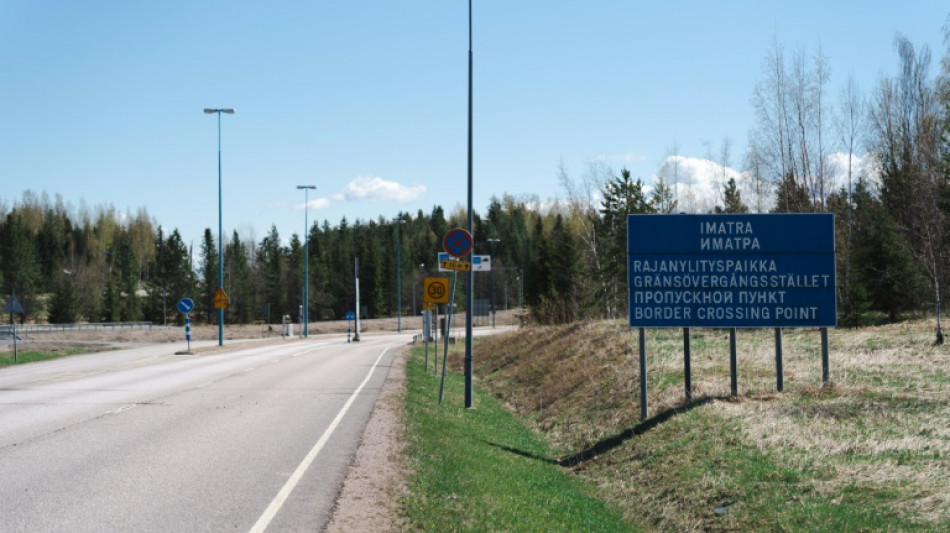
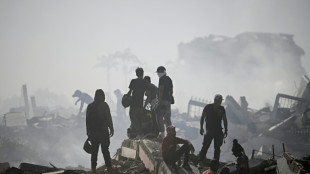
Finland plans fence on Russia border, dividing East and West / Photo: Alessandro RAMPAZZO - AFP/File

 Australia boosts shark-spotting drone coverage at Sydney beaches

 Scotland boss Clarke resigns after World Cup exit confirmed
 Kane, Bellingham on target as England win World Cup group

 Croatia battle past Ghana to sew up World Cup Last 32 spot

 US, Iran clash, putting fragile deal under growing strain

 Ryu takes one-shot lead over Henderson at Women's PGA Championship

 Jangoo and Chase put West Indies in control against Sri Lanka

 World Cup star Gakpo requests privacy after death of unborn son

 Aid planes landing at partially reopened Venezuela airport after quakes

 Spain's Williams hits out at Uruguay over World Cup injury
 World's largest particle smasher halts for upgrade to boost hunt for dark matter

 Ex-Olympic medallist Canderloro elected French Ice Sports chief
 Prince Harry and family to stay at royal residences on UK visit

 'Why not?': Cape Verde eye seismic World Cup shock against Argentina
 Russell snatches controversial pole in Austria after Verstappen crash
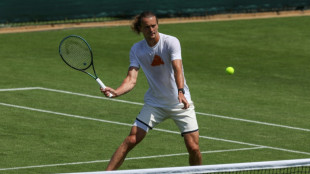
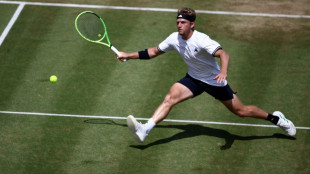 Davidovich Fokina wins in Mallorca for first ATP title

 Sabalenka urges Grand Slams to 'get it done' in prize money boycott row
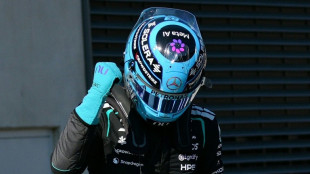
 Russell snatches pole as Verstappen, Antonelli fourth for Austria GP grid

 Smith and supersub Foulkes strike for New Zealand in England finale

 Supersub Foulkes strike for New Zealand in England finale
 Wolff says Russell will be at Mercedes next season

 Djokovic inspired by Serena as he targets history at Wimbledon

 Stokes falls cheaply as England collapse in New Zealand decider

 Russell bounces back to beat Antonelli in final practice

 Iran says US violated peace deal as both sides trade fire

More than 30 years after the fall of the Iron Curtain, Finland plans to erect a barbed-wire fence on its border with Russia dividing East and West, following the war in Ukraine.
The prospective NATO member this week announced broad parliamentary support to replace its wooden fences, designed mainly to stop livestock from wandering across the 1,300-kilometre (800-mile) border, with sturdier barriers to keep Russians and migrants out.
"Hopefully the work can start as quickly as possible," Prime Minister Sanna Marin told reporters in Helsinki.
Finland saw an influx of Russians in September following President Vladimir Putin's mobilisation order, before it clamped down and heavily restricted their entry.
The Finnish border guard says it is necessary to build between 130 and 260 kilometres (80-160 miles) of barriers in areas deemed most critical, particularly in southeastern Finland where most border traffic takes place.
In contrast to the livestock barriers, the new fence proposed on Europe's longest border with Russia is a tall, sturdy metal fence with barbed wire on top and a road running next to it.
The project, estimated to cost hundreds of millions of euros, will start with the construction of a pilot fence a few kilometres long, with the full fence due to be completed in three to four years.
- End of 'pragmatism' -
The new barrier would not cover the entire border, most of which is difficult forested terrain far from populated areas, but would help detect large border movements and concentrate migrants to smaller, more easily managed areas.
While Marin has political support for the project, experts have questioned its aims.
"I think the fence shows an emotional reaction to the war," professor Olga Davydova-Minguet, an expert on Russia and border issues, told AFP.
The Finnish border has great symbolic value as a boundary between the East and West, but it has been "a very pragmatic and practical border", said Jussi Laine, professor of human geography at the University of Eastern Finland.
"Children may have been going to school on the Finnish side, with the parents living on the other side", he told AFP.
With projects like electronic visas and new railway connections between eastern Finland and Saint Petersburg, there had been a push since the 1990s to make the Russia-Finland border a "normal European border".
"That meant that in people's everyday lives the border's significance would disappear," Laine explained.
These pragmatic ambitions explained in part why Finland was slow to restrict border traffic, compared to the Baltic countries.
"Finland has long marketed itself in the EU as an expert on Russia".
An initial November 2021 proposal from the opposition centre-right to build a proper fence was dismissed as populism.
But the situation "radically changed" with Putin's war in Ukraine, Laine explained.
Five months after Russia's invasion, Finland in July amended its Border Guard Act to allow for the construction of stronger fences, the closure of border crossings and concentrating asylum seekers at specific points in the event of a large-scale crossover attempt.
That came amid concerns of "hybrid threats" where migrants could be used to exert political pressure -- as in the 2021 migrant crisis on the Belarus-EU border.
But when Putin's military mobilisation in September led to a doubling of the number of Russians crossing the border, plans for the new fence gained momentum.
The Finnish border guard has said it is preparing for "difficult developments" as the situation evolves.
"It is possible that when travel is restricted, attempts at illegal border crossings will increase," a spokesman said.
- More harm than good? -
The border fence construction may enjoy broad political consensus, but it has been harshly criticised by researchers.
"The harms are alarmingly greater than the benefits", Laine said.
Besides being a very expensive solution to a "relatively small number of migrants", research suggests that building barriers creates greater risks for migrants while "stopping only very few people".
"In short, people die. Fences don't solve problems," Laine emphasised, noting that some migrants could venture into more hazardous terrain to cross into Finland.
And while a new fence may facilitate the Border Guard's work, there is "clear research" that making crossings more difficult fuels human trafficking, he added.
Laine believed the fence discussion -- originally proposed to deter Russia from sending migrants to exert political pressure -- got confused with condemning Russia's aggression in Ukraine and explained the sudden change in political opinion.
"The fence has a symbolic value. It is not based on rational analysis but on emotions", he said.
But Davydova-Minguet argued the fence also "reinforces the image of the Russians as a scary source of threats".
"The fence is creating the impression that there is a danger beyond the border from which we have to separate ourselves".
H.Thompson--AT