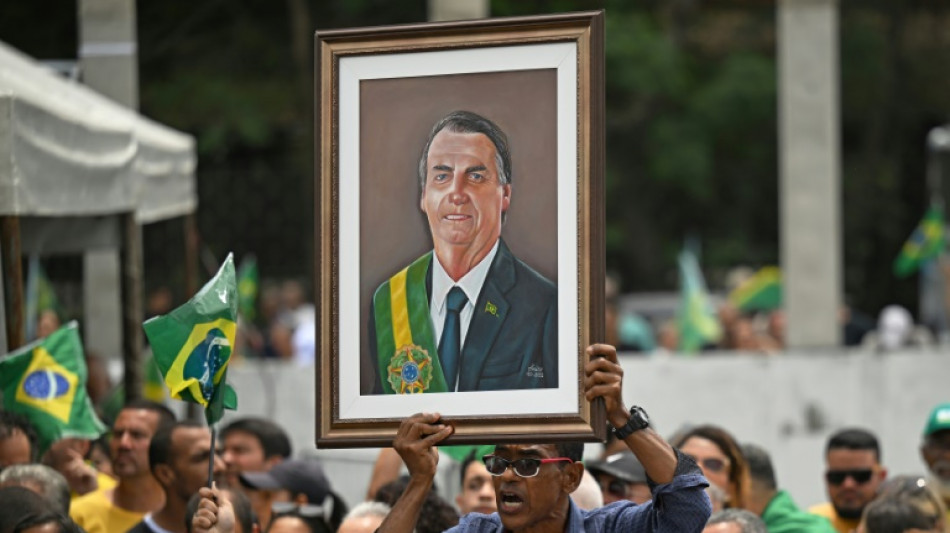
In Brazil, Bolsonaro's far-right echoes Trump's / Photo: Carl DE SOUZA - AFP

 Canada's Davies 'available' for historic knockout clash

 Hovland seizes one-shot PGA Travelers lead over Scheffler

 Mauvaka double inspires Toulouse to fourth-straight Top 14 in storm-impacted final

 Solidarity, sadness among Venezuelans made destitute by quake

 Iran says US violated peace deal as both sides attack

 'We need help': Venezuelans furious at slow official response to quakes

 Venus Williams relishes 'very special' Wimbledon reunion with sister Serena

 Ravindra leads New Zealand rally in England finale after Archer's double strike

 Wimbledon 'towel thief' Swiatek back on the trophy hunt

 Venezuela earthquake deaths near 1,000, with millions more in need

 French Open champs head to Wimbledon wrestling with new-found status

 Budapest Pride marchers push for equality after reversed ban

 Russell snatches pole, Antonelli fourth for Austria GP grid
 Broos smiles and snarls before South Africa's historic World Cup match

 Newborn baby rescued from rubble of Venezuela quake

 Raducanu halts practice session to put Wimbledon bid in doubt

 Keys beats Maria to clinch third Eastbourne title
 Thousands ride through Rome as Vespa celebrates 80 years

 Sinner ready for Wimbledon defence despite lack of time on grass

 Records tumble as European heatwave moves east
 England, Portugal eye top spots as World Cup group stages wrap up

 US, Iran trade strikes putting new strain on Middle East truce

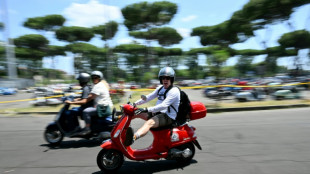 Thousands expected as Vespa celebrates 80 years in Rome

 Pino, Williams injuries mar Spain's World Cup progress

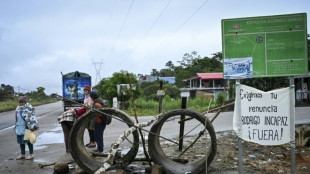 'Struggle continues' in Bolivia's Morales heartland

"Bolsonarismo," the Brazilian far-right movement built around President Jair Bolsonaro, shares much in common with ultra-conservatives in power in Europe -- Hungary, Poland and soon Italy -- but is closer to Donald Trump and the US alt-right.
Whether or not Bolsonaro wins his uphill fight for re-election against veteran leftist Luiz Inacio Lula da Silva in Brazil's October 30 runoff, the far-right's arrival in power in Brazil, as elsewhere, is linked to deep social upheaval, analysts say.
"All these far-right movements are rooted in an economic and social crisis that is growing worse by the year: rising inequality, declining income for the working and middle classes," says Christophe Ventura, a Latin America specialist at the French Institute for International and Strategic Affairs (IRIS).
"That has triggered the rise of widespread mistrust."
The response, he says, has followed a similar pattern internationally: a rejection of "rotten and incompetent" traditional politicians in favor of "virtuous citizens and a more authoritarian government" to right the wrongs unleashed by globalization and free trade -- blamed for all ills.
In Europe, Italy's Fratelli d'Italia, Hungary's Fidesz, Poland's Law and Justice party, the Sweden Democrats and France's Rassemblement National and Reconquete all "accuse immigrants of causing every crisis and want to close the borders," says Geraldo Monteiro, head of the Brazilian Center for Democracy Studies and Research at Rio de Janeiro State University (UERJ).
The Brazilian context is different: no longer a major immigration destination, "immigrants aren't a big subject," and Islamophobia and anti-Semitism are less prevalent than in Europe, says Monteiro.
Bolsonarismo's version of "national solidarity" is instead a battle of "good people" versus the "corrupt."
Internal enemies include the LGBT community, Indigenous peoples, environmental and human-rights activists, the media, academics and the cultural elite -- all lumped together with Lula and the "communist" left.
- Strong men -
As with far-right movements everywhere, Bolsonarismo's Holy Trinity is God, country and family.
The latter, say true believers, is under threat from gay marriage, abortion and "gender ideology."
Whereas conservative Catholics are the core of the European far-right, in Brazil, it is the powerful, fast-growing Evangelical movement.
Bolsonaro's movement is also more military in nature than its European cousins, says Monteiro.
He says Brazil "still carries the memory of the military dictatorship" (1964-1985) -- fondly, in ex-army captain Bolsonaro's case -- and the president has actively courted military support, naming generals to powerful posts in his administration.
He has also energetically promoted gun ownership, signing a raft of legislation and decrees intended to help "good people" defend themselves and their property -- a viewpoint that "doesn't exist in Europe," says Ventura.
"The primary reference point" for Bolsonaro's far-right has been Donald Trump's United States, he adds, drawing parallels with the American alt-right and Tea Party movements.
It is a brand of populism in which "the leader is the direct representative of the people," says Mayra Goulart, a political scientist at Rio de Janeiro Federal University (UFRJ).
Anything supporters perceive as interfering with that direct democracy -- political parties, institutions, the media -- comes under attack.
Like the US alt-right, Bolsonaro's movement has attacked Brazil's democratic institutions as enemies of the people, notably the Supreme Court and the supposedly fraud-plagued election system.
Many observers fear a Brazilian version of Trump supporters' attack on the US Capitol if Bolsonaro loses on October 30.
Like Trump -- who recently gave him a glowing endorsement -- Bolsonaro regularly insults journalists and attacks the "fake news" media.
He prefers to communicate directly with supporters on social media -- which is inundated with "alternative truth" and conspiracy theories.
- Hate speech -
Trump's influence is also visible in Bolsonaro's climate-change skepticism and resistance to expert advice on handling Covid-19.
The US and Brazilian movements also share a "pro-market, pro-business discourse," says Goulart.
Free speech is upheld as an absolute right -- unfiltered hate speech and disinformation included.
Both Trump and Bolsonaro ran as political outsiders and achieved "unexpected" victories, says Monteiro.
And both "easily draw thousands of supporters into the streets."
H.Romero--AT